


Senior Housing Deal Could Be A Big Moment For National Health Investors Stock
- National Health Investors invested US$107.7 million to acquire six senior housing properties with 443 units across Kentucky, Michigan and Tennessee, adding them to its Senior Housing Operating Portfolio managed by Allegro Living Management.
- This move deepens National Health Investors' use of the SHOP model, tying more performance directly to property level operations rather than fixed triple net rent.
- This article will examine how National Health Investors' investment narrative is affected by this US$107.7 million SHOP portfolio acquisition.
Compare this National Health Investors expansion with other income focused real estate plays by scanning our curated list of 8 dividend fortresses.
National Health Investors Investment Narrative Recap
To own National Health Investors, you need to be comfortable with a real estate model that leans more on operating performance and less on fixed rent. The thesis rests on senior housing fundamentals and on management deploying liquidity into private pay assets at yields that support funds from operations despite higher overheads.
The main near term swing factor is whether the expanded SHOP platform can offset softness in weaker assets and the guided 1% to 3% same store SHOP NOI growth. The US$107.7 million Allegro managed acquisition adds more exposure to that operating engine, which increases both the potential upside and the execution risk around margins and occupancy.
The most relevant development here is the completed US$560 million sale of the NHC portfolio, since that capital recycling created part of the funding capacity for National Health Investors to pursue new senior housing deals such as this SHOP package. Liquidity of roughly US$792 million to US$960 million gives the REIT room to keep shifting the mix toward private pay operating assets.
Each incremental acquisition now tests whether the internal platform and higher cash G&A, which rose 31% year over year in Q1 2026 and 44% in Q2 2026, can translate into better property level results rather than thinner net margins. For you as a shareholder, the key question is whether these Allegro run properties eventually contribute enough NOI and FFO to counter timing gaps, lower initial yields and the forecast earnings decline of 3.7% per year over the next 3 years.
What The National Health Investors Forecasts Assume
Analysts sketch out a path for National Health Investors that leans heavily on higher SHOP exposure and steady demand for senior housing, but the numbers behind that story matter just as much as the narrative. Consensus forecasts point to revenue expanding by 8.9% a year over the next 3 years, while profit margins are expected to narrow from 38.2% today to 32.3% by 2029. On that framework, earnings are projected to reach US$181.6 million, or US$3.37 per share, by around 2029, compared with earnings today of US$166.5 million. That implies an earnings increase of about US$15.1 million over the period, with the move from current results to the 2029 estimate doing a lot of the heavy lifting in justifying the shift toward the SHOP model and the Allegro managed acquisition.
National Health Investors' narrative projects US$562.5 million revenue and US$181.6 million earnings by 2029. This assumes 8.9% yearly revenue growth and an earnings increase of about US$15.1 million from US$166.5 million.
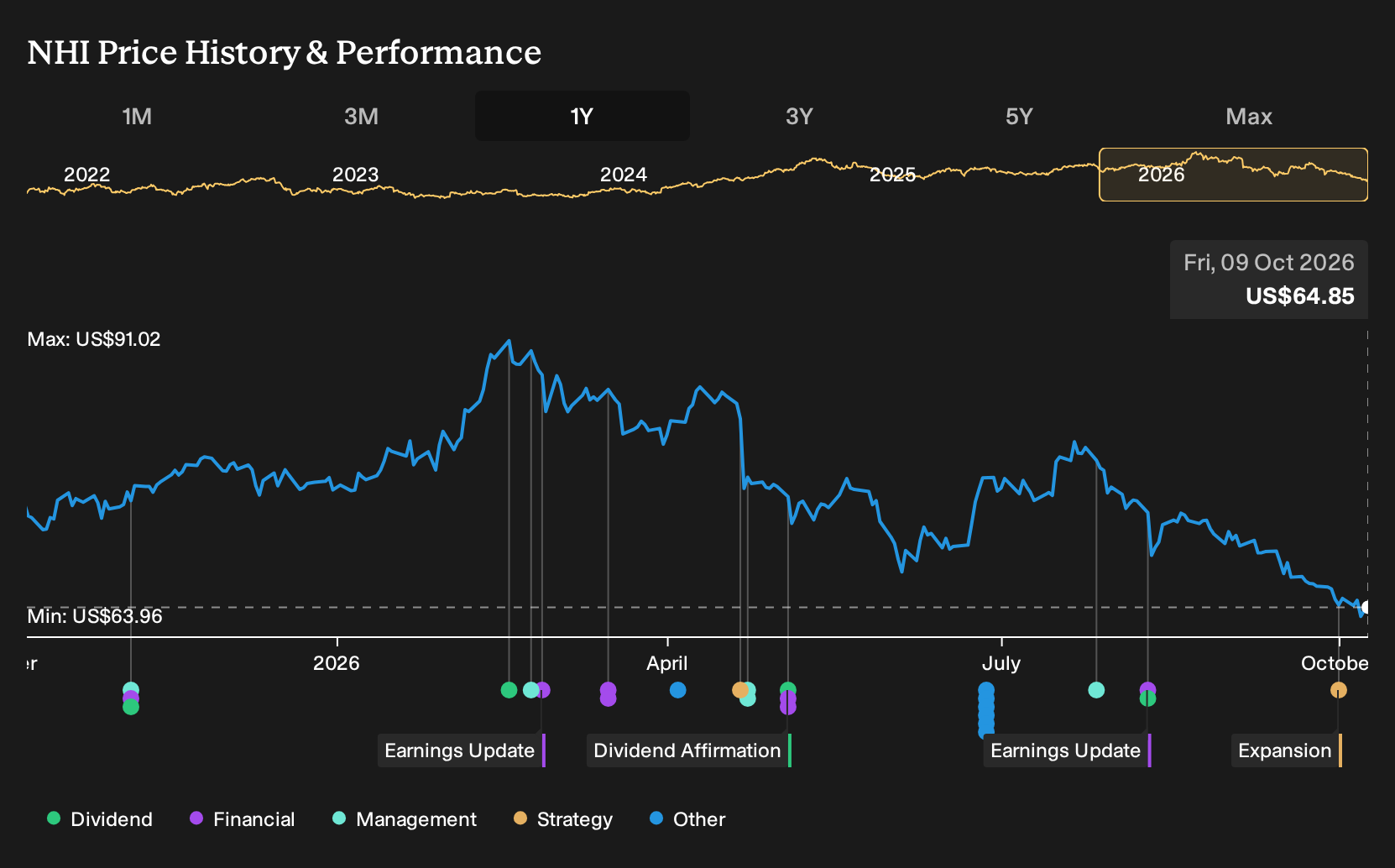
Uncover why National Health Investors' fair value indicates a 26% potential upside to its current price, a gap that may not last much longer.
Exploring Other Perspectives
Three fair value views from the Simply Wall St Community span roughly US$66.6 to US$176.0, so some members see National Health Investors as deeply undervalued while others price in far richer outcomes. Consider this alongside risks such as softer SHOP NOI growth and higher G&A, then weigh how your own expectations compare with these community viewpoints.
Explore 2 other National Health Investors fair value estimates, including one that suggests it could be worth just $66.59.
Form Your Own Verdict
Don't just follow the ticker; dig into the data and build a conviction that's truly your own.
- A great starting point for your National Health Investors research is our analysis highlighting 3 key rewards and 4 important warning signs that could impact your investment decision.
- See our latest analysis for National Health Investors. The report includes a comprehensive fundamental analysis summarized in a single visual, the Snowflake, making it easy to evaluate National Health Investors' overall financial health at a glance.
Looking For More Investment Ideas Beyond National Health Investors?
Once you have a view on National Health Investors, it can help to widen the lens and see how other opportunities stack up on income, quality and risk. The Simply Wall St Screener lets you move from a single ticker to a watchlist built around the traits that matter most to you.
- If capital preservation comes first for you, start with a 31 resilient stocks with low risk scores that focus on steadier balance sheets and lower risk scores.
- For investors hunting for quality at a reasonable price, scan a 28 high quality undervalued stocks that combine solid fundamentals with more modest valuation multiples.
- Income focused readers can build a shortlist of high yield opportunities by looking through a 8 dividend fortresses that target payouts of 5% or more.
This article by Simply Wall St is general in nature. We provide commentary based on historical data and analyst forecasts only using an unbiased methodology and our articles are not intended to be financial advice. It does not constitute a recommendation to buy or sell any stock, and does not take account of your objectives, or your financial situation. We aim to bring you long-term focused analysis driven by fundamental data. Note that our analysis may not factor in the latest price-sensitive company announcements or qualitative material. Simply Wall St has no position in any stocks mentioned.
Have feedback on this article? Concerned about the content? Get in touch with us directly. Alternatively, email editorial-team@simplywallst.com