


3 US Transportation Stocks Exposed To Lower Diesel Prices
Diesel has suddenly become the plot twist of 2026. A US deal that could release up to 4.8mn tonnes of Russian diesel has already nudged wholesale prices in New York about 4.5% lower, which ripples straight into the fuel bills of trucks, planes and ships. That kind of jolt in costs can reshuffle winners and laggards fast, so this article spotlights three fuel intensive transportation and logistics stocks that look especially exposed to this news.
The three stocks covered next are just a first cut from this idea, and the full screen on Simply Wall St pulled out 16 more fuel intensive transportation and logistics companies with equally compelling narratives that are not covered here. To identify your own highest conviction angles on this diesel story, head straight into the Fuel-Intensive Transportation & Logistics Stocks screener
Werner Enterprises (WERN)
Overview: Werner Enterprises is a large truckload carrier moving general commodities and consumer goods across North America, where diesel costs heavily influence profitability.
Operations: The business generates about US$2.3b from Truckload Transportation Services and US$847.7 million from Werner Logistics, mostly in the United States at US$3.1b.
Market Cap: US$2.0b
Werner Enterprises sits right in the crosshairs of this diesel story, because its long haul trucks are heavily affected by fuel costs and operating efficiency. This puts a spotlight on how management is trying to reshape the cost base and earning power of the fleet.
"Continued investment in fleet modernization, digital platforms and automation, including the Werner EDGE TMS and AI-driven tools that are already improving functions like road breakdown support, carrier payments and appointment scheduling, creates scope for further structural cost reduction and higher productivity that can support net margin expansion and earnings over time."
The real swing factor is how a single pressure on the cost side interacts with that efficiency push to either deepen or cap margin recovery.
That margin tug of war is the starting point for the full narrative for Werner Enterprises, which maps how diesel, efficiency gains and contract structure could be decoupling for Werner Enterprises.

Covenant Logistics Group (CVLG)
Overview: Covenant Logistics Group is a US trucking and logistics operator whose fuel hungry expedited and dedicated fleets tie results closely to diesel costs.
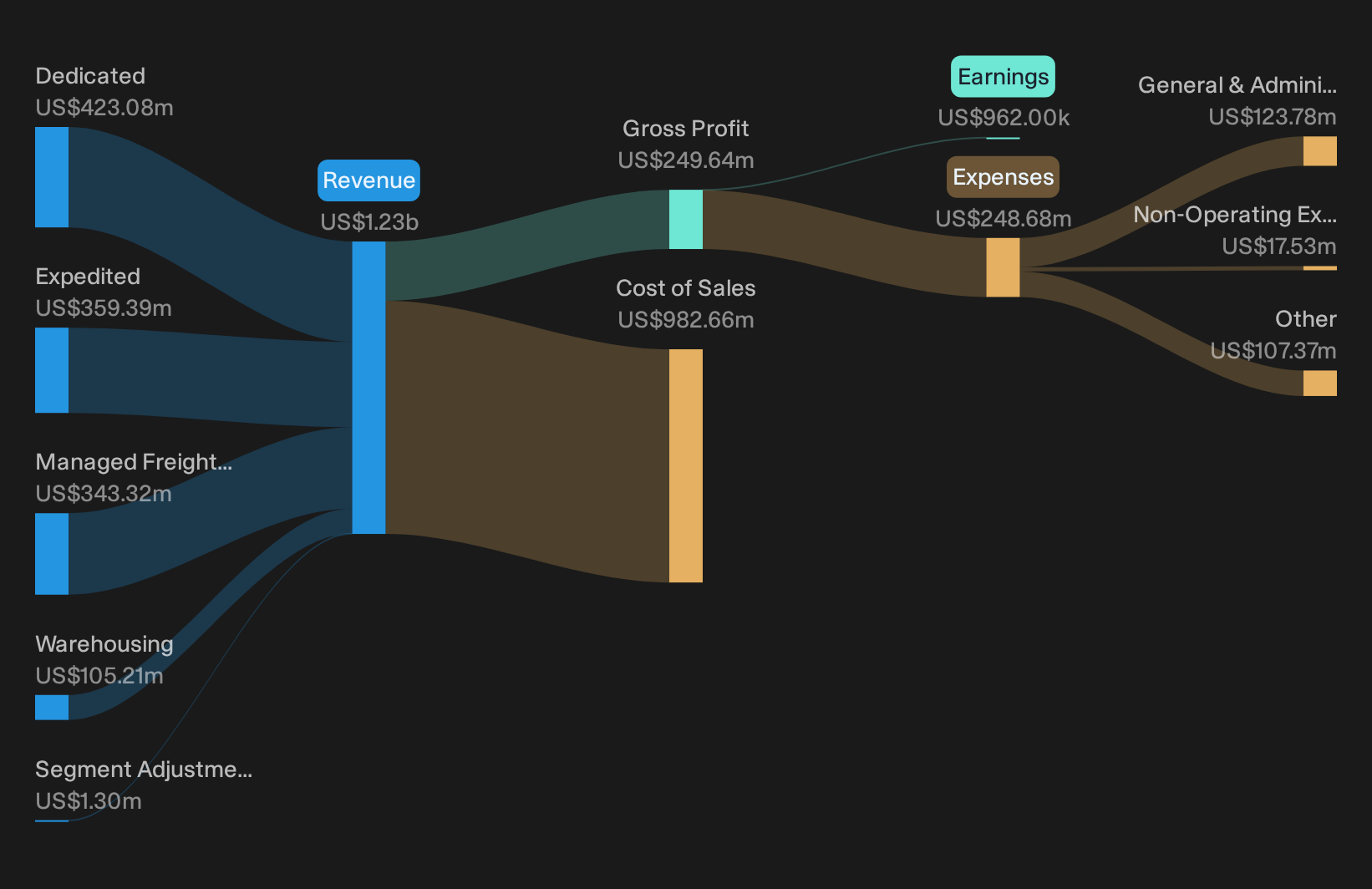
Operations: Covenant Logistics generates about US$423 million from Dedicated, US$359 million from Expedited, US$343 million from Managed Freight and US$105 million from Warehousing, almost entirely in the US.
Market Cap: US$830 million
Covenant Logistics Group provides direct exposure to how diesel costs affect a large truckload fleet, because changes in fuel expenses can quickly reshape trip economics and contract profitability across expedited lanes and long running dedicated deals.
"Management is actively converting more uncommitted truckload capacity into long term agreements in both Dedicated and Expedited, which can reduce exposure to spot market swings. Over time, this approach can also support higher average rates and more stable operating margins."
The real test for Covenant Logistics Group is how that contract heavy mix absorbs one stubborn cost line if it refuses to move in sync.
If that tug of war is what interests you, read the full narrative for Covenant Logistics Group to see how diesel exposure, contract mix and capital plans could be quietly decoupling.
Knight-Swift Transportation Holdings (KNX)
Overview: Knight-Swift Transportation Holdings runs a large US and Mexico freight platform where diesel hungry truckload and LTL fleets drive most activity.
Operations: Knight-Swift generates about US$5.0b from Truckload, US$1.5b from Less-Than-Truckload, US$568 million from Logistics and US$397 million from Intermodal, almost all in the United States.
Market Cap: US$10.6b
Knight-Swift Transportation Holdings is a useful bellwether for this fuel focused screen, because a broad mix of truckload and LTL freight makes diesel costs central to how much earnings benefit from any sustained break in pump prices.
"The continued expansion and integration of the LTL segment remains a key lever. Door count is expected to be up roughly 10% by late 2025, with new terminals opened in Phoenix, Olympia, Detroit and Toledo in 2026, and management indicating the current LTL infrastructure can support up to US$2b of annualized revenue."
What happens if one less visible cost pressure moves in the wrong direction just as that extra LTL capacity fills up.
If that risk is on your mind, the full narrative for Knight-Swift Transportation Holdings explains how diesel costs, LTL expansion and contract structures could be quietly decoupling for Knight-Swift.

Seeking Alternatives Before Others Catch On
Fresh ideas move first. By the time momentum headlines hit, early entry points can be gone. Scan curated shortlists now, while they are under the radar, and consider early opportunities.
- Look for quietly building breakouts before screens everywhere catch them by running the 28 high quality undervalued stocks and focusing on quality businesses with cash flows and balance sheets doing the heavy lifting.
- Explore structural demand shifts as critical metals gain attention by checking the curated 33 best rare earth metal stocks and seeing which producers could matter most if supply remains tight.
- Review potential income ideas while yields remain elevated by scanning the hand picked 8 dividend fortresses and seeing which payers still pair high yield with balance sheet strength.
This article by Simply Wall St is general in nature. We provide commentary based on historical data and analyst forecasts only using an unbiased methodology and our articles are not intended to be financial advice. It does not constitute a recommendation to buy or sell any stock, and does not take account of your objectives, or your financial situation. We aim to bring you long-term focused analysis driven by fundamental data. Note that our analysis may not factor in the latest price-sensitive company announcements or qualitative material. Simply Wall St has no position in any stocks mentioned.
Have feedback on this article? Concerned about the content? Get in touch with us directly. Alternatively, email editorial-team@simplywallst.com