


How Investors Are Reacting To Transocean (RIG) Backlog Wins
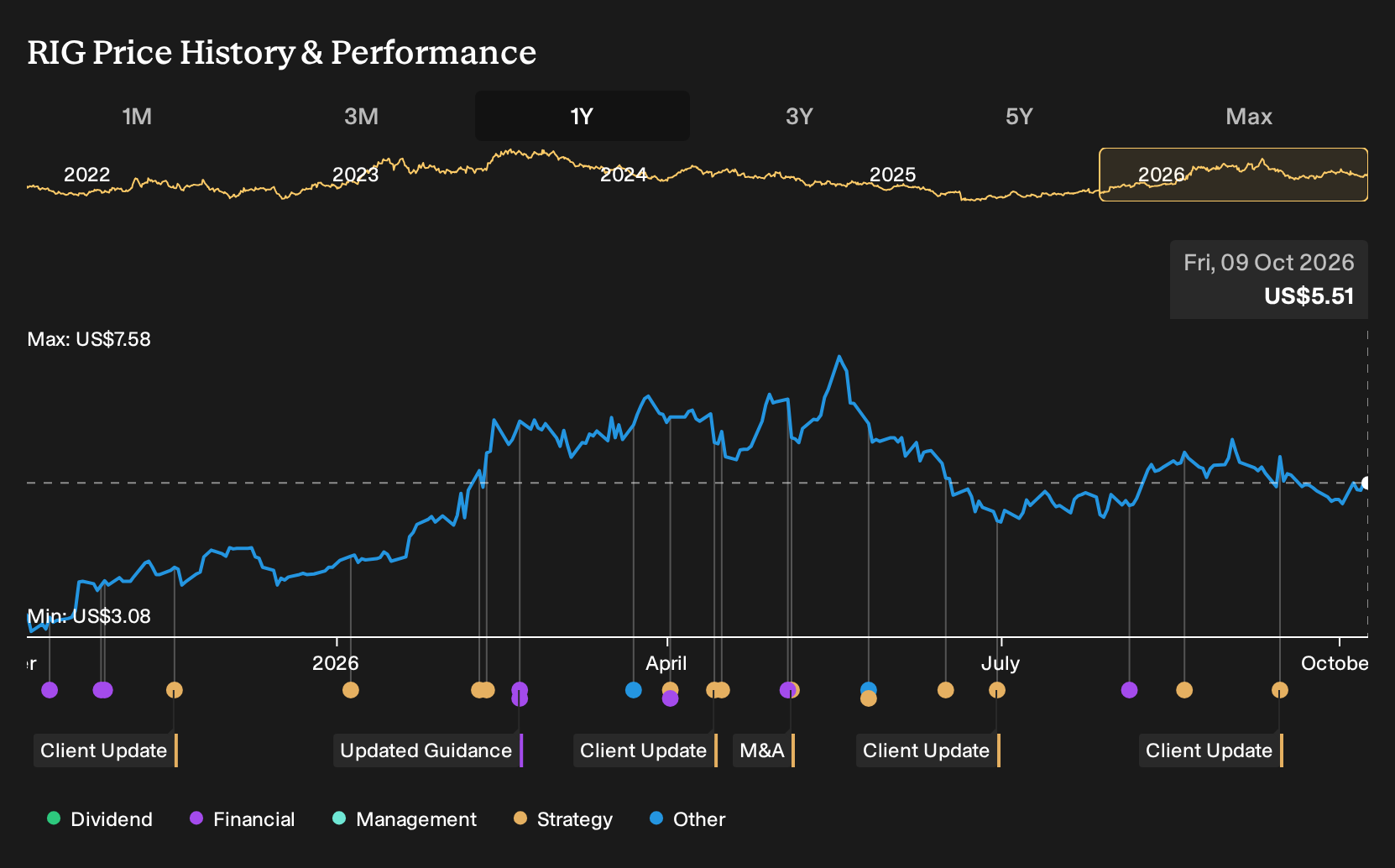
- Transocean reported that the Transocean Norge secured a two well contract with A/S Norske Shell in Norway, adding about US$62 million to firm backlog and including a single well option, while Equinor granted final approval for a previously announced agreement that converted roughly US$1.0 billion of contract value for three harsh environment semisubmersibles into confirmed backlog.
- The jump in committed work materially lifts Transocean’s revenue visibility and operational utilization for key Norwegian rigs. This directly affects how durable the company’s cash flow profile looks against its high debt load and offshore market cyclicality.
- The next area of focus will be how Transocean's larger firm backlog, anchored by Equinor's approval, reshapes the existing investment narrative.
Transocean Investment Narrative Recap
To own Transocean, you need to believe that tight offshore supply and customer appetite for high spec rigs can support strong utilization and reliable conversion of backlog into cash flow. The Shell award and Equinor approval increase firm work in Norway and provide more line of sight on near term activity, which matters for a contractor still working back from recent losses.
The key short term catalyst is whether this deeper backlog starts to ease concerns about Transocean’s heavy debt and higher risk funding profile. The biggest near term risk remains soft or volatile dayrates and any hiccups in executing these contracts, since weaker pricing or downtime would make it harder to service debt and move toward sustainable profitability.
The most relevant update is the Equinor agreement, which now represents roughly US$1.0b of firm backlog across three harsh environment semisubmersibles in Norway. That shifts a previously announced value into confirmed work and provides Transocean with more concrete visibility on rig activity and cash generation potential in a key region for the group.
For catalysts, the Equinor backlog interacts directly with expectations that Transocean can steadily turn contract commitments into revenue and eventually positive earnings. Execution risk remains, particularly around pricing and operating efficiency, but the step up in firm work links near term performance to a defined set of rigs and counterparties rather than theoretical demand trends.
What Analysts Are Baking Into The Transocean Story
Transocean's narrative projects US$3.7b in revenue and US$253.3 million in earnings by 2029. This is based on analyst assumptions that revenue will decline by 3.5% per year and that earnings would need to change by roughly US$3.1b from a loss of US$2.8b today to the 2029 consensus figure.
Uncover why Transocean's fair value indicates a 19% potential upside to its current price that could narrow quickly.
Exploring Other Perspectives
One alternate view says the real swing factor for Transocean is long term demand risk from renewables, not today’s backlog wins. The most cautious analysts were assuming revenue around US$3.5b and earnings of US$276.0 million by 2029 before this news. That is a more pessimistic story. Use it as a reference point to assess how these new contracts might eventually reshape expectations.
Explore 4 other Transocean fair value estimates, including one that suggests it could be worth just $6.31.
Reach Your Own Conclusion
Disagree with existing narratives? Extraordinary investment returns rarely come from following the herd, so consider your own analysis and instincts.
- A great starting point for your Transocean research is our analysis highlighting 2 key rewards that could impact your investment decision.
- See our latest analysis for Transocean. The report includes a comprehensive fundamental analysis summarized in a single visual, the Snowflake, making it easy to evaluate Transocean's overall financial health at a glance.
Looking For More Investment Ideas Beyond Transocean?
If the Transocean story has sharpened your view on risk, cash flow and balance sheets, use that same lens to scan a wider opportunity set with the Simply Wall St Screener.
- For investors who want potential mispricing with support from fundamentals, start with a curated set of 28 high quality undervalued stocks that already clear basic quality checks.
- If resilience matters more than excitement right now, focus on companies screened for stronger finances through a 31 resilient stocks with low risk scores that puts balance sheet strength and risk scores front and center.
- When you want something off the beaten track, look at a 20 high quality undiscovered gems that highlights lesser known businesses with solid underlying metrics.
This article by Simply Wall St is general in nature. We provide commentary based on historical data and analyst forecasts only using an unbiased methodology and our articles are not intended to be financial advice. It does not constitute a recommendation to buy or sell any stock, and does not take account of your objectives, or your financial situation. We aim to bring you long-term focused analysis driven by fundamental data. Note that our analysis may not factor in the latest price-sensitive company announcements or qualitative material. Simply Wall St has no position in any stocks mentioned.
Have feedback on this article? Concerned about the content? Get in touch with us directly. Alternatively, email editorial-team@simplywallst.com