


Is L'Oréal more reliable than the French government? The sell-off of French bonds spawned an inversion spectacle. The yield of nearly 40% of high-rated corporate bonds was lower than that of sovereign bonds
The Zhitong Finance App notes that after a fierce sell-off of treasury bonds, France currently has nearly 215 billion euros (about 241 billion US dollars) of corporate bonds trading at a lower price than the same period treasury bonds, which is considered safer than government bonds. This scale has increased nearly 18 times since the beginning of 2026.
According to compiled data, the yield of about 38% of France's high-rated corporate bonds on Wednesday was lower than that of treasury bonds for the same period. At the beginning of this year, that amount was only 12 billion euros.
This phenomenon of disrupting traditional market hierarchies is not new, but it is rapidly escalating in France. Market concerns focus on the failure of the deficit target, the impasse in the new budget, and the upcoming presidential election, which could take France in a very different direction.
As market confidence in government bonds erodes, corporate bonds, especially corporate bonds that account for a high share of international business, such as L'Oréal and oil and gas giant Total Energy, have now become one of the safest havens.
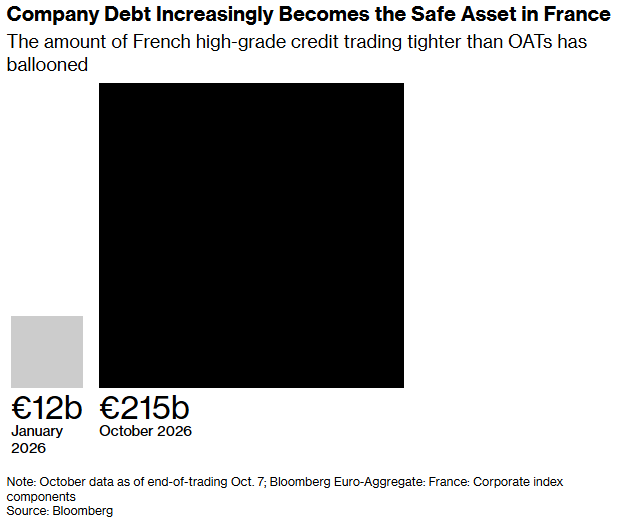
In France, corporate debt is increasingly becoming a safe asset
Elisa Belgacem, senior credit strategist at Generali Investments, said, “France's sovereignty story and corporate credit story have become increasingly disconnected.” Businesses and banks “continue to enjoy strong investor demand, highlighting the market's confidence in issuers' fundamentals and the appeal of full returns.”
The Paris-based Air Group is the latest example. The industrial gas manufacturer issued 2 billion euro bonds on Tuesday, attracting approximately €12.5 billion in investor subscriptions. The yield of both fixed-rate varieties was lower than that of French treasury bonds.
For Edward Farley, PGIM's European investment-grade corporate debt director, the key factor is where the company's revenue comes from. Taking L'Oréal and LVMH (LVMH) as an example, “in addition to the place of registration in France, French factors only influence them,” he said.
However, Farley is more cautious about the Bank of France because banks are more closely linked to the treasury bond market. Whether they directly hold sovereign debt or loans are indirectly affected by economic policies, banks are closely linked to national risk. The cost of default insurance on French bank bonds has soared higher than other European peers.
An extreme case
Although France is an extreme case of inversion in corporate bonds and treasury yields, this dynamic has been in the works for a long time in advanced economies.
Traditionally, sovereign debt is the benchmark for the security of bond markets, because governments can raise taxes when capital is scarce. But as countries' deficits continue to expand, and politicians of all parties find it difficult to control them, companies with strong balance sheets and strict financial discipline have instead become better choices.
Last year, due to market concerns about the impact of US tax cuts on the budget, Microsoft's bond transaction costs were briefly lower than US Treasury bonds. Earlier, during the Eurozone sovereign debt crisis, some Spanish and Italian corporate bonds were also cheaper than domestic treasury bonds. This is also a situation more commonly faced by investors in emerging markets.
In France, political uncertainty has been an enduring theme in the bond market since Macron announced an early general election after his fiasco in the European Parliament elections in mid-2024. By the end of the year, a few companies' bond yields had begun to fall below French Treasury Bonds (OAT).
Today, however, this phenomenon is much more common, and the scale of corporate debt reversals is likely to continue to grow. The French election is still more than six months away, and the sell-off in treasury bonds has begun to affect other markets.
Barclays credit strategist Melissa McCallum said that the typical situation where the domestic treasury yield curve acts as the lower limit of the credit market “may fail during a period of sovereign pressure.”
“However, it is worth noting that it is not just high-rated credit bonds that have fallen below the OAT curve; interest spreads on many BBB-grade bonds have also narrowed below it,” she said.