


Netlist Stock Is Up 970% Over the Past Year, But Its Latest $600 Million Win Suggests Caution Is the Right Approach
As high-density memory and solid-state storage technologies advance, IP licensing and patent partnerships are essential for defending proprietary innovations. By securing cross-licensing agreements, semiconductor innovators protect critical architecture while generating high-margin revenue streams that drive market valuation.
Highlighting the immense value of these intellectual property rights, Netlist (NLST) recently surged following a major $600 million five-year licensing agreement.
About Netlist
Netlist based in Irvine, California, designs and sells high-performance memory and storage solutions, including modular memory subsystems for enterprise customers. Its products target enterprise and data center applications. The company also holds a patent portfolio covering server memory, DDR5, and high-bandwidth memory technologies, which it licenses and enforces, positioning Netlist as a notable small-cap player in the AI memory market.
Netlist Stock Spikes
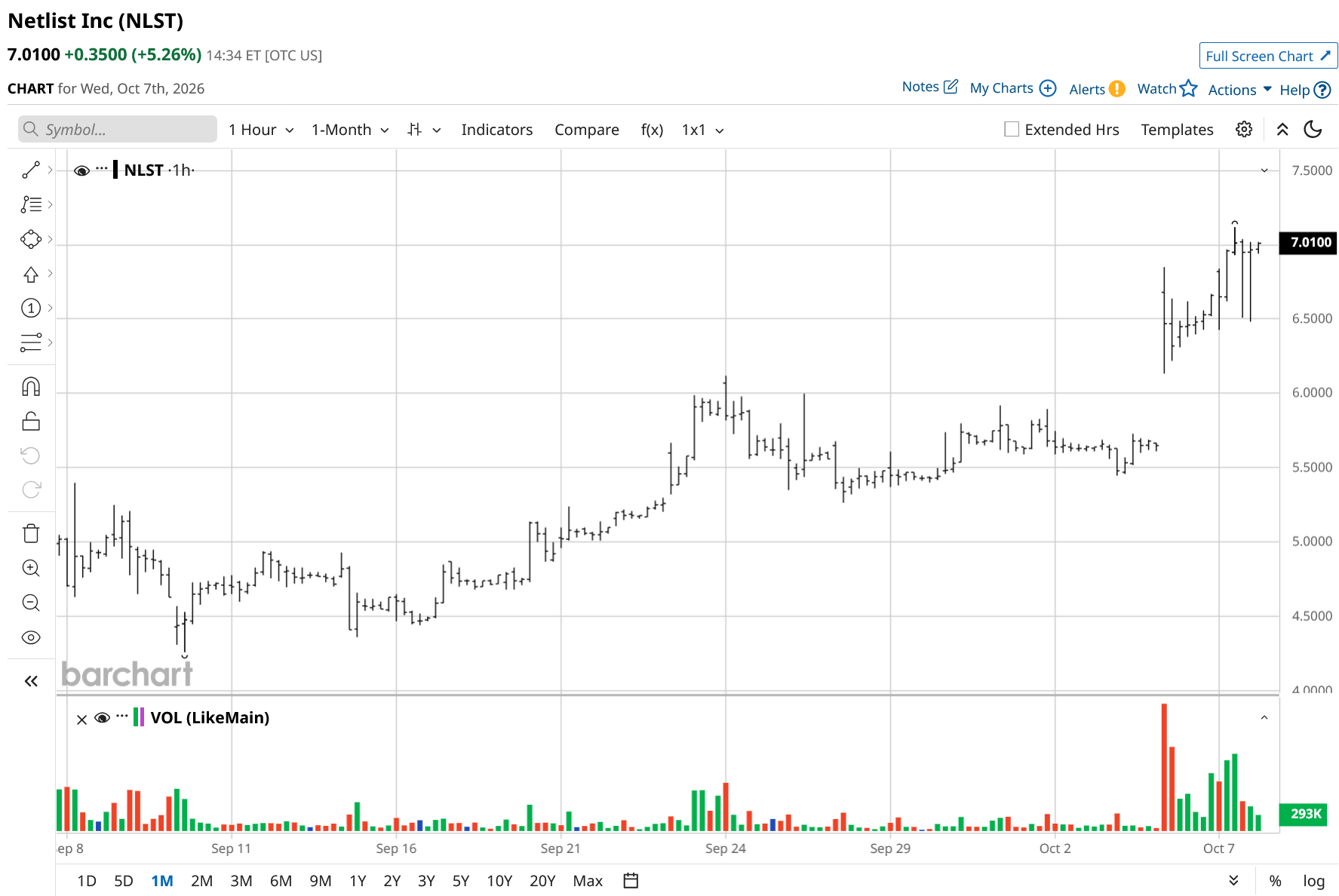
Netlist stock closed at $6.66 on Oct. 6, jumping about 18% in one session after Micron (MU) agreed to pay $600 million for a five-year license to its patent portfolio and settle the litigation. The rally followed a separate settlement with Samsung (SMSN.L.IX) in August, a pattern investors are rewarding, and shares now sit near a new 52-week high of just a hair above $7, far above the low of $0.446. NLST has gained more than 970% over the past year, lifting its market value above $2 billion.
Netlist has dramatically outpaced its benchmark. The PHLX Semiconductor Index ($SOX), the standard gauge for chip stocks, is up roughly 84% year-to-date (YTD), while NLST has surged to more than six times its price at the start of the year. That makes Netlist a high-risk, high-reward small-cap outperformer in the AI memory trade.
Results Outpace Estimates
Netlist reported second-quarter 2026 net sales of $109.8 million, up 163% year-over-year (YoY), well above the roughly $90 million Zacks consensus estimate. The company posted net income of $1.4 million, a swing from a $6.1 million loss a year earlier, while earnings per share of $0.00 matched the breakeven analyst estimate. First-half net sales reached $214.7 million, up 204%, with net income of $10.0 million, or $0.03 per share.
Gross profit jumped 1,544% to $22.9 million, a gross margin of about 21%, and operating income swung to $1.3 million from a $6.2 million loss. Intellectual property legal fees climbed to $16.8 million, reflecting ongoing patent battles. Netlist ended the quarter with $30.7 million in cash, $10 million in restricted cash, and $23.2 million in stockholders' equity, versus a deficit at year-end. It also received $10.5 million from warrant exercises.
Netlist did not provide formal numerical guidance in its release, but management struck a confident tone. CEO C.K. Hong said the company will keep developing next-generation AI memory technologies and defending its IP, cited a tight memory supply that analysts expect to last through next year, and noted CXL NVvault is sampling with hyperscalers and major OEMs. Looking ahead, the Micron agreement brings $30 million per quarter from the fourth quarter of 2026 through the third quarter of 2031, while an ITC hearing against Samsung is scheduled for late November.
Netlist and Micron Reach Agreement
Netlist shares surged 18% in early trading on Tuesday after Micron Technology agreed to pay $600 million for a five-year license to Netlist's patent portfolio, which includes server DIMMs and high-bandwidth memory technologies. The agreement also settles all pending legal proceedings between the two memory makers.
Micron will pay Netlist $30 million per quarter, starting in the fourth quarter of 2026 and running through the third quarter of 2031. Netlist CEO C.K. Hong said the deal further validates the value of the company's AI memory technologies, adding that Netlist remains committed to protecting its intellectual property while investing in next-generation products.
Micron also bought 10 million Netlist shares for $1 million, with the shares released from transfer restrictions gradually over five years, a detail NLST investors will want to watch.
Should You Bet on NLST Stock?
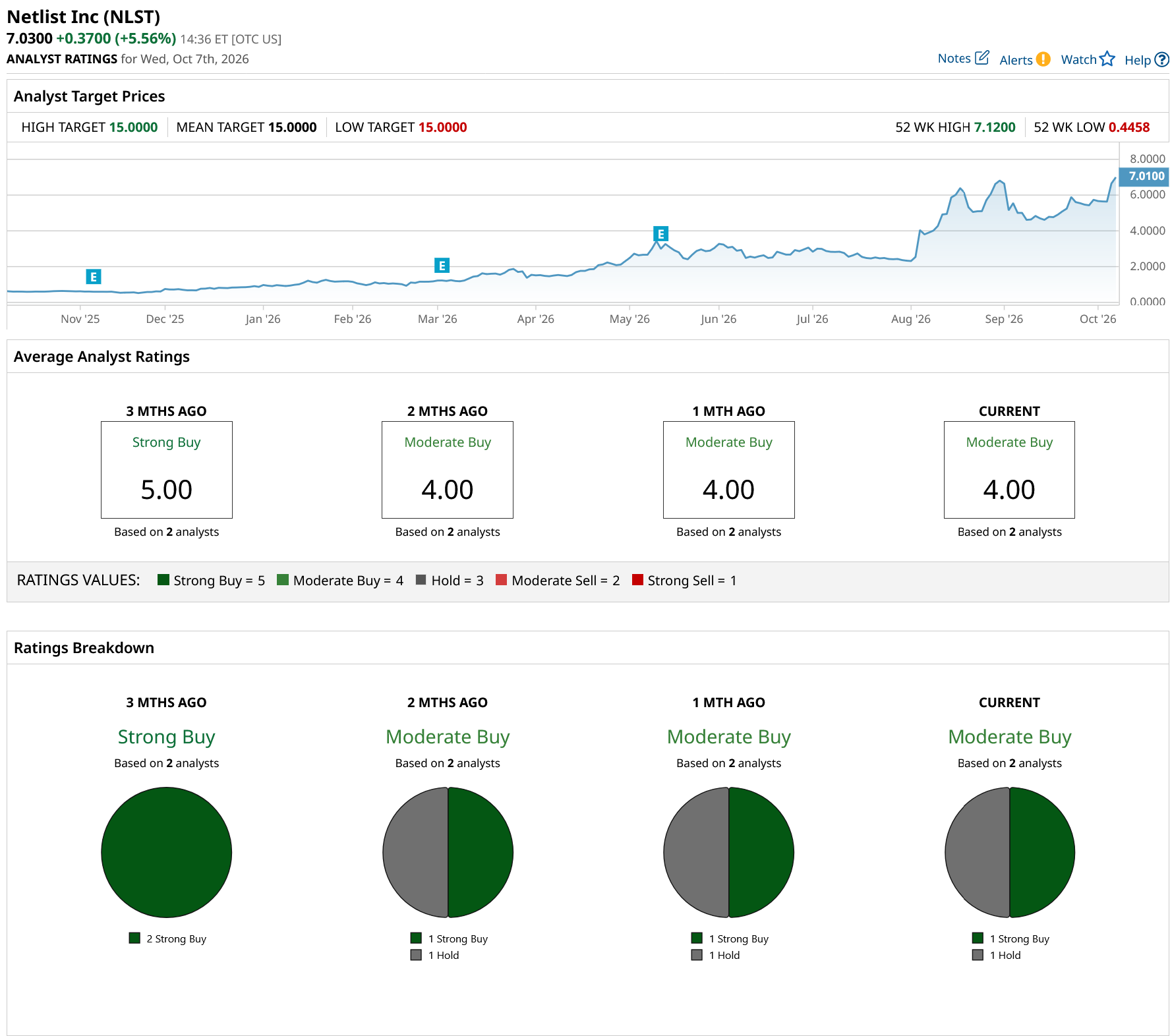
Netlist's $600 million patent license deal with Micron removes a major legal overhang and adds predictable quarterly cash through 2031. Analyst sentiment is encouraging but thinly spread: only two analysts cover NLST, with one rating it a “Strong Buy” and one a “Hold,” producing a consensus “Moderate Buy” rating. The mean price target of $15 (which is also the high and low targets) implies roughly 114% upside from current levels. After a rally of more than 970% in a year, though, investors should weigh that potential against the stock's volatility, legal imbroglios, and its OTCQB listing.
On the date of publication, Ruchi Gupta did not have (either directly or indirectly) positions in any of the securities mentioned in this article. All information and data in this article is solely for informational purposes. For more information please view the Barchart Disclosure Policy here.