


100,000 Reasons to Buy Oracle Stock
Oracle (ORCL) investors have a fresh 100,000-chip reason to pay attention as the cloud giant reportedly secured a major artificial intelligence (AI) deal with China’s Tencent (TCEHY). Tencent has agreed to lease access to about 100,000 advanced AI chips through Oracle’s data centers in Southeast Asia under a reported five-year, $7 billion agreement, with roughly 30% of the deal expected to be paid upfront.
The deal highlights the surging demand for AI computing capacity and reinforces Oracle’s growing role as a key infrastructure provider for companies racing to develop and deploy AI models. For Tencent, the arrangement provides access to advanced chips that are unavailable in China, while for Oracle, the agreement represents another potentially significant source of long-term AI infrastructure revenue. Thus, Oracle stock could be worth your attention now.
About Oracle Stock
Known for its pioneering relational database software and enterprise tools, Oracle Corporation has evolved into a powerhouse in cloud infrastructure, SaaS applications, hardware systems, and consulting services. Headquartered in Austin, Texas, the firm serves a global client base, and with a market cap of $431.9 billion, the company ranks among the world’s top software and cloud computing firms.
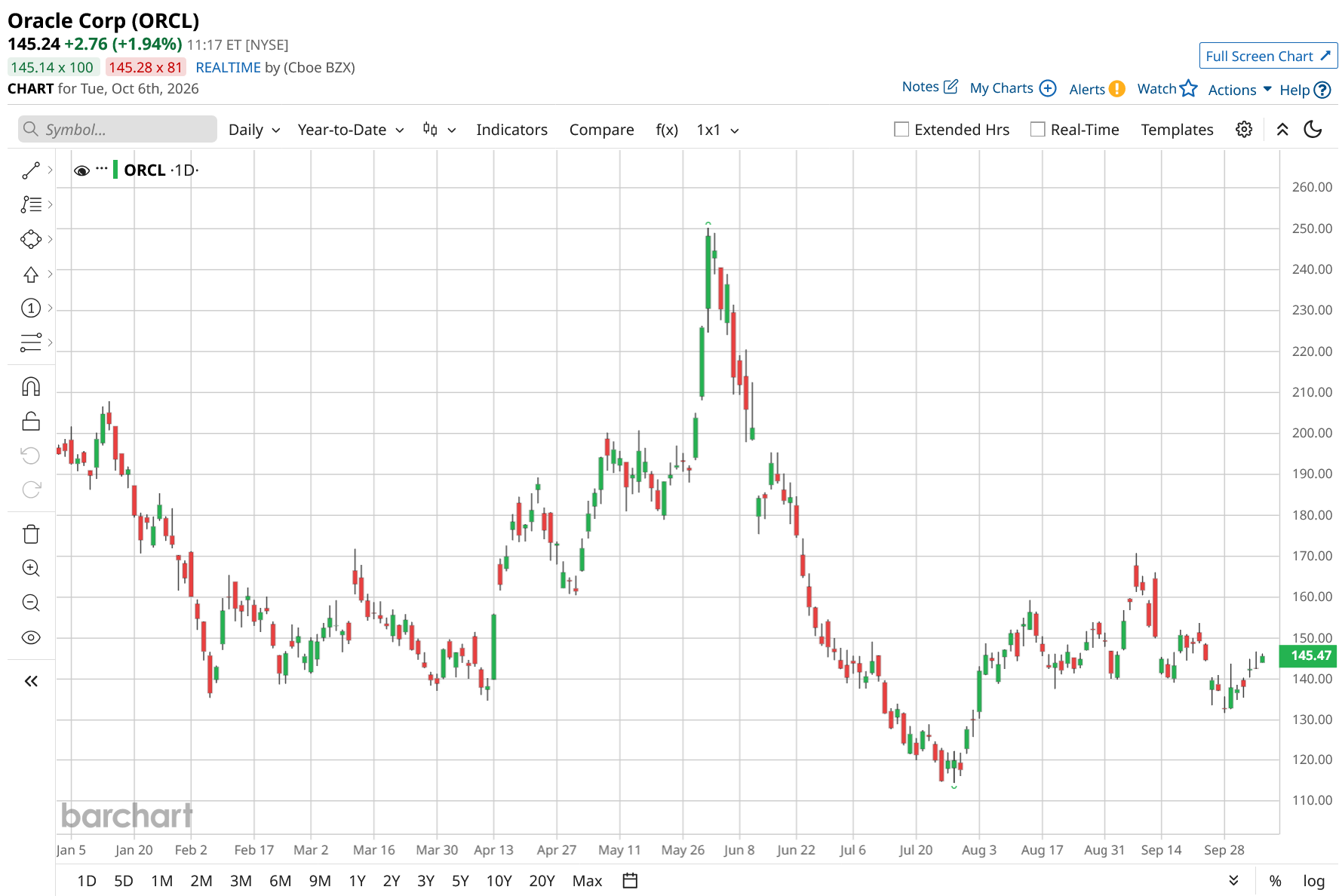
Oracle stock has endured a steep pullback in 2026, with shares down 26% year-to-date (YTD) and 50% over the past 52 weeks. The stock also remains 55% below its 52-week high of $322.54.
The selloff has largely reflected investor concerns about the cost and financing of Oracle’s aggressive AI infrastructure expansion. The company is committing heavily to data centers to serve major customers such as OpenAI and Meta Platforms (META), while its capital expenditures have surged and free cash flow has turned negative. Oracle has projected as much as $95 billion in fiscal 2027 capital spending while also planning substantial debt and equity financing, raising concerns about leverage, cash burn, and the returns it will generate from its AI investments.
However, ORCL has shown signs of a near-term rebound. Shares jumped 3.1% on Oct. 2 and edged higher again in the following sessions, bringing the stock’s five-day return to roughly 5%. The recent strength came as investors responded positively to the Tencent deal. The reported deal highlights continued demand for Oracle’s AI cloud infrastructure.
Oracle’s AI buildout is expensive, but its massive backlog and growing demand for computing capacity suggest that the company may have significant revenue opportunities ahead.
ORCL stock is currently trading at a significant discount compared to peers and its own historical average at 20.64 times forward earnings.
Q1 Results Demonstrate Cloud Momentum
Oracle delivered a strong fiscal first-quarter (ended Aug. 31) performance, with results released on Sept. 10, driven by accelerating cloud infrastructure demand and AI-related contracts.
Total revenue rose 30% year-over-year (YoY) to $19.3 billion. Cloud revenue was the key growth engine, jumping 62% to $11.6 billion. Within the cloud segment, Cloud Infrastructure (IaaS) revenue surged 121% to $7.4 billion, while Cloud Applications (SaaS) revenue increased 10% to $4.2 billion. The strong IaaS growth reflects robust demand for AI training and inference capacity.
The remaining businesses delivered a mixed performance. Software revenue declined 3% to $5.5 billion as customers continued shifting from on-premise software to the cloud. Hardware revenue increased 15% to $0.8 billion, while Services revenue rose 5% to $1.4 billion.
Profitability also improved substantially. Non-GAAP operating income climbed 31% to $8.2 billion. Non-GAAP net income available to common shareholders increased 34% to $5.8 billion, while non-GAAP EPS increased 30% to $1.92, topping Wall Street expectations.
Oracle’s cash-flow picture was particularly notable. Operating cash flow surged 184% to a record $23 billion, although free cash flow was negative $5 billion as the company continued making heavy investments in cloud infrastructure. Oracle also delivered more than 300,000 GPUs to AI cloud customers during the quarter, nearly triple the capacity delivered in the previous quarter.
Another major positive was remaining performance obligations (RPO), which increased by $209 billion YoY to $664 billion. Oracle booked more than $30 billion of additional AI cloud contracts during the quarter, underscoring the scale of demand for its AI infrastructure.
For the second quarter of fiscal 2027, Oracle expects revenue growth of 30%-34%, while total cloud revenue is projected to increase 65%-71%. Non-GAAP EPS is expected at 1.85-1.93, representing 21%-25% YoY growth.
Oracle also raised its full-year fiscal 2027 outlook, now expecting total revenue of at least $90 billion and non-GAAP EPS of $8.10.
Analysts predict EPS to be around $6.69 for fiscal 2027, up 6% YoY, and to surge by 36.6% annually to $9.14 in fiscal 2028.
What Do Analysts Expect for ORCL Stock?
Citizens JMP reiterated its “Market Outperform” rating on ORCL stock on Oct. 2 while maintaining its $285 price target.
Last month, BMO Capital Markets maintained its “Outperform” rating on ORCL but lowered its price target to $195 from $220 following the company’s fiscal Q1 results. The change reflects a more cautious view of the economics of Oracle’s aggressive AI infrastructure buildout rather than a deterioration in the underlying demand story.
Plus, Mizuho analyst Siti Panigrahi maintained a “Buy” rating and a $320 price target on Oracle, reaffirming a bullish view despite the stock’s sharp decline.
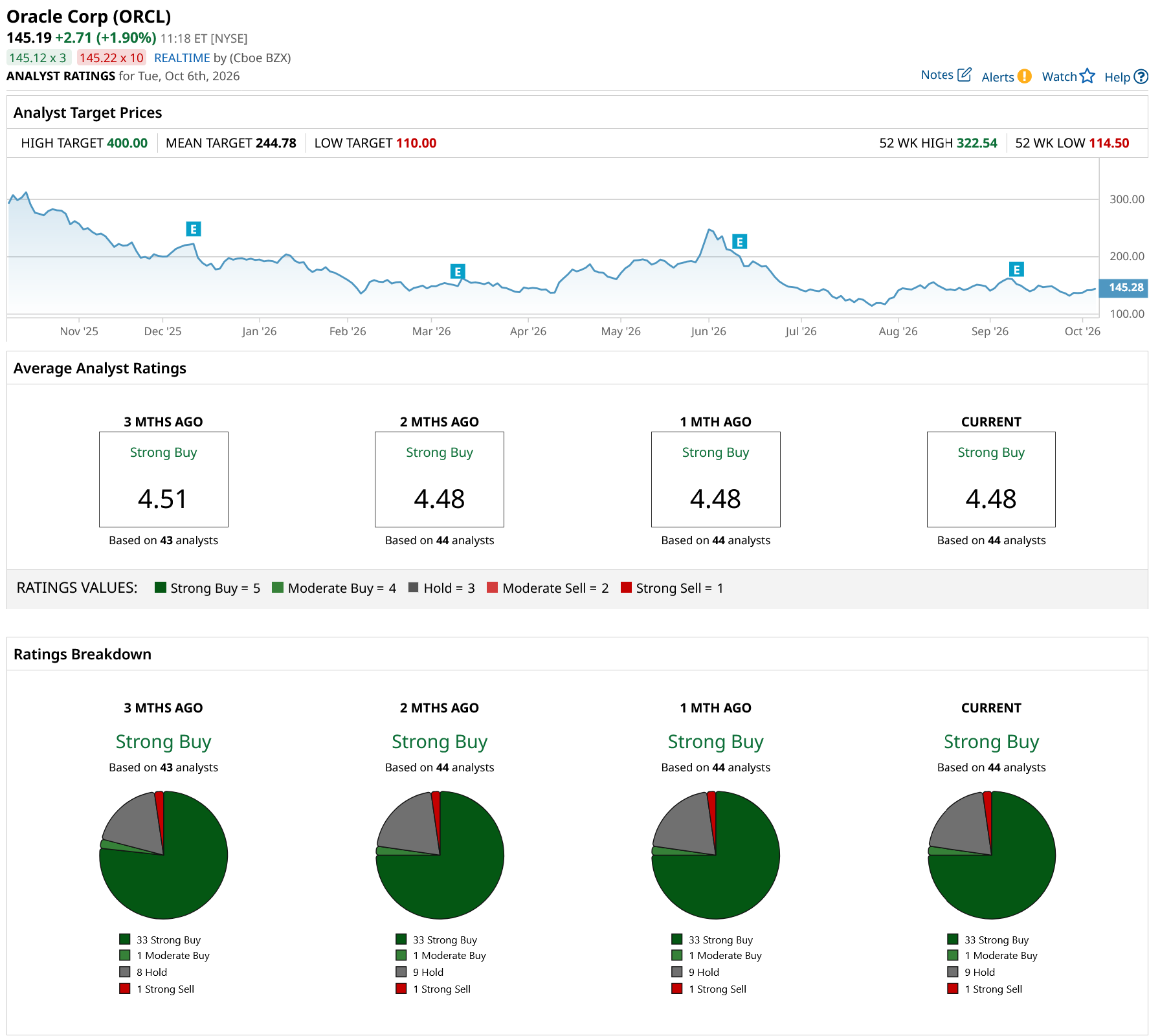
ORCL stock has a consensus “Strong Buy” rating overall. Among the 44 analysts covering the tech stock, 33 recommend a “Strong Buy,” one gives a “Moderate Buy,” nine analysts stay cautious with a “Hold” rating, and one gives a “Strong Sell” rating.
While its average price target of $244.78 indicates an upside of 69%, the Street-high target price of $400 suggests that the stock could rally as much as 176%.
On the date of publication, Subhasree Kar did not have (either directly or indirectly) positions in any of the securities mentioned in this article. All information and data in this article is solely for informational purposes. For more information please view the Barchart Disclosure Policy here.