


Chinese AI Chips Could Flood the Market. Alibaba’s New Chip Is 3X Better Than Its Predecessor.
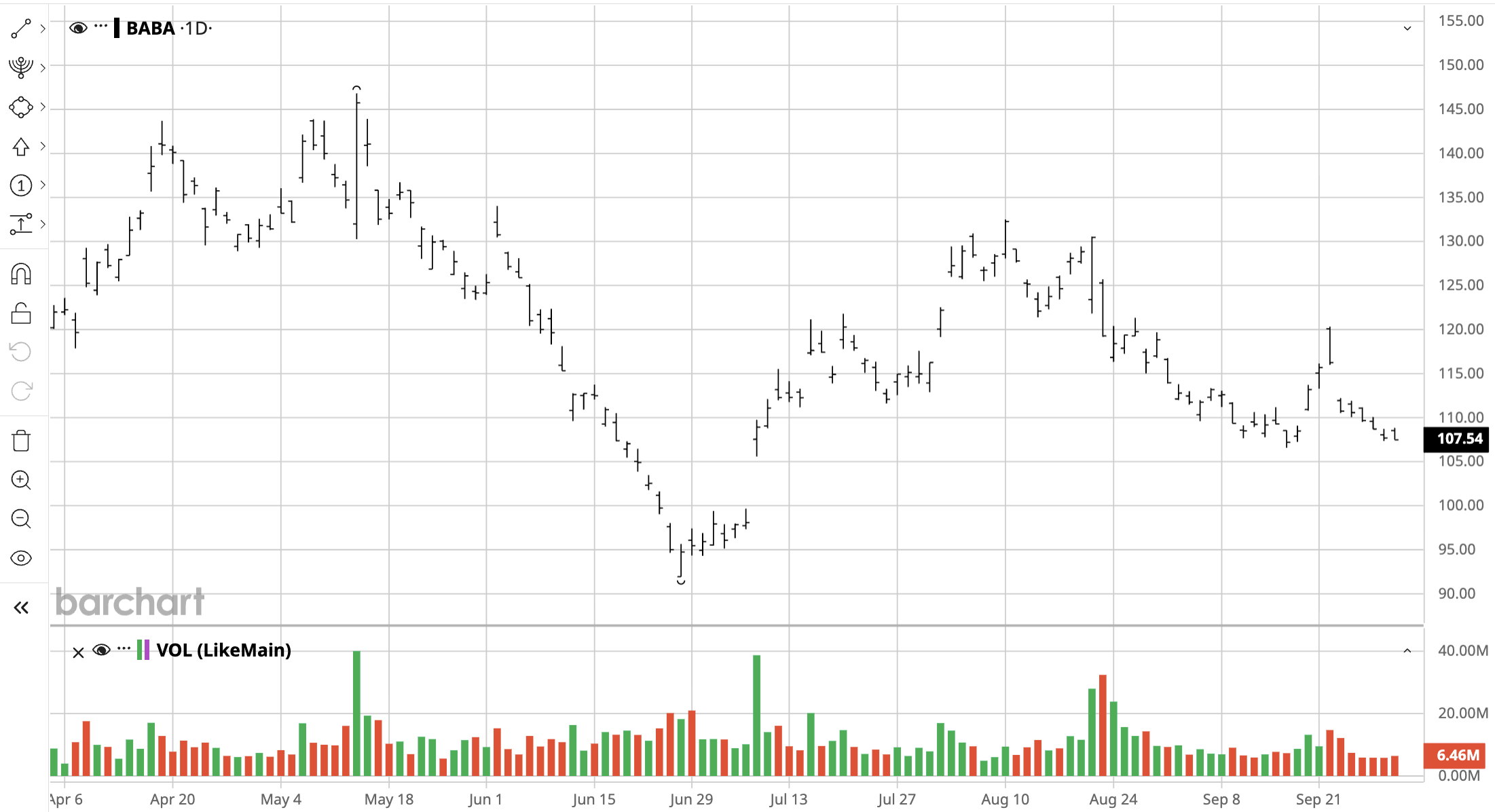
Alibaba (BABA) stock more than doubled in the first nine months of 2025 as several Chinese stocks roared back thanks to the artificial intelligence (AI) boom. However, BABA stock quickly topped out and has since fallen 45% from its 52-week high of $191.07.
The company itself has been making steady gains behind the scenes as Chinese AI labs play the long game. Alibaba recently announced its Zhenwu V900 AI chip on Sept. 22. This chip is reportedly three times faster than Alibaba's previous chip and targets 20 gigawatts of global data-center capacity by 2032. Alibaba says these chips will enter mass production as early as the first quarter of 2027.
Once released, the Zhenwu V900 chip will likely serve as a domestic alternative to Nvidia's (NVDA) chips in China. The pace of the company's chip development points to swift gains that may fill the gap Nvidia left in the Chinese market, if Alibaba's trajectory does not change.
The Chinese Market Is Open for Alibaba
In 2025, large Chinese tech companies stopped buying Nvidia AI chips amidst a trade war with the United States. The U.S. approved H200 chips to be sold to China earlier this year, but Nvidia still does not sell a meaningful amount of H200 chips to China.
For fiscal 2026, around 9.1% of Nvidia's operating revenue was directly tied to China. Given how fast Nvidia is growing, it can seemingly afford to lose that 9.1% of the market and instead focus on satisfying demand in the U.S. market.
Chinese companies are turning to domestic chips instead, and while they remain behind their Western counterparts, Chinese AI models are still competing on benchmarks despite the hardware bottleneck.
Can Chinese AI Companies Flood the Market With AI Chips?
Huawei, Cambricon, Baidu (BIDU), among many others, are trying to fill the gap left by Nvidia by designing their own chips inside China. However, there are obstacles that are likely to hinder these companies from being globally competitive just yet.
China's largest contract microchip maker, SMIC, has no extreme ultraviolet (EUV) machines due to sanctions. SMIC has to use deep ultraviolet (DUV) technology instead, which is more expensive and slower. ASML (ASML) is the only company that can make EUV machines today, although China is trying to break out of that chokehold by developing domestic DUV and EUV. China reportedly has a prototype EUV machine in Shenzhen with target chip output in 2028 at the earliest.
Alibaba's Zhenwu V900 must be made in China, so its volume and cost depend on SMIC's capacity and yields, and on high-bandwidth memory (HBM) supply. If China can introduce and scale up domestic EUV technology earlier than expected, it could end up making competitive chips at scale in the 2030s.
I don't expect Chinese AI semiconductors to flood the market anytime soon, though they may start making ground in 2030 and beyond. A Chinese RAM and DRAM flood is what I'd expect, although even that will likely take years, as demand remains hot.
Should You Buy BABA Stock for Its AI Chips?
Alibaba may seem like a strong buy after such a drawdown, but I wouldn't buy BABA stock right now because it still isn't cheap. Due to how fast most other AI companies have been growing, even NVDA stock is cheaper on forward earnings.
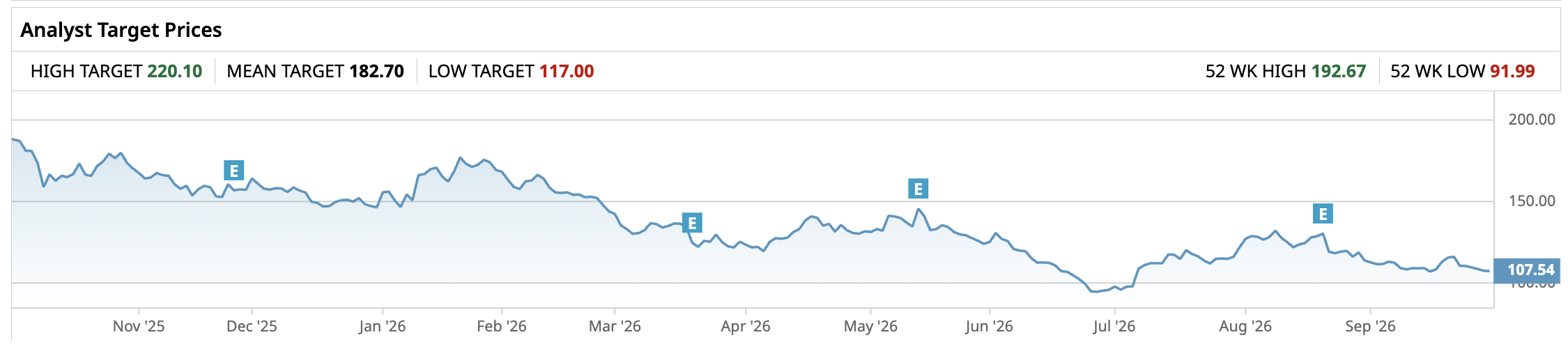
Alibaba trades at more than 18 times forward earnings, whereas Nvidia stock trades at around 15 times forward earnings based on its fiscal 2028 EPS estimate. Alibaba is obviously cheaper than most “Magnificent Seven” firms and other software companies, but the sluggish growth suggests not buying BABA stock is the better choice. While analyst price targets remain high, I believe they're unrealistic unless Chinese AI stocks reprice broadly.
On the date of publication, Omor Ibne Ehsan did not have (either directly or indirectly) positions in any of the securities mentioned in this article. All information and data in this article is solely for informational purposes. For more information please view the Barchart Disclosure Policy here.