


Up 228% in the Past Year, Bloom Energy Expands Manufacturing Capacity
It took Bloom Energy (BE) 21 years to reach its first $1 billion year, a milestone that the company hit in 2022. Over the last three years, Bloom Energy has doubled its revenue and is on track to surpass $4 billion in sales this year. Valued at a market capitalization of roughly $85 billion, BE stock has climbed 232% year-to-date (YTD), 228% in the last 12 months, and has returned a monstrous 2,500% in the last three years.
Bloom Energy designs, manufactures, sells, and installs solid-oxide fuel-cell systems for on-site power generation. Called the Bloom Energy Server, the company's energy server platform converts fuel like natural gas, biogas, and hydrogen into electricity through a non-combustion electrochemical process. The company also offers the Bloom Electrolyzer to produce clean hydrogen. Bloom Energy sells its products through direct and indirect sales channels to utilities, data centers, retail, healthcare, education, telecom, manufacturing, and other industries.
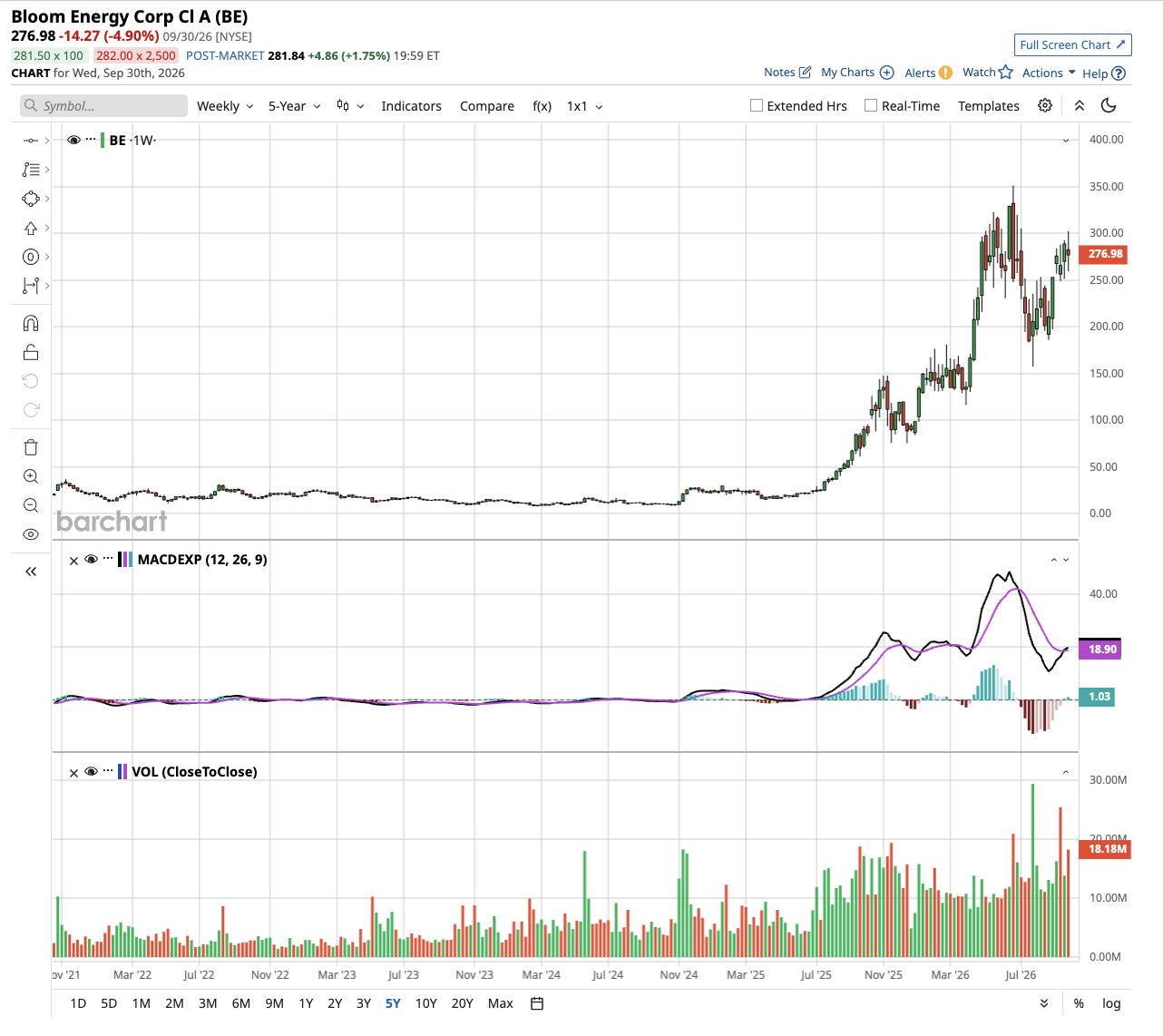
Bloom Energy Stock Rides the AI Power Crunch
For decades, Bloom Energy’s customers were hospitals, factories, telecom providers, and retail stores. Then artificial intelligence (AI) changed the math.
AI data centers need staggering amounts of power. CEO K.R. Sridhar said on the company's July 28 earnings call that spare grid capacity is no longer available, and grid operators quote timelines measured in years. "Chips without power are inventory, not intelligence," Sridhar said.
The CEO put a price on waiting. By his estimate, a 1 gigawatt AI data center can generate $12 billion to $24 billion in revenue a year. Getting power just one month sooner could mean $1 billion to $2 billion in extra revenue for the operator.
Sridhar noted that Nebius (NBIS) canceled orders for combustion turbines and engines this year and chose Bloom. According to the CEO, all the major U.S. hyperscalers, plus more than a dozen neoclouds, AI labs, and colocation operators have now approved Bloom's systems.
Bloom recently acquired a 158,000-square-foot facility on Encyclopedia Circle in Fremont, California, according to a company statement. The site expands Bloom's Fremont operations and supports hundreds of new advanced manufacturing jobs. The company tied the move directly to the tech sector's appetite for faster, cleaner onsite power.
Bloom is not alone in betting on Fremont. Wislab recently paid $120 million for three industrial buildings in the area. Fremont also captured roughly three-quarters of Silicon Valley's commercial real estate leasing activity last year.
The purchase fits a strategy Sridhar laid out on the second-quarter earnings call. Bloom has been adding U.S. factory capacity since the start of the year in “copy exact increments,” ahead of committed orders. "Capacity is not going to be our constraint," he told analysts.
BE Stock Price Gets Fuel From Record Results
The numbers behind that confidence are striking. Bloom reported Q2 revenue of $1.065 billion, up 166% from a year earlier. Gross margin was 33.4%, while operating margin was 22.5%, meaning roughly $22.50 of every $100 became operating profit. The company had about $2.7 billion in cash on hand at quarter's end.
Revenue jumped 166%, yet operating expenses rose “just” 48%, which indicates significant operating leverage. CFO Simon Edwards called that leverage "structural."
Management also raised its full-year targets. The company now expects operating income of $800 million to $900 million in fiscal 2026. In January, that guidance was much lower at $425 million to $450 million.
In June 2026, Brookfield (BN) expanded its financing commitment fivefold — from $5 billion to $25 billion — to fund Bloom power projects. In July, Industrial Development Funding also teamed up with Oaktree, MUFG Bank (MUFG), and Morgan Stanley (MS) to bring its own total to $2.6 billion.
What Could Move BE Stock Next?
Bloom is also pushing a bigger idea. In a new industry report, the company projects that 800V DC power will reshape AI data centers.
Its model for a 1 GW site shows $3.6 billion in savings on spending outside the computing gear, a 27% cut. Over five years, total ownership costs drop by $5.5 billion, or 9%, compared with traditional AC systems. The report also notes that Nvidia (NVDA) plans to specify 800V DC for its Rubin Ultra and Kyber racks starting in 2027.
However, revenue can be lumpy, since one or two customers may dominate any given quarter. On the Q2 call, analysts also pressed management on project delays and on access to scandium, a key material. Bloom said it has visibility for 25 GW of deployments and does not depend on China.
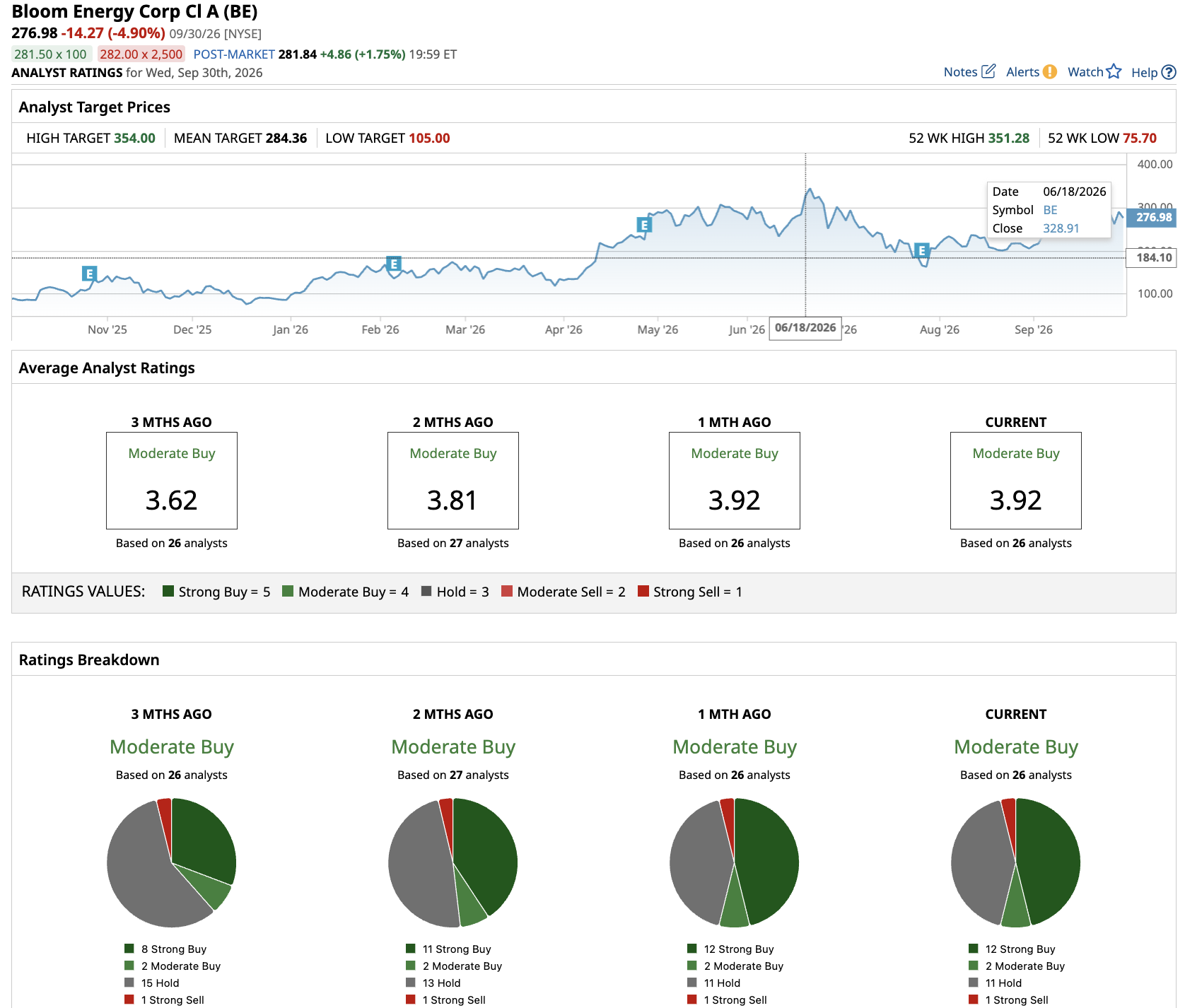
Overall, Bloom Energy stock has a consensus “Moderate Buy” rating on Wall Street. Out of the 26 analysts covering BE stock, 12 recommend a “Strong Buy” rating, two recommend a “Moderate Buy,” 11 recommend a “Hold,” and one analyst recommends a “Strong Sell” rating. The average price target of $285.82 has already been surpassed, while the high price target of $354 suggests potential upside of 22% from current levels.
Sridhar was candid about the biggest unknown. When asked whether AI spending will keep growing this fast, he said that customer talks suggest it will accelerate. "However, I do not know for sure, and I will not insult you by pretending to," he said.
So, Bloom is doing what it can control. It is building factories before the orders arrive.
On the date of publication, Aditya Raghunath did not have (either directly or indirectly) positions in any of the securities mentioned in this article. All information and data in this article is solely for informational purposes. For more information please view the Barchart Disclosure Policy here.