


Did Cheaper Loan Repricing Just Shift Pitney Bowes (PBI) Investment Narrative?
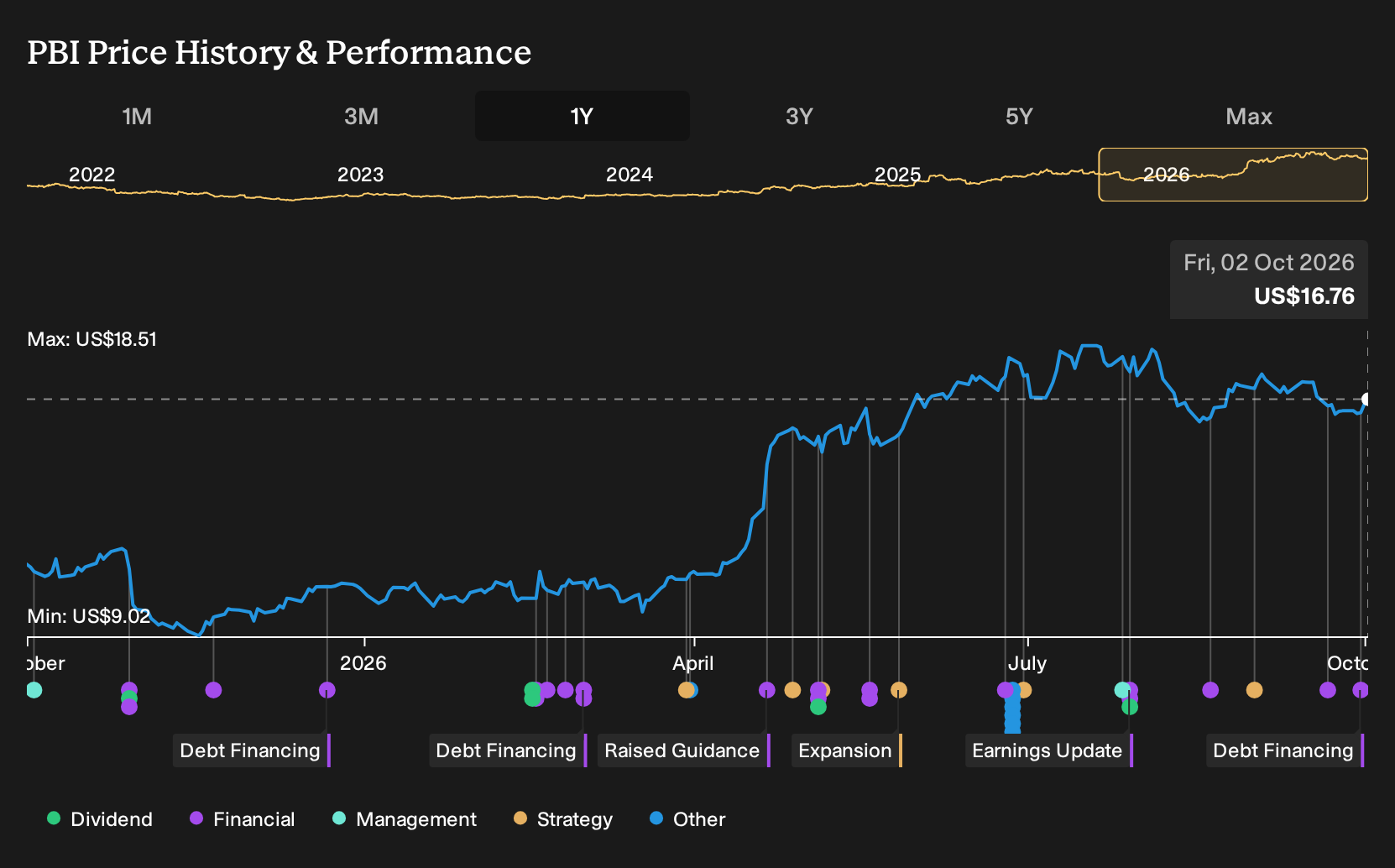
- Pitney Bowes recently repriced its $585 million Term Loan B that matures in March 2032, cutting the SOFR margin by 75 basis points to 300 basis points, after retiring about $46 million of long dated notes through a tender offer completed in September 2026.
- Together with the recent S&P upgrade to BB-, these debt moves reduce ongoing interest costs and simplify Pitney Bowes' capital structure, which directly affects cash flow available for operations and future investment in its shipping and mailing businesses.
- We will now see how Pitney Bowes' lower interest margin on its Term Loan B could reshape the broader investment narrative around debt.
Pitney Bowes Investment Narrative Recap
Owning Pitney Bowes means believing its shift toward SaaS shipping and more efficient mailing services can offset pressure on traditional mail volumes and intense logistics competition. The key near term swing factor is execution in SendTech and Presort, where consistent earnings quality and recent margin improvement matter more than short term trading moves.
The fresh debt repricing and tender offer mainly tidy up financing. They modestly lower interest expense, which supports free cash flow but does not change the central question. Can Pitney Bowes grow higher quality, recurring logistics and software revenue fast enough to counter mail digitization and the risk that legacy segments keep shrinking?
The repricing of the US$585 million Term Loan B, which trims the SOFR margin by 75 basis points and is expected to cut annual interest by about US$4 million, is the clearest link to current catalysts. Lower coupon costs slightly improve breathing room as management pursues digital shipping, automation and operational efficiency projects.
For you as a shareholder, the relevance is simple. A cleaner capital structure and the S&P move to BB minus lessen one of the key historical worries: high leverage and refinancing risk. That shift does not remove the execution hurdle. It just means more of Pitney Bowes' cash can be directed toward running and modernizing the shipping and mailing businesses rather than servicing expensive long dated debt.
Pitney Bowes is modeled to generate US$1.8b of revenue and US$285.9 million of earnings by 2029, with analysts expecting revenue to remain fairly flat and profits to rise from US$187.3 million today, a gain of about US$98.6 million over that period.
Uncover why Pitney Bowes' fair value indicates a 17% potential upside to its current price, which could narrow quickly if Pitney Bowes executes on its plan.
Exploring Other Perspectives
Not every analyst sees Pitney Bowes’ cleaner balance sheet as the main story. The most pessimistic forecasts already assumed revenue sliding about 2.3% a year to roughly US$1.7b by 2029, with earnings near US$277.3 million. Those views were set before this repricing, so you may want to reconsider how that debt thesis evolves.
Explore 3 other Pitney Bowes fair value estimates, including one that suggests as much as 13% downside from the current price.
The Verdict Is Yours
Disagree with existing narratives? Extraordinary investment returns rarely come from following the herd, so trust your own analysis and judgment.
- A great starting point for your Pitney Bowes research is our analysis highlighting 4 key rewards and 3 important warning signs that could impact your investment decision.
- See our latest analysis for Pitney Bowes. The report includes a comprehensive fundamental analysis summarized in a single visual, the Snowflake, making it easy to evaluate Pitney Bowes' overall financial health at a glance.
Looking For More Investment Ideas Beyond Pitney Bowes?
If this Pitney Bowes debt reset has you rethinking risk and reward, it can help to widen the lens and compare it with other businesses that fit your preferred profile. The Simply Wall St Screener lets you filter by quality, balance sheet strength and income potential so you can build a watchlist that matches how you like to invest.
- If capital preservation comes first for you, focus on sturdier franchises by scanning our 31 resilient stocks with low risk scores that screen for resilience when conditions get tougher.
- Income driven investors can zero in on dependable cash returns by using the 7 dividend fortresses to narrow in on companies targeting yields of 5% or more.
- Those hunting for future outperformers might prefer to start with quality at a reasonable price, using the 19 high quality undiscovered gems that highlight under followed businesses with solid fundamentals.
This article by Simply Wall St is general in nature. We provide commentary based on historical data and analyst forecasts only using an unbiased methodology and our articles are not intended to be financial advice. It does not constitute a recommendation to buy or sell any stock, and does not take account of your objectives, or your financial situation. We aim to bring you long-term focused analysis driven by fundamental data. Note that our analysis may not factor in the latest price-sensitive company announcements or qualitative material. Simply Wall St has no position in any stocks mentioned.
Have feedback on this article? Concerned about the content? Get in touch with us directly. Alternatively, email editorial-team@simplywallst.com