


Will Earnings Beat Change PVH (PVH) Stock Narrative
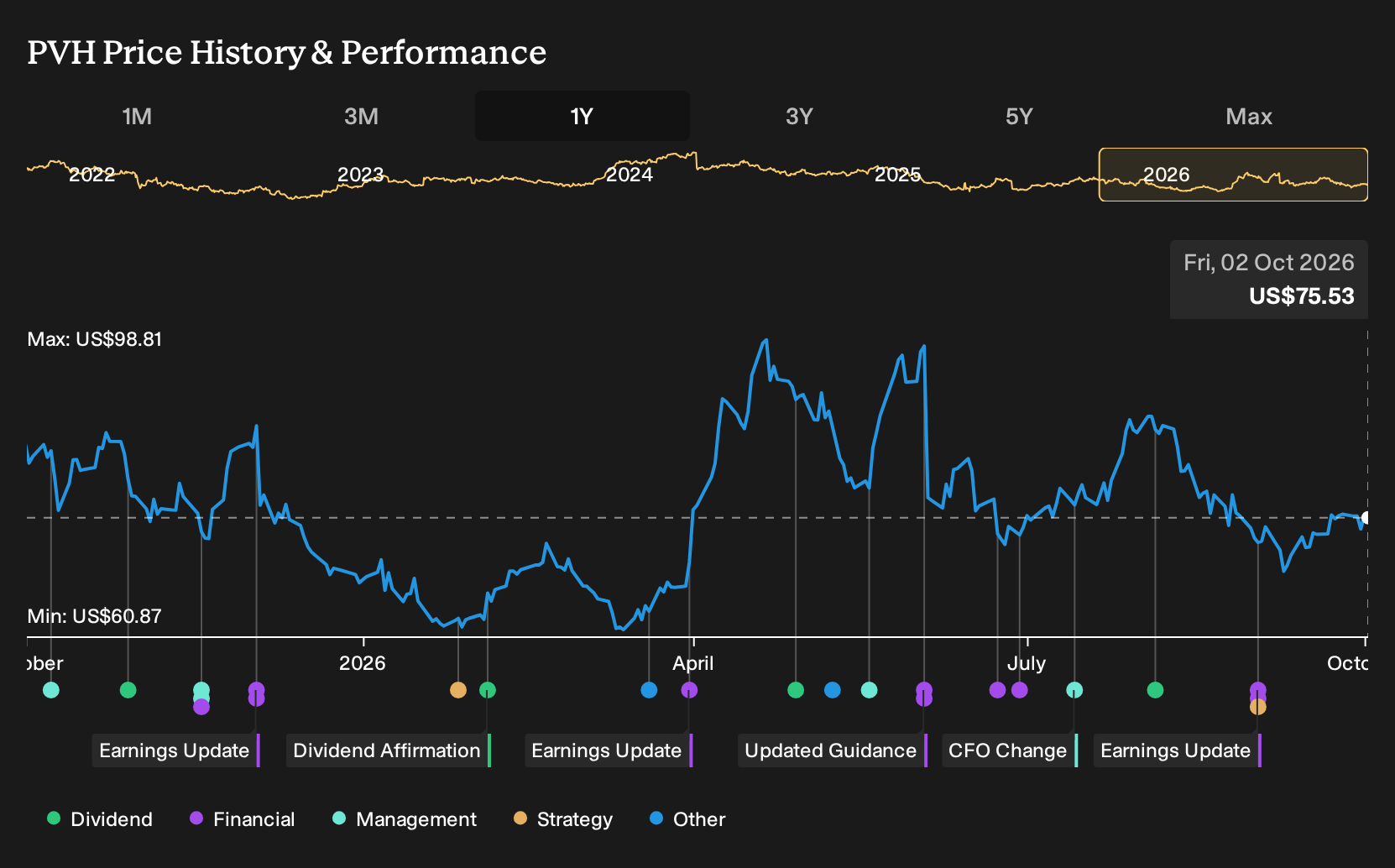
- PVH Corp. reported fiscal Q2 2026 adjusted earnings of $3.70 per share, ahead of the Zacks Consensus Estimate, with revenue in line and support from tariff refunds and lower product costs.
- The quarter featured a stronger cash position, reduced inventory, a richer gross margin helped by tariff refunds, and a reaffirmed full year outlook calling for flat revenue and adjusted EPS of $11.80 to $12.10.
- Next, the focus shifts to how PVH's tariff refund driven margin strength could reshape the broader investment narrative around its earnings quality.
Scan how PVH's tariff refund story compares with other apparel and consumer stocks by reviewing our hand picked list of 31 high quality undervalued stocks.
PVH Investment Narrative Recap
To own PVH, you need to be comfortable that Calvin Klein and Tommy Hilfiger can keep earning healthy pricing on core products while the firm leans harder into direct to consumer and e commerce. The latest quarter supports that view on margins, but the tariff refund boost is temporary, so it does not fully resolve the underlying earnings question.
The near term swing factor is still how quickly demand in EMEA and wholesale channels stabilises, because those areas have already weighed on recent revenue trends. The biggest risk is that softer sentiment in Europe and the Middle East lingers, which would make PVH more dependent on price mix gains and cost cuts rather than broad based volume recovery.
The most relevant piece of context for this quarter is management reaffirming the outlook for flat full year revenue and adjusted EPS of US$11.80 to US$12.10. That guidance effectively tells you PVH sees tariff refunds and lower product costs cushioning weaker regions, rather than driving a step change in the business on their own.
For catalysts, attention stays on execution in higher margin channels, including e commerce and direct to consumer, and on whether cost savings from procurement and SG&A really come through as planned. If EMEA pressure or softer wholesale demand persists, investors will likely focus even more on whether PVH can stick to that earnings range while tariff support fades over time.
PVH's analyst narrative points to revenues of US$9.4b and earnings of US$647.0 million by 2029, assuming revenue expands at about 1.7% a year and profit improves from a loss of US$169.0 million today to that future level, which means an earnings swing of roughly US$816.0 million over the period.
Uncover why PVH's fair value indicates a 20% potential upside to its current price that could narrow quickly.
Exploring Other Perspectives
One alternate view on PVH leans hard into the risk that EMEA pressure and tariff costs cap the benefit from direct channels. Before this quarter, the most cautious analysts were looking for roughly US$9.0b of revenue and about US$703.7 million of earnings by 2029, yet still arrived at a US$70.0 price target. That is a far more pessimistic narrative on valuation than the baseline. Investors can use this earnings beat and tariff refund news as a chance to compare those expectations and decide which story they find more convincing.
Explore 2 other PVH fair value estimates, including one that suggests it could be worth just $90.83!
Decide For Yourself
Disagree with existing narratives? Extraordinary investment returns rarely come from following the herd, so go with your instincts.
- A great starting point for your PVH research is our analysis highlighting 3 key rewards that could impact your investment decision.
- See our latest analysis for PVH. The report includes a comprehensive fundamental analysis summarized in a single visual, the Snowflake, making it easy to evaluate PVH's overall financial health at a glance.
Looking For More Ideas Beyond PVH?
If PVH's tariff story has sharpened your sense of risk and reward, it can be helpful to compare it with other businesses that share some of the same quality traits, income angles, or recovery potential. The Simply Wall St Screener makes that search quicker by filtering for specific financial characteristics instead of broad sector labels.
- For investors who care most about resilient balance sheets and solid fundamentals, start with the list of solid balance sheet and fundamentals (25 results) and see which businesses clear a similar quality bar.
- If income is a priority and you want companies offering higher yield with staying power, scan our curated set of 7 dividend fortresses that focus on both payout and strength.
- When you are hunting for future leaders that are not yet widely followed, the 19 high quality undiscovered gems can surface smaller, high quality opportunities that might otherwise stay off your radar.
This article by Simply Wall St is general in nature. We provide commentary based on historical data and analyst forecasts only using an unbiased methodology and our articles are not intended to be financial advice. It does not constitute a recommendation to buy or sell any stock, and does not take account of your objectives, or your financial situation. We aim to bring you long-term focused analysis driven by fundamental data. Note that our analysis may not factor in the latest price-sensitive company announcements or qualitative material. Simply Wall St has no position in any stocks mentioned.
Have feedback on this article? Concerned about the content? Get in touch with us directly. Alternatively, email editorial-team@simplywallst.com