


3 US Life Insurer Stocks That Could Benefit From Higher Treasury Yields
Fed rate hikes, higher Treasury yields and a stronger dollar are reshuffling where money feels comfortable in the market, and not every stock is reacting the same way. Some shares exposed to this news are feeling the pressure, while others could find a tailwind as investors look for steadier income and clearer cash flows. This article walks through 3 stocks from our U.S. life insurer and annuity screener that appear positively positioned. It explains how the news backdrop might affect each one and what that could mean for your watchlist decisions.
The three stocks below are just a sample from this idea, and the full screen surfaced 17 more U.S. life insurers and annuity providers with equally compelling narratives that are not covered here. To go straight to the source, use the U.S. Life Insurers and Annuity Providers Benefiting from Higher Long-Term Yields screener to identify, analyze and compare the highest conviction candidates for your watchlist.
Brighthouse Financial (BHF)
Overview: Brighthouse Financial is a U.S. insurer focused on annuities and life policies that tie long-term customer promises to long-term bond portfolios.
Operations: Brighthouse Financial generates about US$3.5b from Annuities, US$1.4b from Run-Off, US$1.1b from Life, and US$643 million from Corporate & Other, all in the United States.
Market Cap: US$2.9b
For investors tracking how higher long-term Treasury yields filter through to actual business models, Brighthouse Financial is a direct line of sight, since its annuity and life franchises live and die by the spread it earns on very long-dated assets and promises.
"Ongoing regulatory pressures, including potential changes to capital requirements and tighter fiduciary standards, are likely to increase compliance costs and reduce profitability at a time when industry margins are already under threat from technological disruption and fintech competition, further constraining earnings growth."
What really matters for Brighthouse Financial is how one less visible pressure ultimately shapes the economics of those long-dated retirement contracts.
That hidden pressure point is exactly where the full narrative for Brighthouse Financial shows how regulation, spreads and product mix could be quietly reshaping Brighthouse Financial's long-run earnings power.

Brookfield Wealth Solutions (BNT)
Overview: Brookfield Wealth Solutions provides retirement annuities, life insurance and P&C coverage that tie long-term promises directly to long-term investment yields.
Operations: Brookfield Wealth Solutions generates about US$9.4b from Annuities, US$2.6b from P&C and US$0.3b from Corporate & Other, primarily in the United States.
Market Cap: US$13.2b
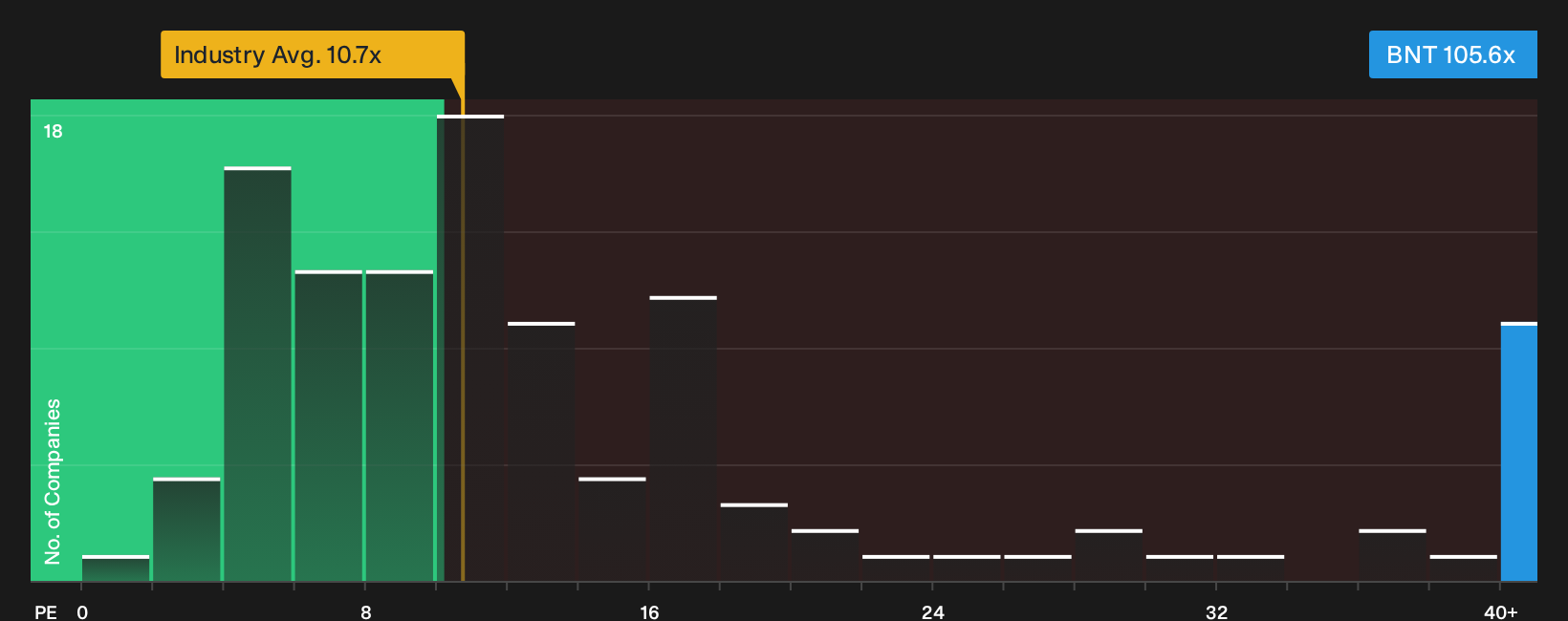
Brookfield Wealth Solutions sits in the middle of this higher-yield theme, with a US$9.4b annuity book and pension risk transfer business whose economics often depend on the spread between long-term assets and long-term guarantees. With very low profitability and a rich P/E multiple, a single shift in how those spreads evolve could have a significant impact on future margins.
Those fragile spreads are exactly why the analysis report for Brookfield Wealth Solutions could be worth your time if you suspect current pricing masks where Brookfield Wealth Solutions goes next.
MetLife (MET)
Overview: MetLife is a large global insurer and retirement provider that uses long-term investments to back life, annuity and employee benefit promises.
Operations: MetLife generates most of its revenue in the U.S., with about US$27.1b from Group Benefits and US$21.5b from Retirement and Income Solutions, plus sizable Asia and Latin America contributions.
Market Cap: US$60.0b
MetLife sits near the center of this higher long-term yield theme, since its life and retirement franchises lean heavily on long-duration bonds and spread income to support the guarantees that employers and retirees care about.
"Ongoing investment in technology and AI, including more than US$3.2b of spend over five years and visible automation in underwriting, claims and RFP processing, points to further unit cost efficiency that can support net margins and earnings quality."
What happens to MetLife's earnings power if a single key assumption about the balance between spread income and funding costs shifts meaningfully?
That kind of shift is exactly what the full narrative for MetLife unpacks, showing where MetLife's spread engine could be accelerating, stalling, or quietly masking risk.

Seeking Alternatives Before Momentum Flies
Fresh ideas move first, and the strongest breakout stories often get caught by fast money before most investors even look. Scan these under-the-radar lists while it matters and consider your options now.
- Track cash-generating miners before gold momentum goes mainstream by scanning a curated pool of 36 elite gold producer stocks positioned for sustained production strength.
- Spot potential compounding machines by filtering through a hand-picked 7 dividend fortresses offering high yields that aim to keep paying even when sentiment drops.
- Review a focused set of 40 power grid technology and infrastructure stocks aligned with grid upgrades, electrification spending and long-haul transmission projects to stay informed on infrastructure-related opportunities.
This article by Simply Wall St is general in nature. We provide commentary based on historical data and analyst forecasts only using an unbiased methodology and our articles are not intended to be financial advice. It does not constitute a recommendation to buy or sell any stock, and does not take account of your objectives, or your financial situation. We aim to bring you long-term focused analysis driven by fundamental data. Note that our analysis may not factor in the latest price-sensitive company announcements or qualitative material. Simply Wall St has no position in any stocks mentioned.
Have feedback on this article? Concerned about the content? Get in touch with us directly. Alternatively, email editorial-team@simplywallst.com