


3 Consumer Staples Stocks Investors Are Watching After The Weak US Jobs Report
With job growth undershooting forecasts and unemployment nudging up to 4.2%, the market is quietly rewriting the script on what kind of stocks feel comfortable when paychecks look less secure and wage pressure cools. That shift can alter where money flows and where it quietly exits. This article walks through three U.S. consumer staples and discount retailer stocks exposed to that weaker labor data and explains why each could matter for your portfolio decisions.
The stocks covered next are only a small sample of the idea, and the full screen pulled out 27 more U.S. consumer staples and discount retailers with everyday spending exposure and equally compelling narratives that are not included below. To explore this theme in more detail, head to the U.S. Consumer Staples and Discount Retailers screener to identify, filter and analyze potential high conviction opportunities across the full list.
Conagra Brands (CAG)
Conagra Brands is a pure-play on at-home eating, with a portfolio of packaged foods that fits the consumer staples theme when households look to stretch grocery budgets without giving up familiar brands.
Conagra Brands sells branded packaged foods across grocery, frozen, international and foodservice channels, with well known labels like Birds Eye and Healthy Choice, and currently carries a market value of about US$6.3b.
"Project Catalyst, which applies new process and technology including AI to simplify work and reduce working capital, is being funded today with most financial benefits expected from fiscal 2028 onward."
The evolution of Conagra Brands' margin profile will depend in part on how one less visible cost pressure ultimately plays out.
That quiet cost tension is exactly what the full narrative for Conagra Brands unpacks, highlighting where efficiencies could accelerate, where pricing power might stall, and what that mix could mean for returns.
Kroger (KR)
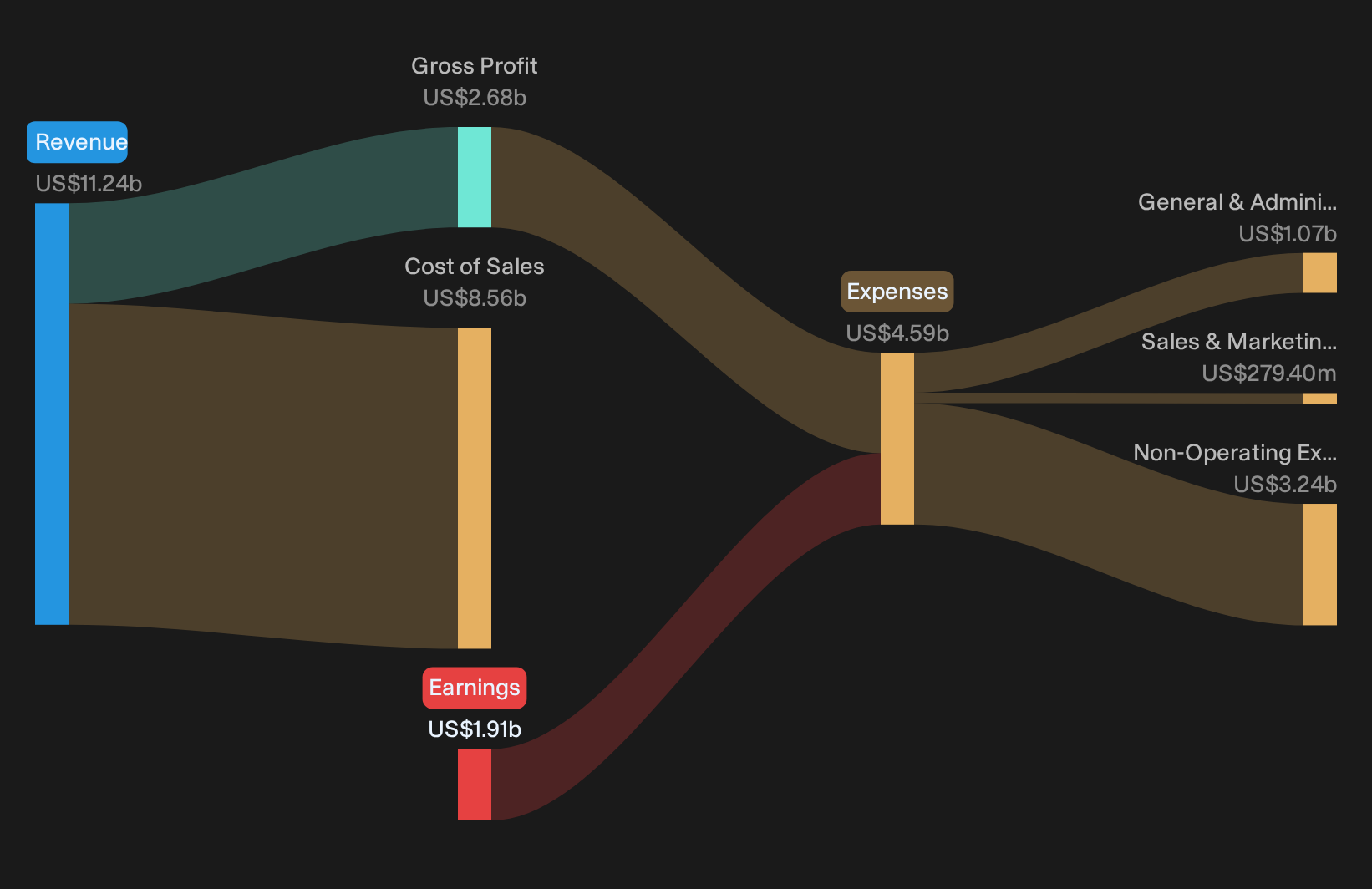
Kroger gives this screener direct exposure to U.S. households prioritizing grocery and pharmacy essentials, with all US$149.3b of Retail Operations revenue generated domestically and backed by a market value of about US$35.1b.
For investors focused on everyday spending and trade down behavior, Kroger is a pure play on where paychecks often go first, with its grocery, pharmacy and private label offerings tying closely to how households react when budgets feel tighter and value matters more.
"The rapid growth in Kroger's e-commerce business, highlighted by a 15% YoY increase and strong improvements in delivery, suggests significant upside potential as more consumers shift to online grocery shopping; ongoing investment in unified digital platforms and fulfillment operations is expected to drive future revenue growth and accelerate profit improvement as the business scales."
What happens to Kroger’s margins if one less visible cost pressure moves differently to what management and analysts are currently banking on.
If that cost curve bends differently, the full narrative for Kroger shows how Kroger’s scaling digital push could still accelerate value creation while flagging where margins might quietly stall.

Albertsons Companies (ACI)
Albertsons Companies plugs directly into the screener’s focus on everyday spending, with large supermarket and pharmacy chains that lean into value when household budgets tighten.
Albertsons Companies runs grocery and drug stores across familiar banners like Safeway and Jewel-Osco, generating about US$82.4b from Retail operations and US$838.7m from Unallocated Other, all in the United States, and carries a market cap of roughly US$5.7b.
For a softer labor market where shoppers hunt for sharper deals on food, fuel and prescriptions, Albertsons Companies offers scale in staples, a growing digital presence and a footprint that already captures value-focused households across many local banners.
"Accelerating growth in digital channels, including a 25% surge in e-commerce sales and a robust loyalty program, is described as positioning Albertsons to respond to rising consumer demand for convenience and online grocery ordering, which the cited source suggests could support higher future revenue and customer retention."
What could matter most from here is how a single pressure on profitability resolves if shoppers trade down faster than one cost line can flex.
If that trade down risk is on your mind, the full narrative for Albertsons Companies explains how Albertsons Companies' digital growth, loyalty economics and margin pressure could be decoupling beneath the surface.

Seeking Alternatives Before Others Catch On
Fresh ideas move first. Slow reactions get caught holding the laggards while early money rides the breakout and momentum. Scan what is still under the radar for now and act now.
- Target resilient cash generators with strong balance sheets by reviewing the curated list of solid balance sheet and fundamentals (26 results) before the crowd starts chasing quality again.
- Consider structural tailwinds in nuclear infrastructure as 19 nuclear energy infrastructure stocks highlights businesses positioned for long-cycle demand while prices may still be dropping or overlooked.
- Track automation-related developments and productivity themes using the hand picked 90 robotics and automation stocks while the theme is still building and may be receiving limited broader market attention.
This article by Simply Wall St is general in nature. We provide commentary based on historical data and analyst forecasts only using an unbiased methodology and our articles are not intended to be financial advice. It does not constitute a recommendation to buy or sell any stock, and does not take account of your objectives, or your financial situation. We aim to bring you long-term focused analysis driven by fundamental data. Note that our analysis may not factor in the latest price-sensitive company announcements or qualitative material. Simply Wall St has no position in any stocks mentioned.
Have feedback on this article? Concerned about the content? Get in touch with us directly. Alternatively, email editorial-team@simplywallst.com