


Tesla Just Lined Up $30 Billion in Credit: What It Means for AI, Capex, and the Investment Case
Key Points
Tesla secured $30 billion in credit from major banks.
While the company may not even use a dollar of the facility, the agreement implies Tesla may well need to borrow to fund its growing capital expenditure plans.
Tesla (NASDAQ: TSLA) recently entered into credit agreements that provide it with $30 billion in credit from Citibank and Wells Fargo. It's a significant move that helps de-risk the company's capital spending plans. Still, it also raises questions about exactly what Tesla has planned and how it fits into the narrative of a business that is supposed to be on the cusp of a long-term stream of recurring income from its robotaxi rollout. Here's my take on matters.
Tesla arranges for $30 billion credit
There are actually three separate credit agreements.
Missed AI’s "Act 1"? Act 2 Could Be 15x Bigger. Most investors think they missed the AI boat because they didn't buy Nvidia in 2005. But according to our analysts, we’re only at the end of "Act 1"—the R&D phase. "Act 2" is the global rollout. Continue »
First, a $20 billion "senior unsecured three-year delayed draw term loan facility" dated Sept. 29, 2026 (the closing date), with Citibank as the administrative agent. Tesla may draw on the facility up to 10 times within 18 months after the closing date. However, the loan facility is automatically reduced to $10 million one year after the closing date, and to $5 million 15 months after the closing date.
Given the relatively small window to access the full $20 billion and the filing's statement that "Tesla does not currently plan to draw on the facilities in 2026," this suggests Tesla is considering a potentially large capital commitment in 2027.
Second, there is an $8 billion senior unsecured five-year revolving facility with Wells Fargo dated Sept. 29, 2026. Any loans taken are repayable on Sept. 29, 2031, but Tesla can request two one-year extensions.
Third, there is a $2 billion senior unsecured 364-day revolving credit facility with Wells Fargo. In common with the revolving facility above, it's dated Sept. 29, 2026, but it's payable on Sept. 28, 2027. Tesla has an option to extend the maturity for one year after this date. The two revolving credit facilities are highly unlikely to be earmarked for known expenditures. You can think of a revolving credit facility as a kind of credit card that allows you to draw on it during periods of weak cash flow.
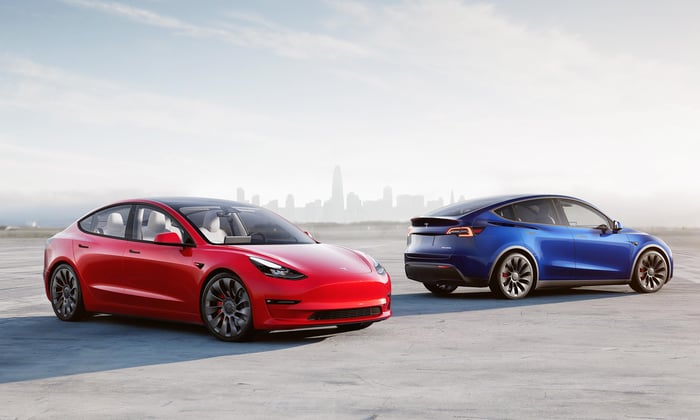
Image source: Tesla.
Why Tesla may need to borrow money
At this point, it's important to note what Tesla said about the agreements in the Securities and Exchange Commission (SEC) filing. Aside from noting no intent to draw on the facilities in 2026, management was non-committal on what it might use the facility for, saying it "may be used for general corporate purposes or for any other purpose not otherwise prohibited by the applicable Credit Agreement."
As such, and focusing on the $20 billion loan facility, it's not accurate to conclude that Tesla has committed to up to an additional $20 billion in spending in 2027 or 2028. However, it's fair to say that the loan facility is structured such that management could be expecting a major outlay next year
As for the combined $10 billion in revolving credit facilities, it's best thought of as a form of insurance to ensure liquidity during periods of weaker cash flow.
Image source: The Motley Fool.
What it means for investors
As previously noted, Tesla is now free-cash-flow-negative, and even though it has ample cash reserves, two things have happened over the last year or so:
- Expectations for capital spending on AI compute, Terafab (the joint venture with Space Exploration Technologies to manufacture chips), and Optimus have been pulled forward.
- Expectations for earnings and cash flow from robotaxis, notably from the dedicated robotaxi Cybercab, have been pushed back, as has revenue from rides.
Moreover, the $30 billion in credit is another indication that Tesla, while still having a strong balance sheet, is no longer the fortress-balance-sheet type of company where investors never question funding requirements. It also raises risks for the company: If capital spending remains high and further delays in the robotaxi/Cybercab rollout occur, Tesla could draw on credit facilities. The bottom line is Tesla needs to deliver on the robotaxi rollout in 2027, and investors should look out for management's commentary on the issue on the next earnings call.
Wells Fargo is an advertising partner of Motley Fool Money. Citigroup is an advertising partner of Motley Fool Money. Lee Samaha has no position in any of the stocks mentioned. The Motley Fool has positions in and recommends Tesla. The Motley Fool has a disclosure policy.