


Google’s Free AI Video Tool Could Guzzle So Much Storage It’s Staggering. Wall Street Isn’t Pricing Micron for It Yet.
Google just made AI video creation free for everyone. On September 23, it opened Google Vids to anyone with a Google account. Powered by its new Gemini Omni 1.1 Flash model, it now offers 1080p HD clip generation to all its users, though still not at a mass consumer scale. As more people try it, the amount of video being made could climb quickly. A 10-minute HD video can take around 1GB, far more than a typical photo. And people rarely keep the first result. Many regenerate a clip several times before they’re happy with it. While the Google tool doesn't yet generate videos of this length, this is where video making could end up, driving tremendous demand for storage.
Most investors will link this to storage names like Western Digital. I think Micron deserves just as much attention, if not more. Every video, including each redo, runs on AI chips that rely on high-bandwidth memory, a type of DRAM that Micron makes. The servers also need regular DRAM, where Micron’s margins have at times topped HBM. And once a video is finished, it needs storing too. Micron’s data center SSD revenue topped $5 billion last quarter, more than doubling from the quarter before. So Micron plays a role in AI video from the first draft to the final file, and stands to benefit at every stage.
Micron Can’t Make Enough Memory
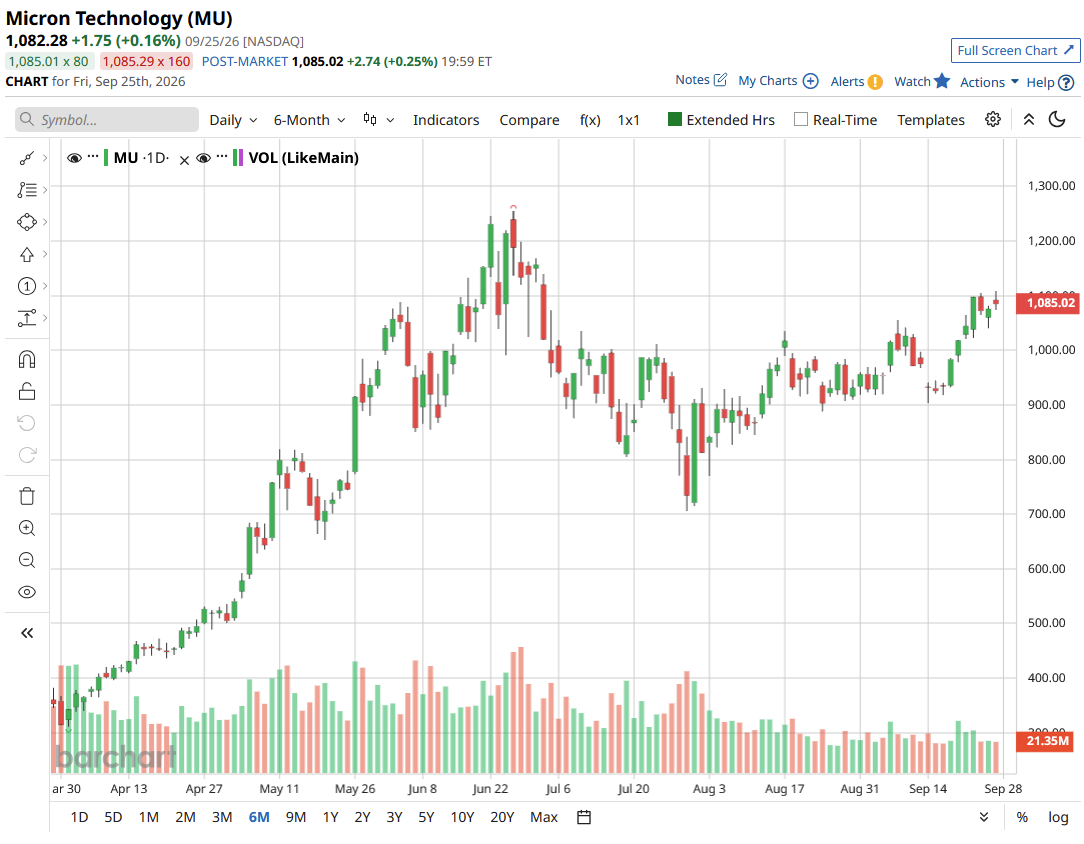
This comes at a time when supply is already tight. CEO Sanjay Mehrotra said Micron can meet only half to two-thirds of customer demand in the medium term. I covered in May how the DRAM shortage was expected to extend into 2028. Rivals can’t easily pick up the slack either, since demand is outpacing supply across the industry. So extra demand from AI video is more likely to lift memory prices. When I covered the stock recently, I took a bullish stance on Micron ahead of its September 30 report. The stock was trading around $927, well below its 52-week high, and I believed it would go up from there in the short term. It has since climbed about 17% to above $1,080. So with some of the upside already played out, the focus now shifts even more to management’s demand outlook for 2027. Any sign that consumer AI tools like this are adding to that demand would be a plus.
About Micron Technology Inc. Stock
Micron Technology makes memory and storage chips used in everything from phones and PCs to AI data centers. Its high-bandwidth memory and data center SSDs have become key parts of the AI buildout. Founded in 1978, the company is headquartered in Boise, Idaho, and is led by CEO Sanjay Mehrotra.
Over the past 12 months, Micron’s stock has skyrocketed 589%, far outpacing the iShares Semiconductor ETF’s 110% gain during the same period. The rally has been driven by soaring AI demand for memory, which has left supply tight and pushed prices higher.
Micron’s valuation looks reasonable despite trading at a rich premium on sales. The forward GAAP P/E of 15.03x has no meaningful 5-year average, since Micron’s loss in fiscal 2023 distorts the history. The forward Price-to-sales ratio of 9.53x sits about 130% above its 5-year average of 4.14x, a steep increase from its historical norms. The EPS outlook explains why. Analysts expect earnings to jump 787% in fiscal 2026 and 116% in fiscal 2027. Growth then slows to 13% in 2028 before falling 32% in 2029, suggesting analysts expect the memory cycle to cool by then. The balance sheet is a clear strength. Micron holds $26.02 billion in cash against just $6.38 billion in debt. For investors, the key question is how long tight supply lasts, and new demand like AI video could help extend it.
Micron Raises Capex as HBM Stays Booked Through 2027
Micron Technology Inc. reported its third-quarter fiscal 2026 earnings on June 24. The company’s quarterly results beat Wall Street consensus on both profit and revenue. It reported revenue of $41.46 billion, well above the forecast of $35.69 billion. Data center revenue was $25 billion, while enterprise SSD revenue was $5 billion. The adjusted earnings per share came in at $25.11, comfortably beating the Wall Street consensus of $20.49.
Micron is set to announce fourth-quarter fiscal 2026 earnings on September 30. It expects free cash flow to keep improving in the fourth quarter, with free cash flow projected to exceed $30 billion. The company also raised fiscal 2026 capital spending to about $27 billion. On the product side, Micron said HBM3E and HBM4 are fully booked through calendar 2027, with demand stretching into 2028. JPMorgan analyst Harlan Sur asked whether Micron had already secured HBM volumes and pricing for 2027. Executive VP Sumit Sadana said demand remains well above supply, not only in 2027 but also in 2028. He added that the same is true for non-HBM DRAM.
What Do Analysts Expect for Micron Stock?
Citi analyst Atif Malik raised his price target from $1,150 to $1,300 and kept a Buy rating. He expects Micron to beat fiscal Q4 estimates, helped by stronger-than-expected DRAM pricing. On the same day, Wells Fargo analyst Aaron Rakers reduced his price target from $1,525 to $1,400, while also keeping a Buy rating.
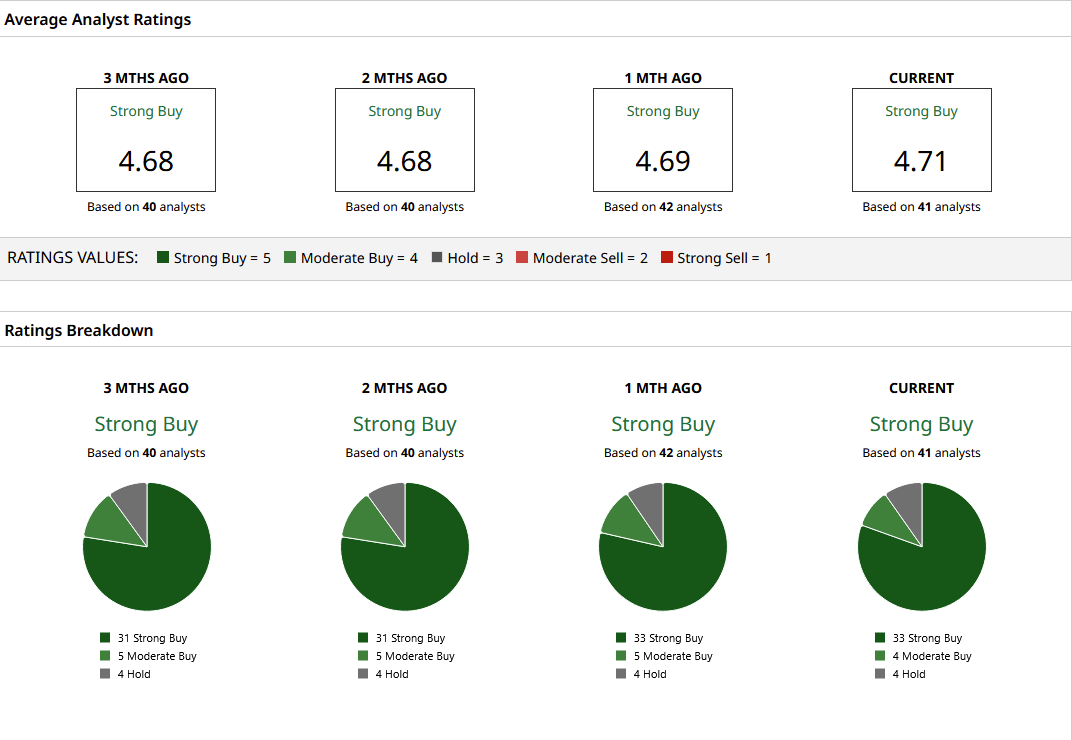
Despite how far the stock has run this year, analysts still remain largely bullish on the firm. Based on the 42 Wall Street analysts covering the stock, Micron holds a Strong Buy rating. Its mean price target of $1,476.64 indicates a further 37% upside from the current share price.
On the date of publication, Jabran Kundi did not have (either directly or indirectly) positions in any of the securities mentioned in this article. All information and data in this article is solely for informational purposes. For more information please view the Barchart Disclosure Policy here.