


What Changed For Jack In The Box When The Story Stopped Covering The Numbers?
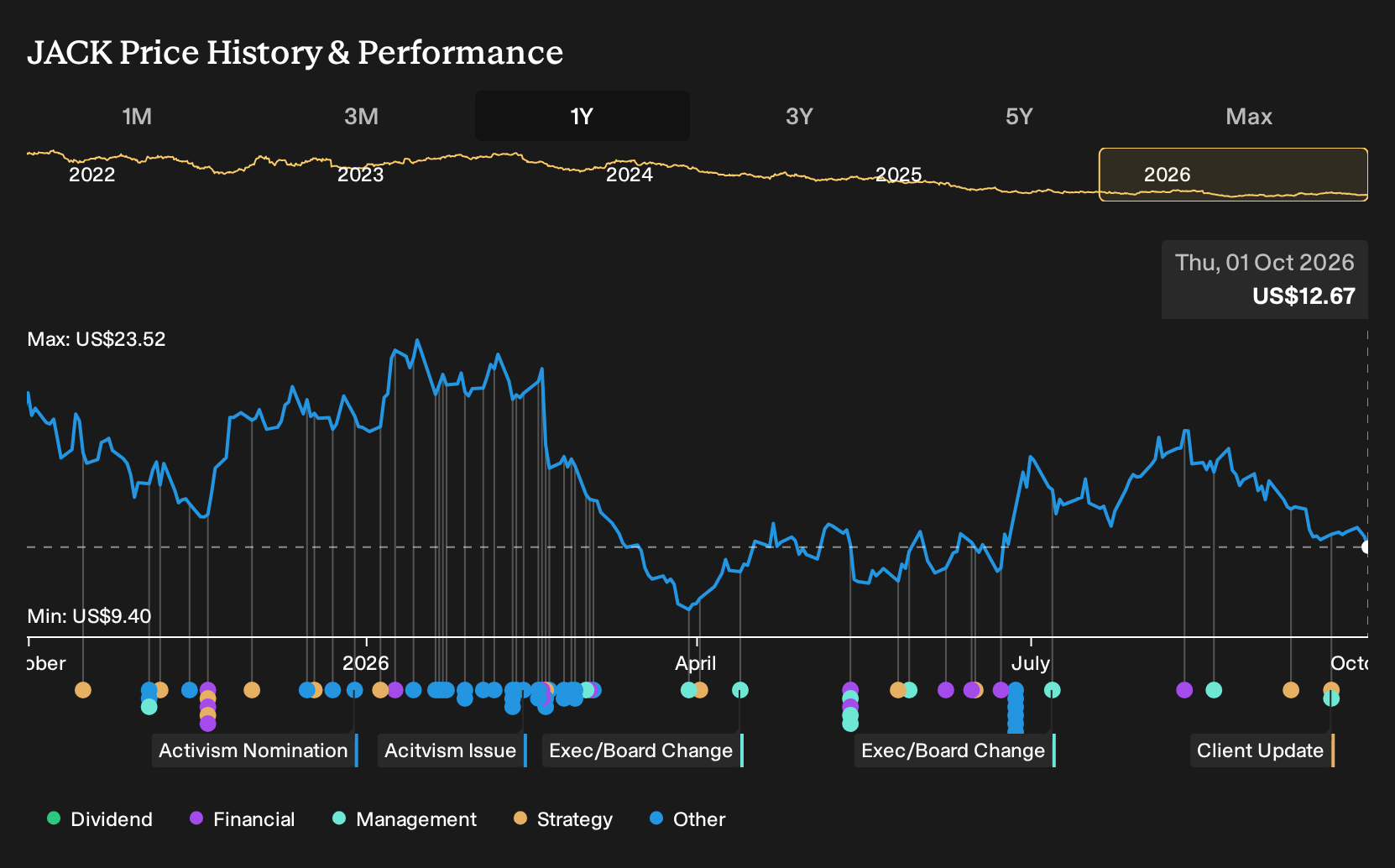
A 45% spike in Jack in the Box shares on the back of a short squeeze and a US$500 million debt refinancing grabbed headlines, with bears still heavily short and management planning to shut 150 to 200 weaker locations by 2026. For Jack in the Box shareholders, the loss over the past year was 35.3%, including dividends. If you had bought a year ago on the urban expansion story, how much did that later refinancing really matter?
Jack in the Box has already moved. See which of 28 high quality undervalued stocks still trade below our estimates.
The Two Stories Jack in the Box Investors Were Really Pricing In
The shares cost US$20.75 at the start of the period, and anyone looking at Jack in the Box then had two very different stories to weigh up.
The bullish view argued that new Chicago and Durham locations plus modernization of more than 1,000 restaurants would pay off, pointing to a Fair Value of US$23.06. This was a notional price if revenue grew 0.4% and profit margins reached 6.9% on a 5.9x future P/E.
The bearish side focused on rising labor expenses and pressure on demand, using a Fair Value of US$16. This estimate rested on revenue declining 2.0% a year even as profit margins were assumed to reach 12.2% on a 2.5x future P/E.
What The Latest Results Said About The Jack in the Box Thesis
The clearest new fact for Jack in the Box investors was operational. Management refinanced US$500 million of debt, pushing maturities to 2029 and giving the bullish case more breathing room on balance sheet risk. Quarterly numbers pulled the other way. Revenue slipped from US$262.401 million to US$257.657 million, net income fell, and net margin eased from 8.7% to 8.2%, which supported the cautious view on profitability pressure. The evidence cut both ways.
The key lesson is about which claim to test first. When a story leans on financial flexibility, you track refinancing and maturity dates. When the pitch leans on better unit economics, you go straight to revenue, absolute profit, and net margin in each filing to see if that improvement is actually showing up.
What Jack in the Box’s Lower Price Is Asking You To Believe
Jack in the Box trades at US$12.67 today after a 35.3% loss over the past year, while the selected Narrative’s Fair Value sits above the current price.
The Narrative leans on digital ordering, urban expansion, and franchise repair to argue that the brand can support stronger unit economics. For that higher figure to be reached, a buyer today would need to assume Chicago style outperformance extends to newer urban markets.
"Analyst consensus expects strong revenue growth from new market openings, but current performance in Chicago shows outperformance above legacy expansion markets and suggests a higher ceiling for new market ramp, indicating long-term upside to system sales growth as urban infill accelerates and brand relevancy rises with urban, multicultural populations."
One Narrative disagrees with today's price. → See where this Narrative says Jack in the Box should trade
Where Jack in the Box Leads Next
Jack in the Box leans on digital ordering and new markets to reshape its restaurants. That focus points to a nearby question for you.
If value menus and app orders matter for this chain, they matter even more in a far larger fast food network.
Another global player is pushing a single digital and loyalty platform that keeps customers returning and raises ordering frequency.
Its emphasis on everyday value deals and bundled meals aims to hold lower income guests, even when budgets stay tight.
As that operator remodels restaurants and refines systems, the role of scale, data and value menus starts to look different again.
It is written up in full, assumptions and all. → Explore the Narrative that puts this company 34% above its price
This article by Simply Wall St is general in nature. We provide commentary based on historical data and analyst forecasts only using an unbiased methodology and our articles are not intended to be financial advice. It does not constitute a recommendation to buy or sell any stock, and does not take account of your objectives, or your financial situation. We aim to bring you long-term focused analysis driven by fundamental data. Note that our analysis may not factor in the latest price-sensitive company announcements or qualitative material. Simply Wall St has no position in any stocks mentioned.
Have feedback on this article? Concerned about the content? Get in touch with us directly. Alternatively, email editorial-team@simplywallst.com