


New Fraud Tools Could Be Material For Equifax Stock (EFX)
- Equifax recently introduced two Signal Score products for email and devices to help banks, e-commerce platforms and telecom operators assess digital fraud risk in real time, and launched Healthcare Report Credential ID to automate license and identity checks for medical professionals.
- The twin focus on fraud intelligence and healthcare credentialing shows Equifax leaning harder into high value, data rich workflows, where its proprietary identity records can reduce manual checks, sharpen risk detection and potentially deepen integration into customer decision systems.
- We will now look at how these new fraud scoring tools could reshape Equifax’s investment narrative around data driven verification revenue.
Equifax Investment Narrative Recap
To own Equifax, you need to be comfortable with a data heavy model that leans on verification, fraud analytics and cloud delivery to support margins over time. The current story revolves around turning assets like The Work Number, government contracts and mortgage scores into steadier income while managing a high debt load and ongoing legal and regulatory scrutiny.
The fresh fraud and healthcare launches speak directly to that thesis but do not change the near term swing factors on their own. Execution on government verification, where revenue recently declined 4% year on year, and future outcomes on litigation and mortgage policy debates still look like the main near term drivers and pressure points.
The Signal Score for Email and Signal Score for Device rollout is the clearest operational link to near term catalysts. These tools plug straight into existing fraud stacks through APIs and aim to use Equifax non public identity data at the very start of a transaction. That direction fits with the wider push to use the completed cloud migration and EFX.AI platform to ship more multi data products faster.
For you as a shareholder, the question is whether Equifax can turn this kind of fraud scoring into higher margin verification revenue that offsets softer areas such as recent Government Verification weakness. Consistent adoption would support the story of expanding recurring analytics income and productivity gains. However, any issues with product performance, integration or privacy could add to the legal and regulatory risk already present in the narrative.
Equifax's current analyst narrative points to revenues of US$8.3b and earnings of US$1.3b by 2029, based on an assumed 8.8% yearly revenue growth rate. That outlook implies that earnings today of US$691.4m would need to rise by about US$608.6m to reach the US$1.3b consensus forecast for 2029.
Uncover why Equifax's fair value indicates a 54% potential upside to its current price that could narrow quickly.
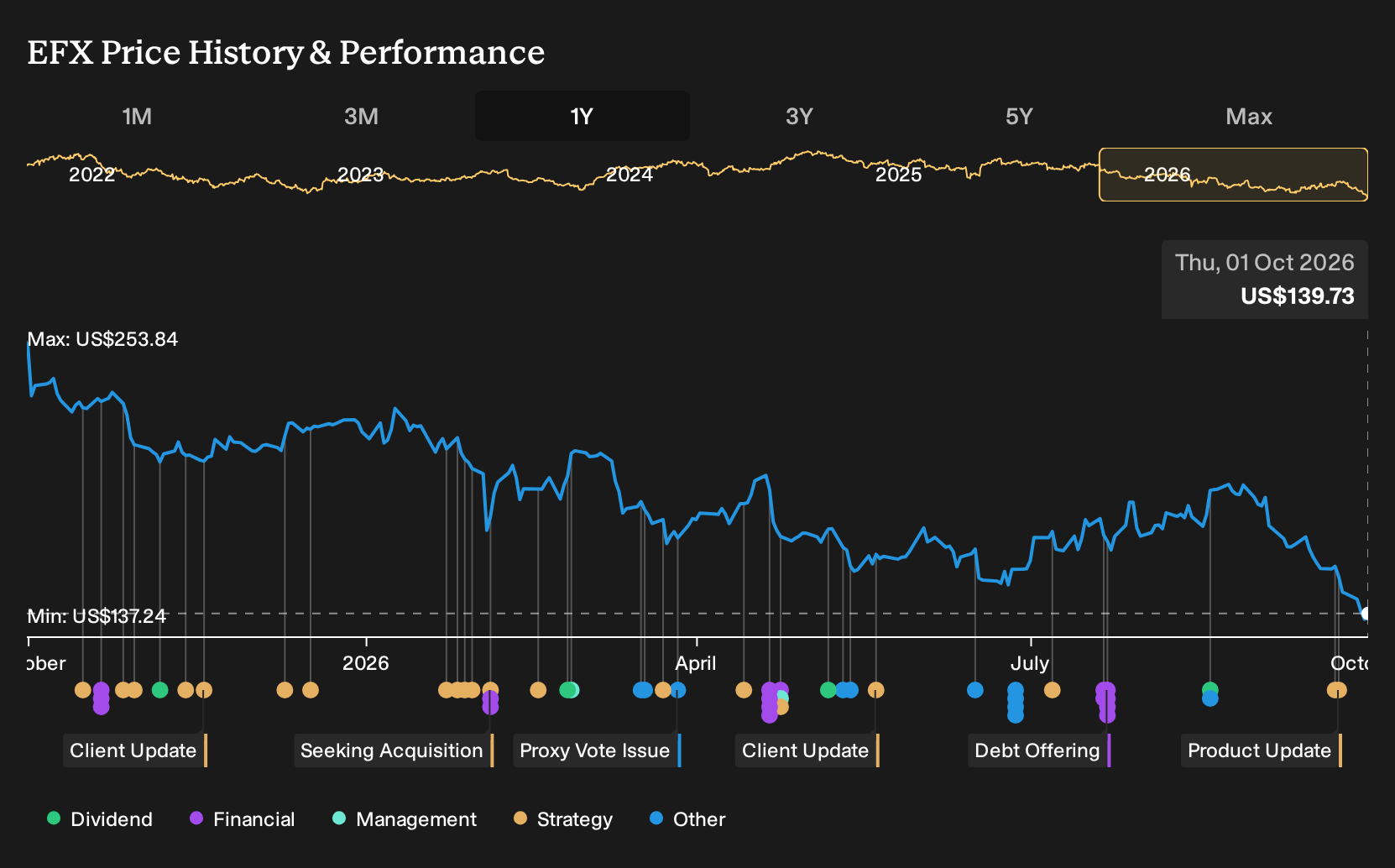
Exploring Other Perspectives
Two fair value views from the Simply Wall St Community span roughly US$215 to US$433, which already shows how far opinions on Equifax can stretch. You are weighing those community models against live issues around litigation, mortgage policy debates and government verification softness. The outcomes of these factors could materially influence how Equifax’s fraud and credentialing launches contribute to future earnings power. Explore the full spread of viewpoints before leaning on any single narrative.
Explore another Equifax fair value estimate, including one that suggests it could be worth just $214.95!
Form Your Own Verdict
Don't just follow the ticker. Dig into the data and build a conviction that's truly your own.
- A great starting point for your Equifax research is our analysis highlighting 4 key rewards and 1 important warning sign that could impact your investment decision.
- See our latest analysis for Equifax. The report includes a comprehensive fundamental analysis summarized in a single visual, the Snowflake, making it easy to evaluate Equifax's overall financial health at a glance.
Looking For More Investment Ideas Beyond Equifax?
If the Equifax story has you thinking about portfolio balance, you can use that same mindset to scout other opportunities with the Simply Wall St Screener. Comparing a few different types of companies may help you judge whether Equifax fits better as a core holding or a supporting role in your overall mix.
- For investors who want income to do more of the heavy lifting, you can scan for higher yield candidates by checking out 7 dividend fortresses.
- If capital preservation and steadier fundamentals sit higher on your priority list, you can filter for stocks with stronger financial footing through the list of solid balance sheet and fundamentals (25 results).
- To hunt for potential mispricings that may not be widely followed yet, you can cast a wider net using the 19 high quality undiscovered gems.
This article by Simply Wall St is general in nature. We provide commentary based on historical data and analyst forecasts only using an unbiased methodology and our articles are not intended to be financial advice. It does not constitute a recommendation to buy or sell any stock, and does not take account of your objectives, or your financial situation. We aim to bring you long-term focused analysis driven by fundamental data. Note that our analysis may not factor in the latest price-sensitive company announcements or qualitative material. Simply Wall St has no position in any stocks mentioned.
Have feedback on this article? Concerned about the content? Get in touch with us directly. Alternatively, email editorial-team@simplywallst.com