


Cummins (CMI) Could Be 40% Below Fair Value After EquipmentShare Deal
Why the new EquipmentShare agreement matters for Cummins
Cummins (CMI) just secured a multi-year fleet agreement with EquipmentShare that targets up to 1 gigawatt of natural gas power generation capacity for major US energy projects.
The partnership turns EquipmentShare into a rental and distribution channel for Cummins power systems, including the C1400N6C gas generator, and ties the manufacturer more closely to temporary power and energy storage needs on mission-critical infrastructure sites.
Recent trading has been choppy for Cummins, with the share price down 6.2% over the past month and 21.9% over the last quarter. At the same time, the 1-year total shareholder return of 21.3% and very large 3-year and 5-year total shareholder returns signal that longer term momentum remains intact. The market is now reassessing how much to pay for that track record in light of new deals like the EquipmentShare partnership.
Scan beyond Cummins and this EquipmentShare deal by reviewing 39 power grid technology and infrastructure stocks that could also benefit from long-duration infrastructure and grid upgrade spending.
Cummins shares have slipped in the short term, yet still trade well below both analyst targets and some intrinsic value estimates. Is that discount justified, or has the price moved further than the fundamentals suggest?
Preferred P/E of 26.2x for Cummins: Is it justified?
On simple valuation markers, Cummins looks cheaper than some benchmarks yet richer than others. The stock trades on a P/E of 26.2x, which sits below both an estimated fair P/E of 34.8x and a peer average of 28.7x, while still coming in above the broader US Machinery industry at 23.7x.
The P/E ratio compares the current share price with earnings per share and effectively shows how many dollars investors are paying for each dollar of profit. For an industrial group like Cummins, which earns most of its $34.7b in annual revenue from engines, components, distribution, and power systems, that yardstick is a quick way to see how the market prices its current earnings power relative to other machinery stocks.
Several factors feed into why the market might be comfortable with a P/E at this level. Earnings have grown at 7.3% per year over the past 5 years, and forecasts point to profit growth of 18.4% per year, which is slightly ahead of the 17.5% per year expected for the US market. Return on equity of 20.3% is described as high, and earnings are assessed as high quality, which can support a richer multiple when investors compare Cummins with slower growing or less profitable industrial peers. At the same time, revenue is forecast to grow 8% per year, slower than both the wider US market at 13.6% and a 20% high-growth threshold, which may keep a lid on how far that P/E stretches.
Compared with its direct Machinery sector, Cummins trades at a premium, since its 26.2x P/E is above the 23.7x industry average. Relative to peers selected for preferred multiple comparisons, the story reverses, as the same 26.2x sits below a 28.7x peer average and below the estimated fair P/E of 34.8x that the fair ratio work suggests the stock could move towards. That combination describes a business that the market prices as more valuable than the typical Machinery stock, yet still short of where regression based fair value modelling indicates it might trade if sentiment or fundamentals lined up with that benchmark.
Explore the SWS fair ratio for Cummins.
Result: Price-to-earnings of 26.2x (UNDERVALUED)
Still, Cummins faces real pressure if EquipmentShare underuses the agreed capacity, or if broader US Machinery valuations compress and drag high P/E stocks lower.
Find out about the key risks to this Cummins narrative.
Another view on Cummins using our DCF model
The earlier P/E work presents Cummins as undervalued. A second lens tells a similar story. Our DCF model estimates a future cash flow value of $721.97 a share, while the stock trades at $517. That gap suggests potential upside but also raises a simple question: Is the market rightly cautious, or late to adjust?
Look into how the SWS DCF model arrives at its fair value.
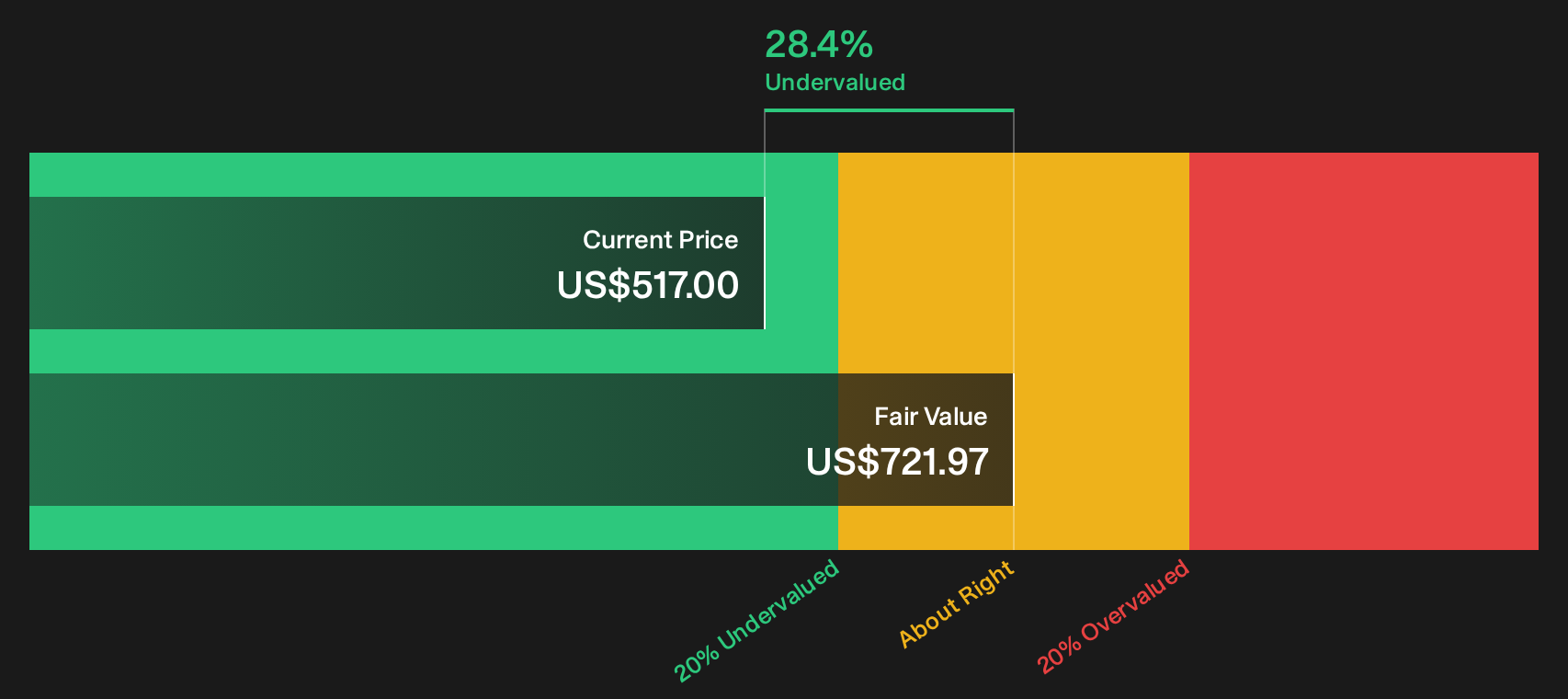
Simply Wall St performs a discounted cash flow (DCF) on every stock in the world every day (check out Cummins for example). We show the entire calculation in full. You can track the result in your watchlist or portfolio and be alerted when this changes, or use our stock screener to discover 28 high quality undervalued stocks. If you save a screener we even alert you when new companies match - so you never miss a potential opportunity.
Next Steps
If this mix of signals around Cummins feels complicated, that is the point. It is why checking the underlying numbers yourself matters. Take a few minutes to review the 4 key rewards
Looking for more Cummins investment ideas?
If Cummins has your attention, do not stop here. Fresh opportunities often show up where fewer people are looking, and the right tools help you spot them earlier.
- Target potential mispricing by scanning a broader universe of 28 high quality undervalued stocks that pair stronger fundamentals with more modest expectations.
- Prioritize resilience by reviewing a list of solid balance sheet and fundamentals (25 results) so you can focus on businesses with sturdier financial footing.
- Get ahead of the crowd by checking a 19 high quality undiscovered gems that may not yet be widely followed but already show strong underlying metrics.
This article by Simply Wall St is general in nature. We provide commentary based on historical data and analyst forecasts only using an unbiased methodology and our articles are not intended to be financial advice. It does not constitute a recommendation to buy or sell any stock, and does not take account of your objectives, or your financial situation. We aim to bring you long-term focused analysis driven by fundamental data. Note that our analysis may not factor in the latest price-sensitive company announcements or qualitative material. Simply Wall St has no position in any stocks mentioned.
Have feedback on this article? Concerned about the content? Get in touch with us directly. Alternatively, email editorial-team@simplywallst.com