


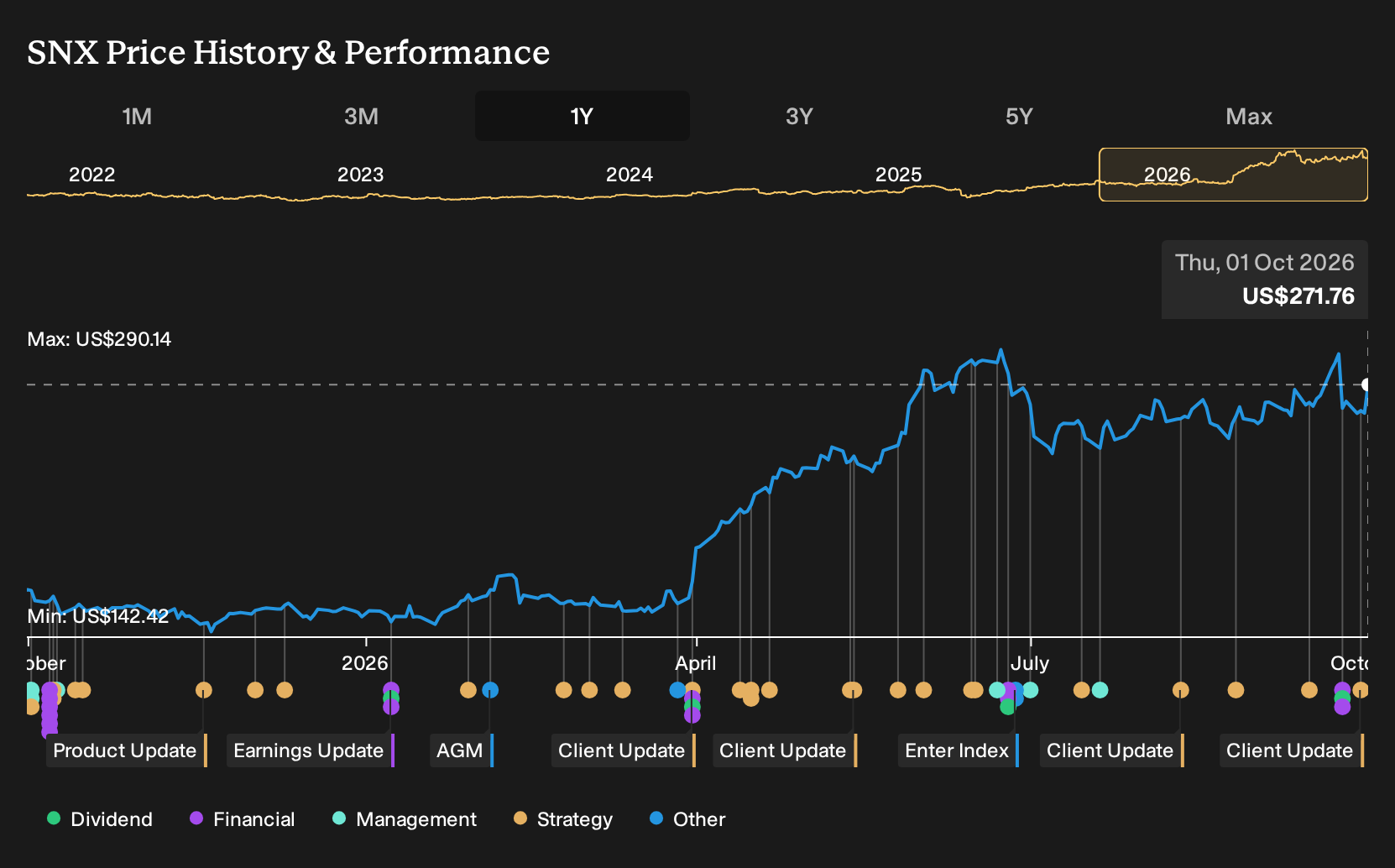
Why TD SYNNEX (SNX) Is Up 5.8% And What's Next
- TD SYNNEX reported third quarter 2026 sales of US$21,558.41 million and net income of US$416.24 million, alongside new earnings guidance, a US$0.48 quarterly dividend, and ongoing share repurchases.
- CyberFOX disclosed a fresh distribution deal that adds its privileged access, password, DNS and SASE offerings to TD SYNNEX's North American security portfolio, expanding what partners can source from a single aggregator.
- We will now look at how TD SYNNEX's earnings profile and the new CyberFOX agreement could influence the existing investment narrative.
Scan how TD SYNNEX fits into the wider security and infrastructure story by comparing it with a curated list of 90 AI infrastructure stocks shaping the next wave of cyber defense and data workloads.
TD SYNNEX Investment Narrative Recap
To own TD SYNNEX, you need to believe its role as an IT distributor and solutions aggregator keeps benefiting from ongoing cloud, cybersecurity and AI adoption, even as hardware distribution faces pressure. The main near term swing factor is execution on higher value software, security and services, which could either support margins or leave the business exposed to volume and pricing strain.
The latest quarter, with US$21.56b of sales and US$416.24m of net income, suggests the operating engine is holding up, but it does not erase risks like customer concentration, demand pulled forward in prior periods and debt that is not well covered by operating cash flow. Those remain key watchpoints.
The CyberFOX distribution agreement looks most relevant because it plugs directly into TD SYNNEX's security and infrastructure story. Privileged access tools, password management, DNS filtering and SASE are exactly the controls many customers are prioritising as they modernise networks and move away from legacy VPNs toward Zero Trust style access.
For catalysts, this deal broadens what partners can source from a single aggregator and supports the shift toward software and recurring style offerings. It also sits alongside the new fourth quarter guidance, which gives investors a clearer near term yardstick to judge execution on revenue mix, margin resilience and any easing or worsening of previously flagged demand pull forward.
TD SYNNEX's current analyst storyline points to US$90.7b in revenue and US$1.6b in earnings by 2029, based on a projected 9.1% yearly revenue growth rate and an earnings increase of about US$0.5b from US$1.1b today.
Uncover why TD SYNNEX's fair value indicates a 23% potential upside to its current price. This represents a discount that could close sooner than many expect.
Exploring Other Perspectives
Another angle on TD SYNNEX focuses on the risk that AI data center demand cools. The most cautious analysts were only modelling about US$87.2b of revenue and US$1.6b of earnings by 2029, using a lower P/E of 18.1x. Those views pre date the CyberFOX deal, so expectations could shift as this agreement beds in.
Explore 2 other TD SYNNEX fair value estimates, including one that suggests it could be worth just $333.55!
Form Your Own Verdict
Don't just follow the ticker. Dig into the data and build a conviction that's truly your own.
- A great starting point for your TD SYNNEX research is our analysis highlighting 5 key rewards and 1 important warning sign that could impact your investment decision.
- See our latest analysis for TD SYNNEX. The report includes a comprehensive fundamental analysis summarized in a single visual, the Snowflake, making it easy to evaluate TD SYNNEX's overall financial health at a glance.
Looking for more investment ideas beyond TD SYNNEX?
Once you have a handle on TD SYNNEX and its role in security and infrastructure, it can help to widen the lens and compare it with other businesses that share similar qualities or offer different risk and return profiles.
- If you want potential bargains with strong fundamentals, scan a 28 high quality undervalued stocks that pair quality metrics with pricing that still looks conservative.
- For investors who care most about resilience, review a 31 resilient stocks with low risk scores that screens for balance sheet strength and lower historical risk scores.
- If stability and income are your focus, zero in on a 7 dividend fortresses that combines higher yields with a focus on more robust underlying cash flows.
This article by Simply Wall St is general in nature. We provide commentary based on historical data and analyst forecasts only using an unbiased methodology and our articles are not intended to be financial advice. It does not constitute a recommendation to buy or sell any stock, and does not take account of your objectives, or your financial situation. We aim to bring you long-term focused analysis driven by fundamental data. Note that our analysis may not factor in the latest price-sensitive company announcements or qualitative material. Simply Wall St has no position in any stocks mentioned.
Have feedback on this article? Concerned about the content? Get in touch with us directly. Alternatively, email editorial-team@simplywallst.com