


Nio's Riskiest Asset Is Valued at $2.4 Billion, But Its Potential Just Skyrocketed
Key Points
Geely will soon own a 30% stake in NIO Power, Nio's subsidiary that runs its battery swap network.
Nio will buy a 10% stake in Haohan Energy, Geely's charging business.
This is a huge step in widening Nio's battery swap ecosystem and one step closer to becoming the battery swap standard in China.
Nio's (NYSE: NIO) battery swap network has always been intriguing and a bit controversial to investors. If people see value in the speed of swapping batteries and using battery-as-a-service, a built-out network would be a huge competitive advantage and would unlock a higher-margin business. However, if they find it just as fast and simple to charge vehicles at a fast-charging network, Nio's battery swapping stations could turn into a big waste of time, effort, and, of course, capital.
All that said, the game just completely changed with the announcement that Geely is "buying" into Nio's battery swap network. Here are the details, and what investors have to know.
Missed AI’s "Act 1"? Act 2 Could Be 15x Bigger. Most investors think they missed the AI boat because they didn't buy Nvidia in 2005. But according to our analysts, we’re only at the end of "Act 1"—the R&D phase. "Act 2" is the global rollout. Continue »
The fine print
Nio recently announced that a Geely Holding subsidiary, assuming regulatory approval, will soon hold a 30% stake in NIO Power, Nio's subsidiary that runs its battery swapping network. While the deal values NIO Power at roughly $2.4 billion, Geely is mostly avoiding cash outflows. Instead, it's contributing its own commercial battery swap business (Yiyi Internet Technology) and about $94 million for the 30% stake in NIO Power. In a second transaction, Nio is purchasing a 10% stake in Haohan Energy, which is Geely's charging business.
This development does a couple of positive things for Nio and its investors.
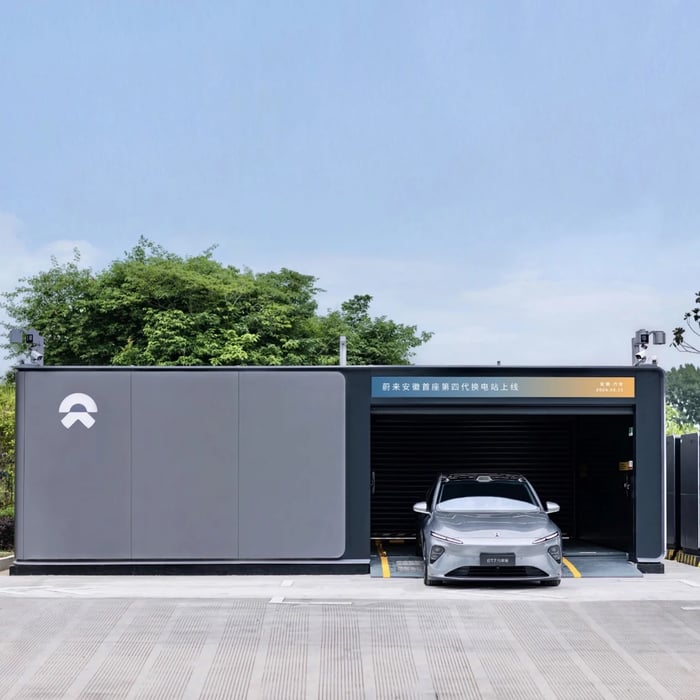
Image source: Nio.
First, adding a massive automaker such as Geely to Nio's battery swap network accelerates its path to profitability. Simply put, Nio doesn't have the volume of vehicles on the road needing battery swaps to use swap stations to a breakeven level. It's been estimated that each station needs to average about 60 battery swaps a day to break even. While utilization rates appear to be improving, Nio doesn't consistently disclose the information.
Second, Nio purchasing a 10% stake in Geely's Haohan Energy immediately opens access to Geely's ultra-fast megawatt charging technology, without Nio needing to fork out massive research and development spending to build its own version. Nio and Geely intend to fully connect their charging infrastructure.
Lastly -- and this might be the big takeaway -- this makes vehicles cheaper for Geely customers to purchase upfront, because it can now use Nio's battery-as-a-service model that takes the battery off the invoice. It's also a huge step for Nio to become the "gold standard" for China's battery standards.
Nio is trying to make its battery swap network profitable with a user base pooled from its 1.26 million cumulative vehicle sales. Bringing in a partner such as Geely that can eventually work Nio's battery swap specifications into its vehicles would drastically increase its potential user base and strengthen Nio's ability to lower battery swap station overhead and improve margins.
In fact, if Nio continues getting automakers to buy into its battery standards, allowing non-Nio vehicles to use the charging stations, it could open the door to the more than 370 million vehicles in use in China, per China's Ministry of Public Security and Ministry of Commerce.
The three-way war
Whether Nio's battery swap network turns into a massive competitive advantage -- perhaps even evolving into a higher-margin business that becomes more lucrative than its traditional vehicle sales business over the next two decades -- or whether the network turns into a poorly utilized black hole of profits comes down to which technology and strategy wins. The positions are becoming entrenched among Nio and Geely's unified battery-swapping ecosystem, CATL's independent "Choco-Swap" network, and BYD Co.'s gamble on its ultra-fast megawatt flash-charging stations.
For investors, while this transaction won't load Nio's coffers with cash, or directly split costs of developing its battery swapping network, bringing Geely vehicle owners into the ecosystem unlocks massive potential. It's also much closer to becoming the standard for battery swaps in China. That could one day be a brilliant and lucrative victory.
Daniel Miller has no position in any of the stocks mentioned. The Motley Fool recommends BYD Company. The Motley Fool has a disclosure policy.