


AI Agents Could Drive a 14x Jump in CPU Spending. Rambus May Be the Biggest Hidden Winner.
Rambus (RMBS) may be one of the quieter winners of the shift to AI agents. The company makes the chips that sit on server memory modules, helping CPUs work with memory. And CPUs are becoming more important. In a recent note, Bank of America explained that GPUs do the “thinking” in AI, while CPUs carry out the tasks, like running code and pulling data. BofA expects the server CPU market to grow from about $61 billion this year to roughly $211 billion by 2030. The part tied to AI agents could rise about 14-fold.
Rambus has already noticed the shift. Management said AI agents are pushing server designs toward more CPUs, and the company holds a mid-40% share of its main memory interface chip market. Its next big opportunity is MRDIMM, a faster memory module carrying about four times the interface chip content of today's standard DDR5 modules. Sales should start ramping in 2027 alongside new Intel (INTC) and AMD (AMD) platforms. Rambus has also launched chips for SOCAMM2, a memory format for servers built around LPDDR memory, though sales there are small for now.
The Bull Case Still Works With Smaller Numbers
ARM (ARM) is the main risk. Rambus' MRDIMM ramp is tied to new Intel and AMD servers, so a faster shift to ARM chips could shrink that opportunity. Analyst Ben Bajarin expects ARM to reach about 40% of server CPU units by decade-end, which still leaves x86 with the larger share.
Some bulls believe the MRDIMM market could top $3 billion. Rambus puts it closer to $600 million. I’d stick with the company’s number, and it still looks promising. If Rambus matched its current share, that could mean roughly $250 million a year. With revenue now running above $800 million a year, that would be about a 30% boost.
About Rambus Stock
Rambus develops semiconductor technologies that help move, manage, and secure data in high-performance computing systems. Its products are used in data center, artificial intelligence, cloud computing, automotive, and government applications. Instead of building massive chips like GPUs, Rambus specializes in the digital plumbing. It is the advanced memory interface and security IP required to move data quickly and safely. Founded in 1990, the company is headquartered in San Jose, California.
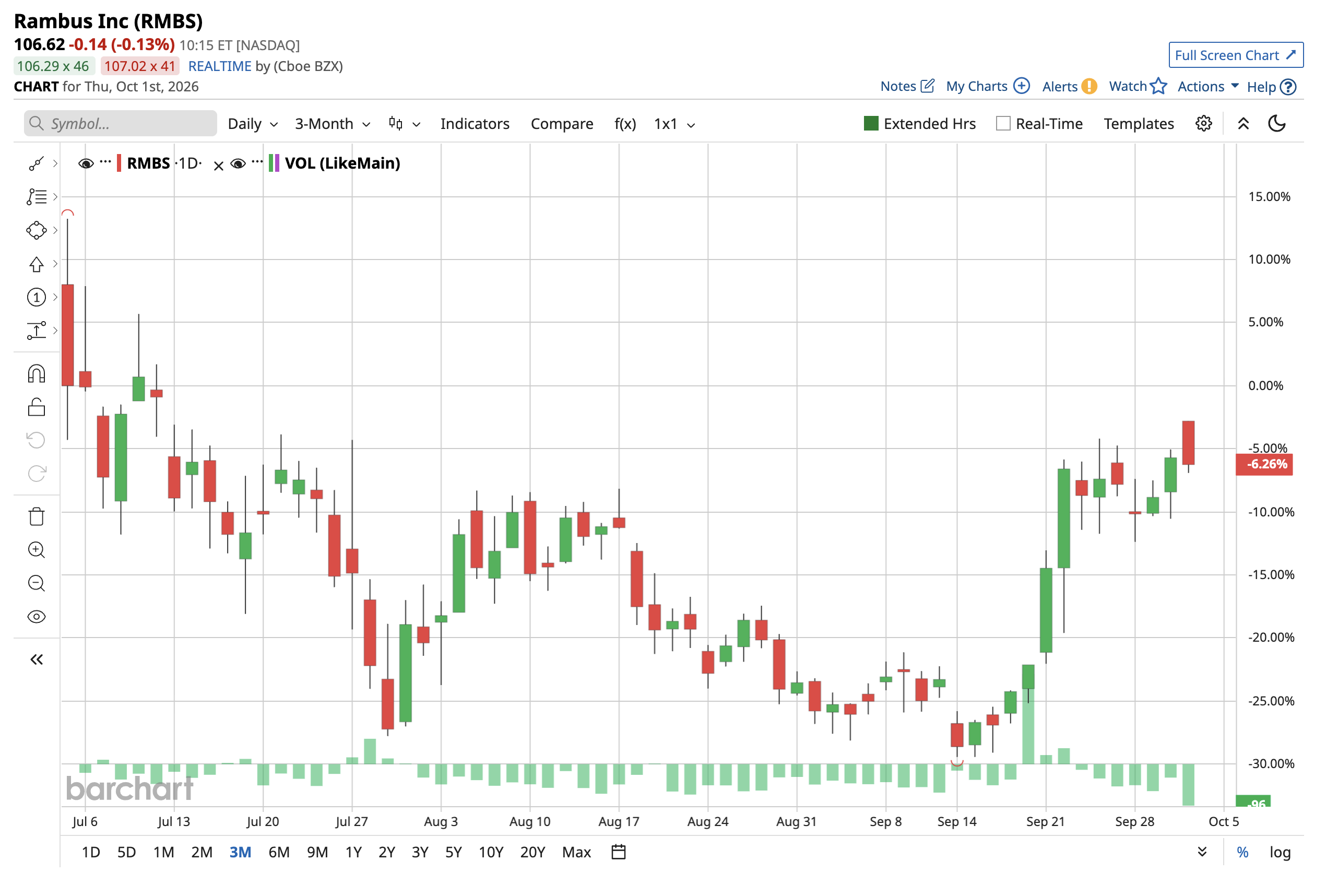
RMBS stock is up 16% year-to-date (YTD) but with high volatility. The stock ranged from about $78 to $174 over the past 52 weeks and remains about 39% below its high. RMBS nearly doubled from late March to late April on AI memory demand and the launch of its SOCAMM2 server memory chipset, then fell about 11% after Q1 earnings despite in-line results. By contrast, the iShares Semiconductor ETF (SOXX) gained about 90% YTD. RMBS, therefore, significantly underperformed its sector.
Rambus Projects Another Quarter of Double-Digit Growth
Rambus reported its second-quarter fiscal 2026 earnings on July 28. The company reported revenue of $207.4 million, with product revenue of $99.2 million, royalties revenue of $84.2 million, and contract revenue of $24 million. The earnings per share came in at $0.77, beating the Wall Street consensus of $0.72. Rambus’s non-GAAP net income for the quarter was $84.4 million.
Looking forward, CFO Sumeet Gagneja guided Q3 revenue to be between $210 million and $216 million. EPS is expected to be between $0.75 and $0.82. Operating expenses are projected to be between $115 million and $119 million, and capital spending should be about $13 million. Management said new products are still ramping through customer qualification but should make up a mid-double-digit percentage of product revenue by the end of the fourth quarter.
What Do Analysts Expect for RMBS Stock?
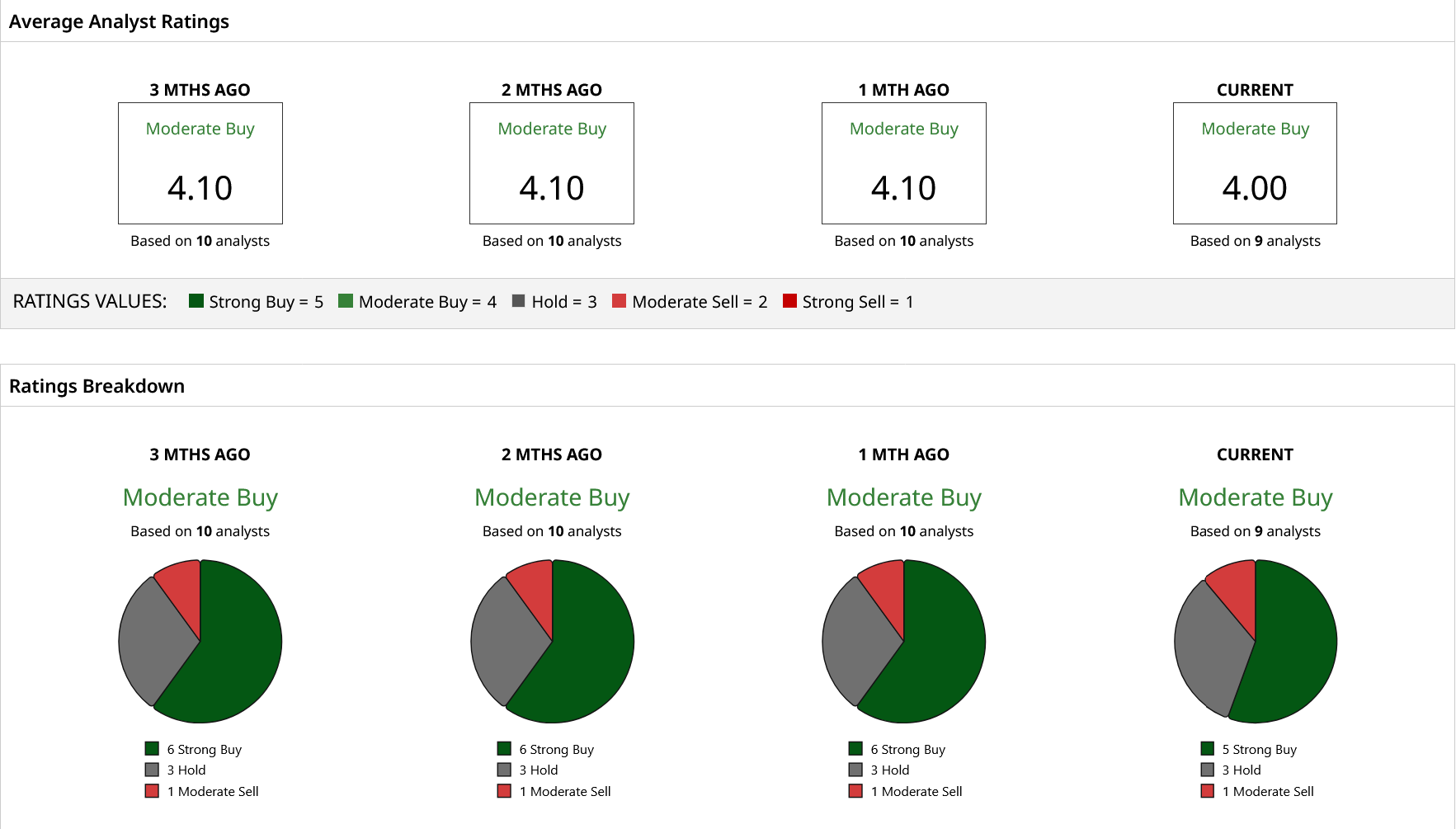
Based on nine Wall Street analysts covering the stock, RMBS holds a consensus “Moderate Buy” rating. Out of those, five have a “Strong Buy” rating, three have a “Hold” rating, and one has a “Moderate Sell” rating. The stock has a mean price target of $142.50, which reflects 32% upside from current levels. The high price target of $165 implies 60% upside from the current share price, while the low price target of $100 sits just below the current levels. This suggests analysts expect RMBS to benefit from AI-related memory demand and DDR5 adoption, but there is disagreement on how much of that growth is already priced into the stock.
On the date of publication, Jabran Kundi did not have (either directly or indirectly) positions in any of the securities mentioned in this article. All information and data in this article is solely for informational purposes. For more information please view the Barchart Disclosure Policy here.