


Why Citi Is Sounding the Alarm on Moderna Stock
Moderna (MRNA) skyrocketed to fame during the pandemic. Its Covid-19 vaccine put the biotech on the map, sent sales soaring, and made the company one of Wall Street’s hottest names. Then the pandemic boom ran out of steam. Vaccine demand cooled, revenues took a hit, and the stock spent years trying to find its footing.
Fast-forward to 2026; the shares have soared roughly sixfold in 2026 alone, fueled by excitement around its personalized cancer vaccine developed with Merck (MRK). The rally accelerated after positive Phase 3 melanoma results, sending MRNA stock sharply higher as investors began pricing in a much bigger oncology opportunity.
But Citi now thinks the market may have run too far, too fast. The bank downgraded MRNA to a “Sell” from a “Neutral,” arguing that its valuation assumes far more success—and sales—from the cancer pipeline than the current evidence supports. The warning sent shares lower.
So, with Moderna’s valuation racing ahead of its fundamentals, why exactly is Citi sounding the alarm on the stock? Let’s understand in detail.
About Moderna Stock
Based in Cambridge, Massachusetts, Moderna was founded in 2010 with an ambitious idea of using mRNA technology to rethink how medicines are developed. What started as a bold scientific bet has grown into a broad platform spanning vaccines and treatments for infectious diseases, cancer, rare diseases, and other conditions. Backed over the years by partners including AstraZeneca (AZN) and the Gates Foundation, the company has built its business around turning mRNA science into practical medicines. Its market capitalization currently stands at more than $81.2 billion.
Covid-19 changed the company’s trajectory completely. Moderna went from a clinical-stage biotech to a global name almost overnight, thanks to its highly successful Covid-19 vaccine. The pandemic boom, however, didn’t last forever. As vaccine demand cooled, the company entered a much tougher chapter, forcing investors to look beyond Covid-19 toward its next wave of growth.
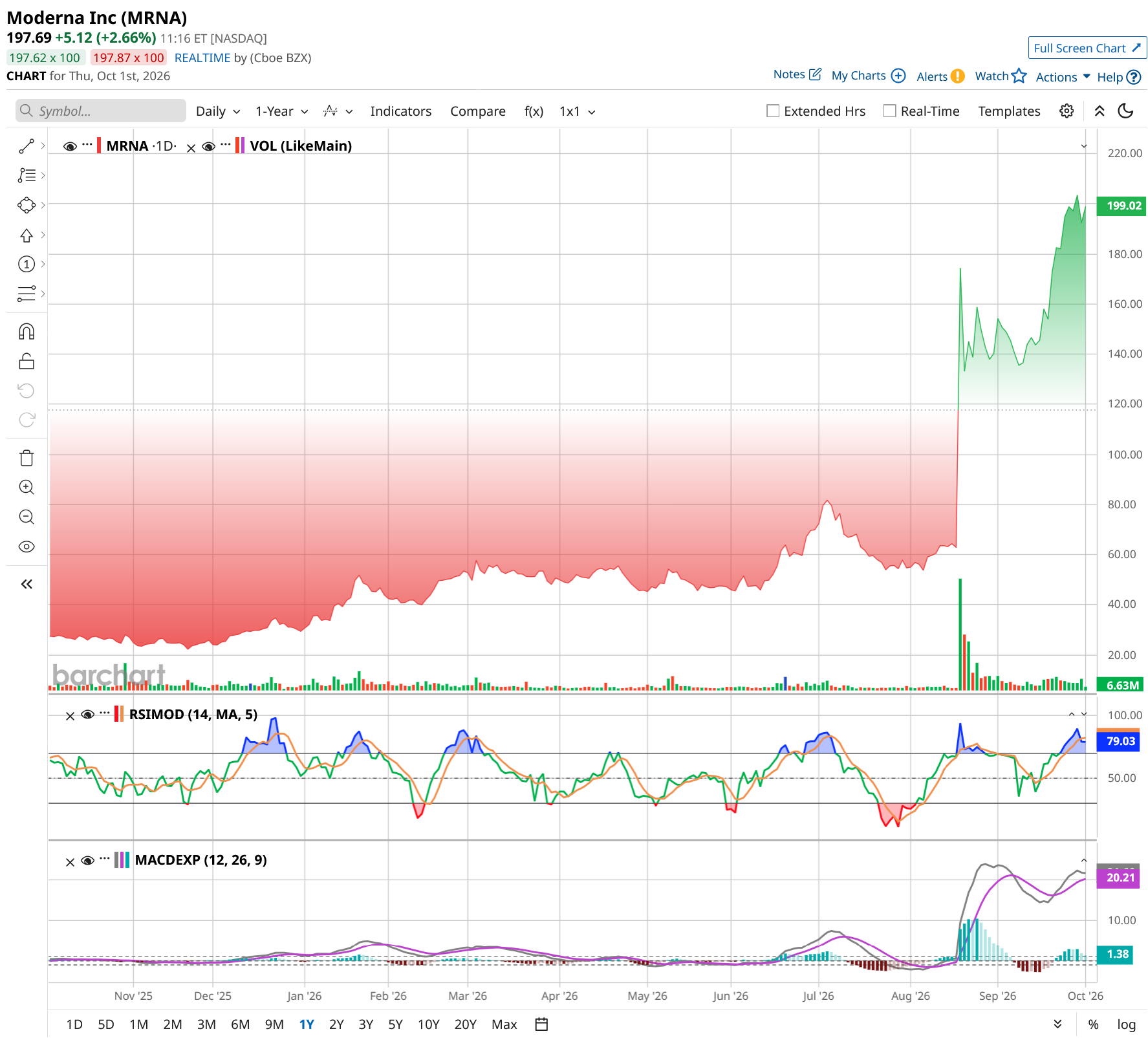
After peaking just shy of $500 in 2021, MRNA stock went into a brutal slide, eventually hitting a low of $22.28 in 2025. Then 2026 arrived, and Moderna pulled off quite the comeback. The shares are up a stunning 573% year-to-date (YTD), hitting a 52-week high of $208.90 on Sept. 29. Over the past 52 weeks, the stock has gained 620%, while it has rocketed 791% from its 52-week low. Zoom out six months, and the gain is nearly 300%, and over three months, it stands at 174%.
Its impressive trajectory began in mid-August. On Aug. 19, shares jumped toward $177 from around $65 after Moderna announced three trials combining its personalized cancer vaccine, intismeran autogene, with Merck’s Keytruda. The combination delivered statistically significant and clinically meaningful improvements in recurrence-free and distant metastasis-free survival for high-risk melanoma patients compared with Keytruda alone. That was enough to get investors excited about a potentially huge oncology opportunity.
But the chart is also flashing a little caution. Trading volumes have picked up, while the 14-day RSI has moved into overbought territory, suggesting the rally could use a breather.
The MACD oscillator is still flashing bullish signals, with the MACD line sitting above the signal line and the histogram remaining positive, suggesting upward momentum is still intact for now.
When it comes to valuation, Moderna’s stock looks pretty stretched. It’s trading at 38.67 times sales, well above both its own five-year average and the broader sector average. Investors are paying a hefty premium for future growth.
A Snapshot of Moderna’s Q2 Earnings Report
Moderna’s second-quarter results, released in July, offered some good news, even as its core vaccine business continued to face pressure. The biotech posted $145 million in revenue in Q2, up 2% year-over-year (YoY) and slightly ahead of Wall Street’s expectations. Its loss also narrowed 7.5% annually to -$1.97 per share, beating analysts’ estimates.
Geographically, the U.S. remained the biggest contributor, accounting for about $87 million, or roughly 60% of total revenue. International markets brought in the remaining $58 million.
The bigger wrinkle was product sales. They fell 17.5% YoY to $94 million, mainly because COVID-19 vaccine sales declined in the U.S. and South America. Moderna generated product revenue from three marketed vaccines: Covid-19 shots Spikevax and mNexspike, along with its RSV vaccine mResvia. The company did not provide a product-by-product sales breakdown, but Covid-19 vaccines still made up most of the total.
On the balance-sheet front, Moderna had $6.9 billion in cash, cash equivalents, and investments as of June 30, giving it a sizable financial cushion as it continues pouring money into its pipeline.
Looking ahead, management stuck with its goal of delivering up to 10% revenue growth from 2025 levels. For 2026, revenue is expected to be split roughly evenly between U.S. and international markets. There is also a seasonal wrinkle—Moderna expects about 55% of its second-half revenue to land in the third quarter, reflecting the usual seasonal demand for respiratory vaccines.
The company also made some modifications to its expense outlook. It lowered its 2026 cost-of-sales forecast to about $1.7 billion from $1.8 billion, including a $900 million one-time litigation settlement charge. R&D spending is now expected to reach about $2.9 billion, while SG&A remains at roughly $1 billion. Capital expenditures are projected at $200 million to $300 million.
By year-end, Moderna expects to have $4.7 billion to $5.2 billion in cash and investments, about $200 million better than its previous outlook. That estimate does not include any additional drawdowns from its remaining $900 million credit facility.
Analysts tracking the biotech company anticipate Moderna’s losses to shrink by 16.1% YoY to around -$6.09 per share in fiscal 2026, and then narrow by another 25.8% annually to -$4.52 per share in fiscal 2027.
What Do Analysts Expect for MRNA Stock?
Citi’s downgrade of MRNA stock is less about questioning the cancer vaccine itself and more about questioning how much success the stock price is already assuming. Analyst Geoff Meacham cut the stock to a “Sell” from a “Neutral” rating, even while raising the price target to $80 from $60. That higher target may sound like a positive change, but with MRNA trading around $193, it still implies roughly 58.5% downside.
MRNA stock has jumped over 200% since the interim results from its Phase 3 INTerpath-001 melanoma trial. The rally reflects growing confidence in intismeran autogene, the personalized cancer vaccine. The trial met its key endpoints, but Citi believes investors have gone a step further and are now pricing in broad success across several other cancers, along with strong commercial execution.
That is where the valuation starts looking stretched to Citi. Moderna’s market value has climbed to over $80 billion, crossing Regeneron’s (REGN), despite much lower expected financial results. Consensus estimates cited by Citi put Moderna’s 2030 revenue at about $5.8 billion and net income at $1.1 billion, below Regeneron’s.
Citi’s pipeline math tells a similar story. Even assigning intismeran a 100% probability of success across its major oncology programs, Meacham’s valuation work supports only about $100 per share. To justify a stock price around $200, Moderna would need roughly $26 billion in annual cancer sales, with about $13 billion accruing to Moderna, nearly seven times Citi’s current forecast.
And there is another wrinkle. The detailed numerical results from INTerpath-001 have not yet been disclosed. Citi wants to see the actual magnitude of the benefit, consistency across patients, safety, and whether an individualized treatment can realistically be manufactured at scale. Meacham also cautions that success in melanoma does not automatically prove the same approach will work across kidney, lung, or bladder cancers.
Citi is not dismissing Moderna’s cancer opportunity—it believes the stock price is already reflecting an overly optimistic outlook for the pipeline.
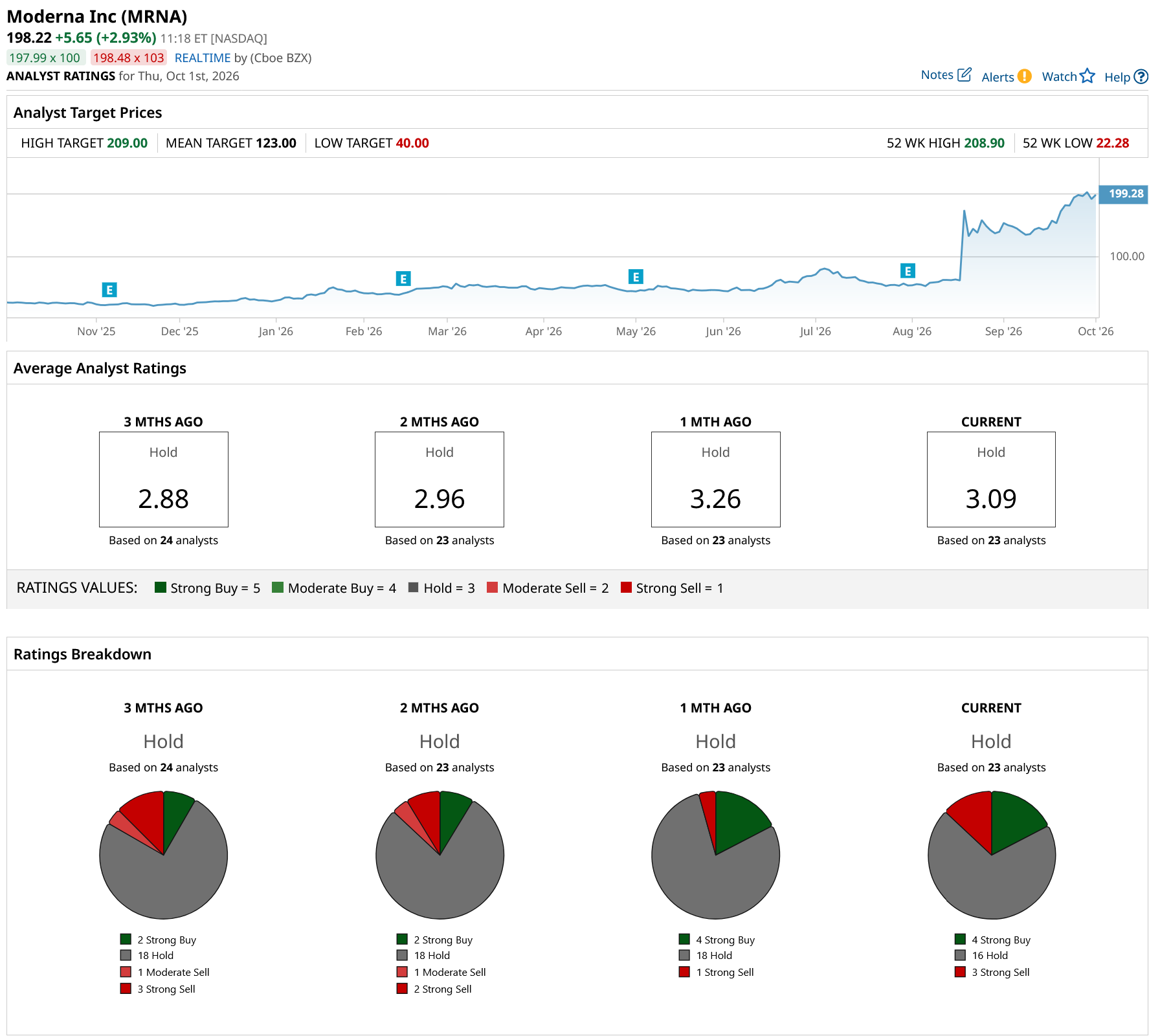
Overall, the Street is staying cautious. Among the 23 analysts covering MRNA stock, the consensus rating is a “Hold.” That’s based on four analysts recommending a “Strong Buy,” 16 advising a “Hold,” and the remaining three suggesting a “Strong Sell.”
MRNA stock is already trading well above the mean price target of $123. The Street-high target of $209 implies the stock could rally as much as 6%.
On the date of publication, Sristi Suman Jayaswal did not have (either directly or indirectly) positions in any of the securities mentioned in this article. All information and data in this article is solely for informational purposes. For more information please view the Barchart Disclosure Policy here.