


The US manufacturing industry has been expanding for nine consecutive months! ISM PMI fell slightly to 54.5 in September, new orders increased, but cost pressure heated up again
The Zhitong Finance App learned that the US manufacturing industry continued to expand in September. Despite a slight slowdown in growth, strong demand and increasing orders continued to support the manufacturing industry. Meanwhile, rising raw material prices and supply chain transportation delays have once again intensified, indicating that the US manufacturing industry is facing a new round of cost pressure during the recovery process.
According to data released by the American Institute for Supply Management (ISM) on Thursday, the ISM Manufacturing Purchasing Managers' Index (PMI) fell 0.1 percentage points to 54.5 in September from August, indicating a slight slowdown in the pace of manufacturing expansion. However, the index has remained above the 50 boom and bust line for nine consecutive months, setting a record for the longest continuous expansion since 2022.
Looking at specific breakdowns, US manufacturing demand remained steady in September. The new orders index rose further, while the uncompleted orders index climbed to the highest level since February this year, indicating that order reserves in the hands of manufacturers continued to increase, providing support for future production activities. Meanwhile, manufacturing activity continued to expand, although the pace of expansion was slower than before.
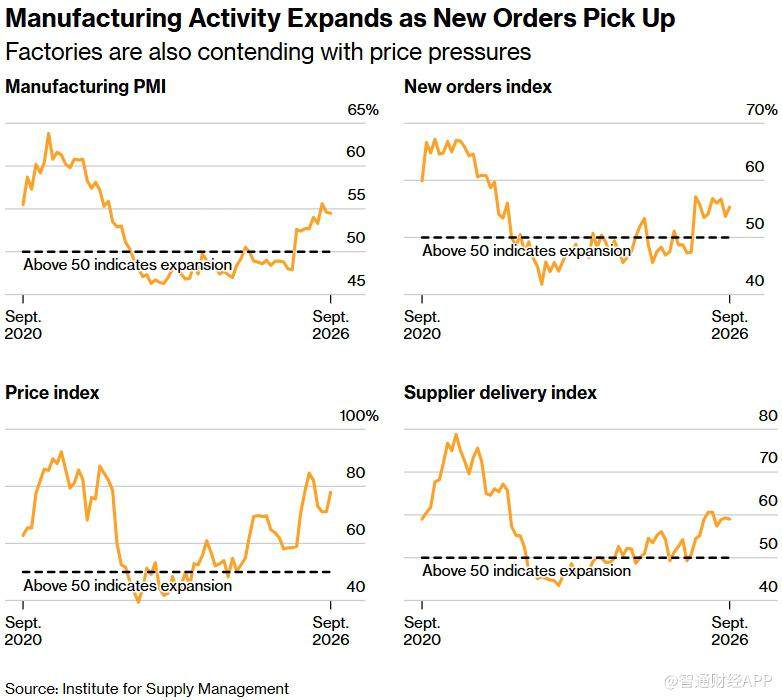
Since the beginning of 2026, the US manufacturing industry emerged from a slump that continued for several years, the overall recovery momentum has remained stable. Resilient consumer spending, steady corporate investment, and government defense spending have jointly boosted the recovery of manufacturing activity.
Although the Middle East conflict has led to rising energy costs and disrupting some shipping routes, at present, rising costs and supply chain bottlenecks have not interrupted the expansion of the manufacturing industry.
As orders continued to rise, US manufacturers also began scaling up recruitment to meet growing production demands. According to the data, the number of people employed in the manufacturing industry increased for the third month in a row in September, setting the longest continuous employment growth record since 2022. This shows that manufacturers are still confident in increasing the workforce, driven by improved demand.
However, at the same time as the manufacturing industry is recovering, cost pressure is building up again.
According to the ISM report, the raw material price index rose to the highest level since May this year in September, reflecting a further increase in investment costs faced by manufacturers. Meanwhile, supplier delivery times continued to be extended, and although the extent of delays was mitigated compared to the previous period, supply chain operations are still limited to some extent.
Rising energy prices are an important source of cost pressure on manufacturing. The ongoing conflict in the Middle East has boosted energy prices and disrupted some international shipping routes, further increasing the burden on enterprises in purchasing raw materials and transporting goods.
This means that while manufacturing demand remains strong, companies need to find a balance between expanding production and controlling costs. If raw materials and transportation costs continue to rise, the future may further affect manufacturers' profit margins and increase the pressure on companies to pass on costs to downstream customers.
Judging from industry performance, the expansion of the US manufacturing industry in September was quite extensive.
According to ISM data, a total of 12 manufacturing industries reported growth in September, including electrical equipment, primary metals, and machinery manufacturing. In contrast, industries such as printing and textile mills are still in a state of contraction, indicating differences in the degree of recovery in different manufacturing sectors.
Overall, the ISM manufacturing PMI declined slightly in September, but it is still in the 54.5 expansion range. The increase in new orders, rising backlog orders, and continued employment growth all indicate that the US manufacturing industry is still resilient.
However, strong demand coexisted with rising costs, and the recovery of the manufacturing industry also showed some inflationary pressure. Against the backdrop of high energy prices and supply chain bottlenecks that have not been completely eliminated, future changes in raw material prices and delivery times will be an important indicator for observing whether the US manufacturing industry can maintain its current expansion momentum.