


Is “Don't Shorten Musk” a Wall Street mantra? As AI and robotics narratives heat up, Tesla (TSLA.US) bears retreat and holding ratings soar
The Zhitong Finance App learned that Tesla (TSLA.US) stock price dropped sharply in 2026, but Wall Street analysts are increasingly reluctant to recommend investors sell the stock.
Compiled data shows that out of 61 analysts' ratings of Tesla, the “sell” rating currently accounts for only 13.1%. This is the lowest share since April 2023, when profit margin concerns dragged down its valuation, and 12.8% of analysts recommended selling the stock. In January of this year, the share of “sell” ratings reached 23.3% of the 2026 high.
The downturn in bearish voices comes as CEO Elon Musk is trying to transform Tesla from an automobile manufacturer to a physical artificial intelligence (AI) giant, shifting the focus from electric cars to autonomous taxis and humanoid robots.
“The market now has a 'don't short Musk' atmosphere,” said Max Gockman, senior vice president of Franklin Templeton Investment Solutions. “It has been proven that even after many extensions, his grand idea can still be implemented. For analysts, taking a neutral view is better than making a wrong judgment.”
Franklin Templeton holds Tesla shares.
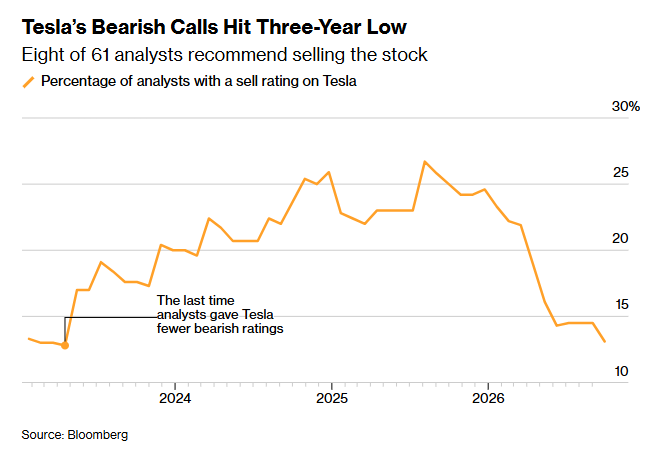
However, a decrease in questioning does not necessarily mean an increase in optimism. Tesla's latest “sell” rating disappeared not because an analyst raised the rating, but because long-time bearish Colin Langan left Wells Fargo. After Langan left his job, the bank suspended coverage of Tesla and 17 other car companies.
Meanwhile, Tesla's “holding” equivalent rating as a percentage of all recommended ratings rose to its highest level in more than two years. Tesla's stock price has fallen 21% this year, while the S&P 500 index has risen 12% over the same period.
Among the big tech giants, Tesla is still a special case. Among the “Big Seven” of US stocks, five companies account for less than 2% of analysts with negative ratings, and only 10.7% of analysts are bearish on Apple (AAPL.US).
Ivan Fiennes of Tigress Financial Partners said analysts covering Tesla “are increasingly aware that the company may have significant option value in autonomous driving, robotics, and AI, which makes it inappropriate to use traditional car company valuation methods. But it also raised the execution threshold: the higher the valuation given to these future businesses, the more Tesla will ultimately need to prove that they can generate significant revenue, profit margins, and returns.”
Tesla's performance in delivering on such a grand vision has fluctuated. Critics have long accused Musk and Tesla of excessive promises and failure to deliver on schedule, while Wall Street has been waiting for autonomous driving technology and Optimus robots to become meaningful sources of profit.
The company's Cybercab debut in recent weeks failed to meet investor expectations and sparked a federal investigation into whether it met safety standards.
Despite this, Musk has achieved his once seemingly unattainable ambition, and his supporters believe he can do it again. Many investors who are optimistic about Musk also want him to merge Tesla with SpaceX (SPCX.US), the rocket, satellite, and artificial intelligence company he is also in charge of.
“The market's attitude towards the overall trend of AI concept stocks is positive, but investors have returned to rationality,” said Dirk Muraki of SLC Management. The company holds Tesla shares through index positions. “They wanted to see evidence of revenue potential and be more sober about valuations.” In contrast, he added, “the stock analyst community as a whole is optimistic.”