


AI Tax Assist Could Be A Game Changer For H&R Block Stock (HRB)
- H&R Block has rolled out GenAI-powered AI Tax Assist in its DIY tax software, reported ongoing double-digit revenue growth at its Wave small-business SaaS platform, and ended the latest period with $978 million in cash and no current debt while hiring ahead of the next tax season.
- The combination of AI-supported filing tools, a growing small-business software arm, and a sizable cash position may help H&R Block build deeper year-round client relationships beyond the traditional peak tax window.
- This article will consider how H&R Block's investment narrative is influenced by AI Tax Assist's role in strengthening its digital tax platform.
Explore the broader tax and AI landscape beyond H&R Block by reviewing a curated set of 37 profitable AI stocks that aren't just burning cash.
H&R Block Investment Narrative Recap
To hold H&R Block, you need to believe the business can keep turning a highly seasonal tax franchise and DIY engine into steadier, year-round economics. The key near term swing factor is how many clients choose its digital and assisted products this coming tax season. Recent hiring and AI Tax Assist integration both point to a push on capacity and client experience rather than a step change in the story.
The biggest current risk remains pressure from low cost online rivals and potential government supported free filing options, especially as Intuit leans harder into cheaper entry points and AI across TurboTax. That backdrop keeps H&R Block’s market share trajectory a central concern. The latest updates do not meaningfully change that risk; they mostly show management trying to compete more effectively with stronger tools and service coverage.
The introduction of AI Tax Assist into H&R Block’s DIY platform is the most relevant update for this context. It aligns the product set more closely with what Intuit is doing with TurboTax and gives existing users more guidance inside the software. That matters for retention and for keeping assisted filers who might otherwise jump to a pure online rival.
Where this touches catalysts is in the mix of clients H&R Block can support and how much work moves into its digital channel without losing those households entirely. AI Tax Assist, combined with hiring across physical offices and the Wave SaaS arm, sets up multiple ways to serve taxpayers and small businesses if execution stays tight. The operational question is whether these tools simply defend share or eventually help reclaim some of the ground conceded to digital first competitors.
H&R Block's current analyst narrative points to revenues of US$4.5b and earnings of US$751.3m by 2029, based on an assumed 4.6% yearly revenue growth rate and an increase of about US$18.7m in earnings from US$732.6m today.
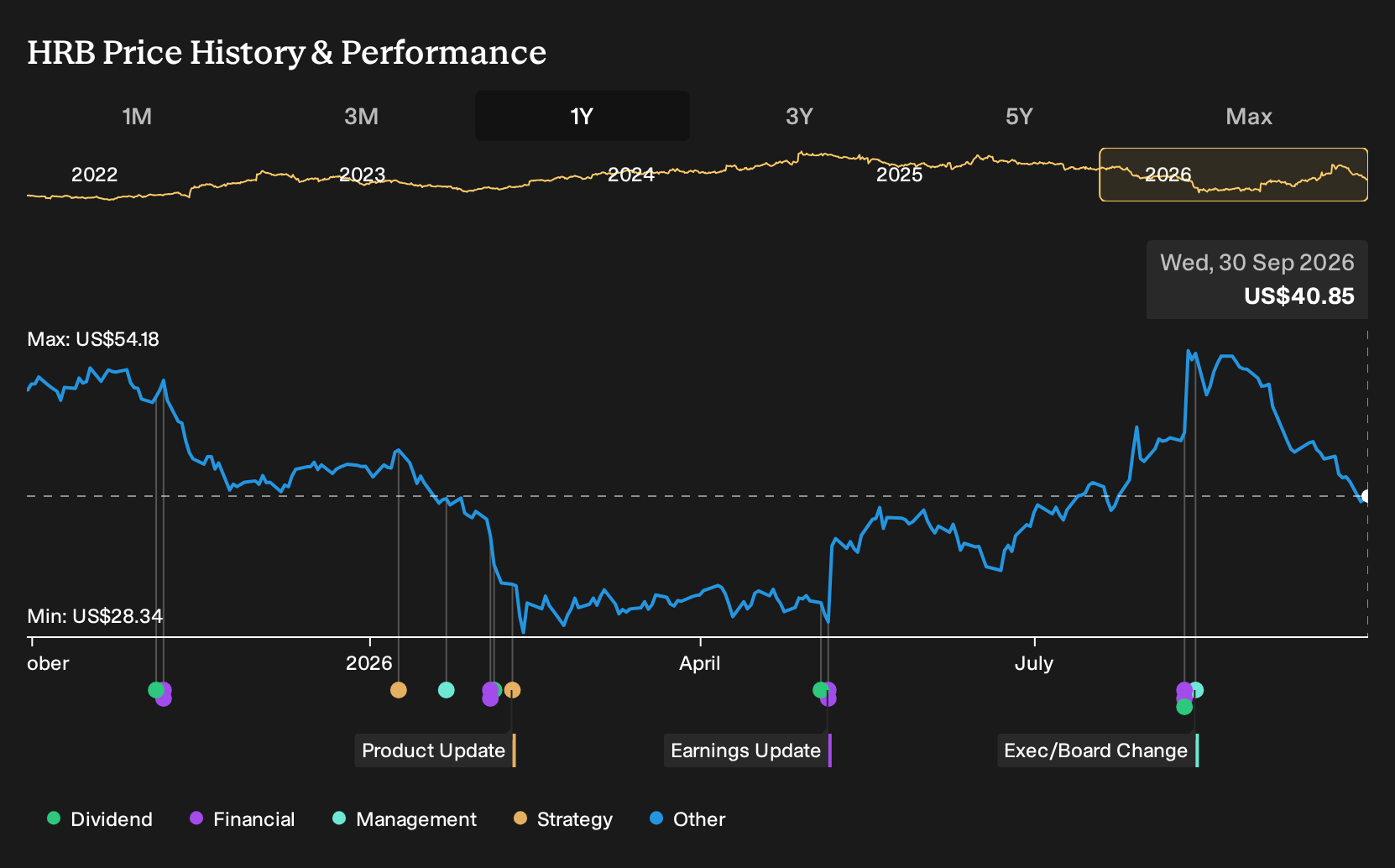
Uncover why H&R Block's fair value indicates a 24% potential upside to its current price that could narrow quickly.
Exploring Other Perspectives
One alternate view for H&R Block focuses less on AI Tax Assist as a boost and more on the risk that automation simply speeds up client migration to cheaper tools, especially as Intuit pushes lower priced TurboTax and QuickBooks options. The most cautious analysts were penciling in US$4.6b of revenue and US$741.6m of earnings by 2029 before this news. That set of assumptions underpins a US$36.0 fair value and reflects a belief that margins could compress faster, which is far more pessimistic than consensus. You can treat this as one possible path and compare it with your own expectations as new information such as the recent AI rollout comes through.
Explore 3 other H&R Block fair value estimates, including one that indicates up to 12% downside from the current price.
Form Your Own Verdict
Don't just follow the ticker; dig into the data and build a conviction that's truly your own.
- A great starting point for your H&R Block research is our analysis highlighting 4 key rewards and 1 important warning sign that could impact your investment decision.
- See our latest analysis for H&R Block. The report includes a comprehensive fundamental analysis summarized in a single visual, the Snowflake, making it easy to evaluate H&R Block's overall financial health at a glance.
Looking for more H&R Block style investment ideas?
If H&R Block has you thinking about where else year-round fundamentals and clear business models might show up, it can help to scan a broader set of companies using structured filters rather than picking tickers at random.
- For investors who want upside potential with tight cash discipline, consider a focused set of 19 high quality undiscovered gems that pair strong fundamentals with limited market attention.
- If you care most about capital preservation and steadier risk profiles, you can narrow in on 31 resilient stocks with low risk scores that score well on resilience and balance sheet strength.
- Income focused portfolios may benefit from a shortlist of 7 dividend fortresses that combine higher yields with underlying business metrics you can track through each reporting cycle.
This article by Simply Wall St is general in nature. We provide commentary based on historical data and analyst forecasts only using an unbiased methodology and our articles are not intended to be financial advice. It does not constitute a recommendation to buy or sell any stock, and does not take account of your objectives, or your financial situation. We aim to bring you long-term focused analysis driven by fundamental data. Note that our analysis may not factor in the latest price-sensitive company announcements or qualitative material. Simply Wall St has no position in any stocks mentioned.
Have feedback on this article? Concerned about the content? Get in touch with us directly. Alternatively, email editorial-team@simplywallst.com