


“Big Short” Bury's protégé warns: South Korea's stock market appears to be a “capitalist paradise,” but it actually conceals a “value trap”
The Zhitong Finance App learned that Phil Clifton, a well-known investor and proud protégé of Michael Berry, the prototype of the movie “The Big Short,” warned that there are hidden pitfalls behind cheap South Korean stocks: most of their value is often out of reach of minority shareholders.
Clifton is the founder of Pomerium Capital Management LLC in Cupertino, California. He met about 20 companies during his August trip to Korea and Japan. In his September 29 letter to investors, he wrote that the trip convinced him that investing in South Korea “requires extra caution and close attention to management incentives.”
Korean stock market: At first glance, “capitalist paradise”, in reality, interests are often misplaced
Clifton wrote in the letter: “At first glance, the Korean stock market is simply a capitalist paradise,” and there are companies with high profit margins and steady growth everywhere. However, he pointed out that interests between shareholders and business operators are often misaligned.
He said that many Korean companies have large valuation discounts compared to their global peers, but this excess value is often difficult for minority shareholders to touch, especially in companies where the founding family retains considerable control.
Clifton was Scion Asset Management's last portfolio manager other than Bury. Bury cancelled the hedge fund in November 2025. According to reports, Barry became famous for shorting the US subprime mortgage market before the 2008 financial crisis, and as a result, he became the prototype for the main character in the movie “The Big Short.” According to reports, Bury recommended Clifton to clients as a talented young investor and a brilliant thinker. Clifton founded Pomerium in January of this year.
Inheritance and gift taxes motivate controlling families to lower stock prices
Clifton blamed the problem on South Korea's inheritance and gift taxes, which in some cases are as high as 60%, and shares in listed companies are also taxed at market value. This gave the holding family an incentive to drive down stock prices by hoarding cash, investing in unrelated businesses, and underpaying or even not paying dividends.
He said, “The shares of such companies are actually perpetual bonds with no interest or principal repayment, and have become a 'value trap'. No matter how good the underlying business is, the stock price stays the same.”
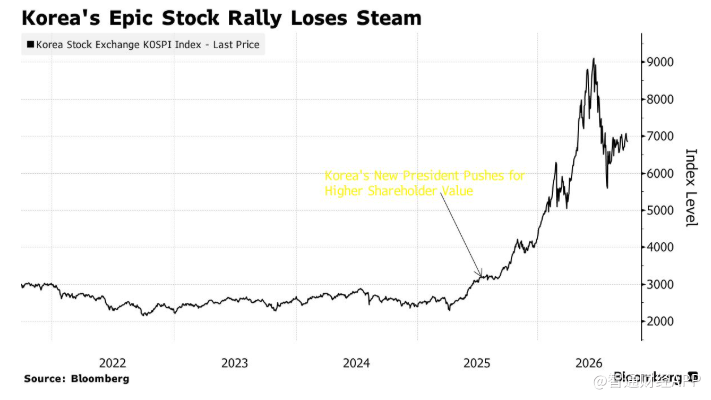
In recent years, South Korea has attracted more and more global investors as the Korean government pushes for corporate governance reforms to enhance shareholder returns, particularly against family-controlled chaebol. Some investors are optimistic that these efforts may drive a revaluation of the Korean stock market. For a long time, the South Korean stock market has been dragged down by so-called “Korean discounts,” and similar reforms have boosted neighboring Japan's stock market.
Driven by this reform, along with South Korea's key position in the global artificial intelligence supply chain, helped the Korea Composite Stock Price Index (KOSPI) rise by more than 100% this year and reach a high point in June. Since then, the gains have gradually subsided as concerns about AI returns heated up.
The Japanese stock market is more popular: discounts have not completely disappeared
The Japanese market made Clifton more optimistic. He said that until recently, the Japanese market was filled with a large number of seriously undervalued companies, but efforts by exchanges and regulators to resolve the issue of discounted valuations have been quite successful.
“Fortunately, Japan's valuation discounts haven't completely disappeared,” he wrote. This is particularly evident in smaller, faster growing companies, such as the health technology company Medley Inc., which is Pomerium's number one position.
Medley's board of directors announced a dividend policy in August, with the goal of controlling the dividend ratio to around 30%. Although Clifton is more inclined to do more share buybacks at current prices, he welcomed the move. “It's certainly much better than buying a luxury hotel or investing in a data center,” he said.