


AMD (AMD.US), which has surpassed a trillion-dollar market capitalization, has begun to compete for the “right to define computing power”! World Labs, founded by Li Feifei, was officially announced to have swallowed up 8.2 billion US dollars
The Zhitong Finance App learned that Nvidia's strongest competitor in the AI GPU field — AMD (AMD.US), the US PC and AI data center high-performance chip leader with an overall market capitalization that recently surpassed trillion US dollars and has repeatedly reached new highs, suddenly announced on Monday EST that it will acquire the AI startup World Labs founded by “AI godmother” Li Feifei for 8.2 billion US dollars. According to reports, AMD, which is at the helm of Su Zifeng, plans to acquire World Labs founded by Li Feifei in an all-stock transaction of 8.2 billion US dollars to incorporate one of the most core AI R&D forces in the field of world models and spatial intelligence into the integrated business layout of this chip supergiant.
This large-scale acquisition transaction is expected to be completed by the end of 2026, and approval from important regulators is still required; according to statements issued by both parties, after completing the relevant settlement procedures, Li Feifei will serve as AMD's Executive Vice President and Chief Scientist to directly report the progress of the work to AMD's CEO Lisa Su (Lisa Su).
Simply put, the core strategic value of this large-scale acquisition, which surprised investors, was that AMD tried to integrate cutting-edge AI model development with chip, software, and AI system design more deeply and more closely, like NVDA.US (NVDA.US), the world's highest market capitalization company and the strongest AI chip competitor. In particular, Meta Muse and OpenAI's GPT-6 Astra completely detonates a wave of AI agents. As AI technology moves from answering questions to carrying out highly complex tasks autonomously, AMD hopes to understand in advance The next generation of AI workloads, and the design of supercomputing platforms more suitable for these tasks, also means that AMD is beginning to compete for the “right to define computing power” currently exclusively provided by Nvidia — that is, AMD hopes to participate in next-generation chip and system architecture design earlier by grasping the underlying computing requirements of cutting-edge models.
According to public information, World Labs is an AI startup that focuses on spatial intelligence and world models. Its core business is to allow machines to infiltrate, generate, reconstruct, and simulate three-dimensional environments. Its Marble products can generate explorable three-dimensional worlds based on text, images, or videos; the next-generation Atlas model launched in September further integrates 3D reconstruction, perspective generation, and spatio-temporal simulation capabilities. The company is also complementing robot simulation technology through the acquisition of SceniX to advance the “real environment - virtual training - real deployment” R&D process. The application direction covers large robot models, cutting-edge physical knowledge fields, digital content, and industrial scenarios.
From Nvidia GPU challenger to AI big model development, AMD plans to take the AI startup World Labs founded by Li Feifei under its command for US$8.2 billion
American chip giant Chaowei Semiconductor (AMD) agreed to buy World Labs for $8.2 billion to include this startup founded by Li Feifei, a pioneer in the field of artificial intelligence and a senior researcher.
The two companies said in a joint statement issued on Monday that this large-scale all-stock transaction is expected to be completed before the end of the year, subject to regulatory approval.
As Nvidia's core challenger in the AI chip market, AMD will receive a team of top researchers and the underlying technical structure of the AI big model, while also gaining an in-depth understanding of the development direction of the AI big model technology field. This should help the company plan a series of key AI infrastructure hardware product launches in the future.
“The more we understand the whole end-to-end process, the better systems we can build,” AMD CEO Su Zifeng said in an interview with the media on Monday. This latest interview was broadcast on Monday afternoon local time.
“This is why we bought World Labs,” Su Zifeng said in an interview. “We want to get world-class AI model development talents brought together by Li Feifei and fully combine them with AMD's hardware, software, and systems capabilities.”
World Labs develops so-called “world models” (world models), which are large-scale artificial intelligence software platforms that can support major trends in real-world physical applications. These models can quickly and accurately generate and recreate 3D environments. The AI startup said these capabilities could be used to advance new and efficient work in fields such as robotics, basic scientific discoveries, and factory equipment.
Li Feifei, who previously served as CEO of World Labs, is a famous researcher and computer scientist at Stanford University. Under the agreement, she will join AMD as Executive Vice President and Chief Scientist, and report directly to Su Zifeng.
“As the company grows, our ambitions also continue to expand,” Li Feifei said in an interview with the media on Monday. She emphasized that this also increased the startup's strong demand for computing power.
“At this stage, if we can work with AMD, we are actually creating significant growth opportunities for ourselves, AMD, and the AI ecosystem as a whole, to accelerate the mutually reinforcing flywheel between software and hardware development,” she said in an interview.
The deal will also enable AMD to enhance its product and service portfolio by providing customers with a variety of large AI models, just like Nvidia, where Hwang In-hoon is at the helm. The company has been expanding its product lineup to sell more products and services to data center customers; data center customers are currently its largest source of revenue data. Its latest idea is to provide all the elements necessary to quickly build these core AI facilities and put them into operation.
“There will be both open models and proprietary models in the future,” said Su Zifeng. “AMD has always contributed to this field. I think we will continue to expand this contribution.”
Su Zifeng added that the ultimate goal is to create better artificial intelligence. “Our ambition is to define the future path of AI computing.”
Nvidia, the larger AI chip competitor than AMD, pioneered the use of bundling AI infrastructure core equipment, AI cloud computing services with large models and AI chip computing power hardware to help customers quickly launch and run related AI large model systems/platforms. Today, Nvidia is using this strategy to expand new customer types and expand its scope of business far beyond the cloud computing giants; however, these cloud computing giants still contribute most of its growth.
Nvidia recently agreed to acquire another high-profile AI startup, Hugging Face, and the deal is valued at around $13 billion. Hugging Face is equivalent to “GitHub in the field of artificial intelligence models”, connecting models, data sets, development tools, enterprise customers and developers; after the acquisition, Nvidia can complete the “model discovery — evaluation — optimization — actual deployment” process on top of GPUs, NVLink networks, CUDA software stacks, and artificial intelligence systems, making the open model more naturally adapting to its hyperscale AI training and inference platform, while at the same time identifying which models and workloads are forming the next round of computing power requirements.
World Labs was founded in 2024 and currently has around 70 employees. This includes a team of robotics experts from SceniX, which it acquired in July. SceniX is a startup that develops software that enables robots to be trained in realistic virtual worlds.
During Su Zifeng's 12 years at AMD, the US-based chip giant has been struggling to gain recognition for its technical prowess and lose its reputation as a backward follower in Silicon Valley. In the company's core processor market, AMD has stepped out of Intel's shadow and now has PC and data center CPU series products rated as the best in the industry.
In the artificial intelligence accelerator market (AI chip market), that is, the AI chip market for training and running AI models, AMD still ranks second in market share, and there is a big gap compared to Nvidia's nearly 90% share. However, Su Zifeng has continued to launch new AI infrastructure products, and said that the performance of these products can surpass that of this larger competitor's AI GPU series products.
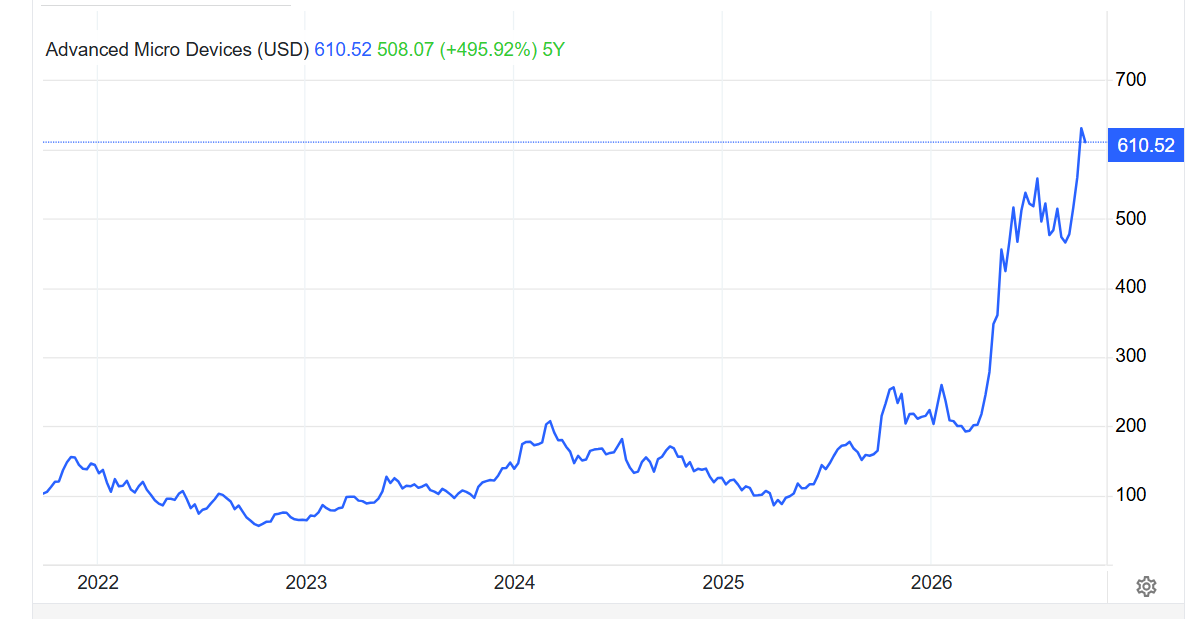
Investors see AMD as the main beneficiary of the world's unprecedented trillion-dollar AI capital expenditure, driving its stock price to nearly triple that of the beginning of the year since the beginning of the year. This brought AMD's market capitalization to about 1 trillion US dollars recently, and only 12 other big tech giants, including Nvidia and Apple, have reached this level.
Nvidia remains the company with the highest market capitalization in the world, with a market capitalization of over $5 trillion. However, its stock price has only risen by about 22% since this year. The overall stock price performance so far in 2026 lags significantly behind almost all popular chip/semiconductor listed companies, and has significantly outperformed the Philadelphia Semiconductor Index, which has the title of “AI computing power infrastructure weather vane.”
Helios takes on the present, the world model lays out the future: AMD's AI ambitions range from selling computing power coverage to participating in defining computing power
AMD first crossed the trillion-dollar market capitalization threshold on September 21, and its stock price soared by more than 200% in the past year. Behind this, the market began to simultaneously reassess the strong future growth space for its AI accelerators and data center server CPUs.
AMD, the strongest competitor of Nvidia's GPU system, announced earlier this month at the Global Technology Conference hosted by Wall Street today's giant Citigroup that by 2030, the market size related to accelerated computing in AI data centers had expanded to 2 trillion US dollars (a sharp increase from the previous 1 trillion US dollar forecast to 2 trillion US dollars), and pointed out that AI inference demand has become the main source of growth in AI computing power resource requirements, and AI agents focusing on proxy AI workflows simultaneously drive GPUs and server CPUs.
AMD said at the conference that Meta and two other AI laboratories, the three core Helios customers, have given future procurement demand forecasts that are higher than those expected when the two sides first established a strategic cooperation. ; At the same time, the company also strongly expects the server CPU business to grow by more than 80% year-on-year in the second half of this year and more than 70% next year. This latest combination of expectations undoubtedly strongly supports the continued expansion of computing power demand, but the sharp increase in customer demand expectations cannot all be regarded as irrevocable computing power infrastructure orders that have already been placed. Helios is AMD's rack-scale AI computing system, and Facebook's parent company Meta is one of the core customers that purchased the system.
To be clear, AMD expects the overall computing market covering the data center, PC, edge, and embedded sectors to be close to $2 trillion in 2030, with data center AI accelerators around $1.4 trillion and server CPUs about $220 billion.
What is particularly noteworthy is the fulfillment of increasingly strong AI computing power requirements. AMD management said at the Citigroup conference at the time that demand forecasts provided by the three core customers of Meta, OpenAI, and Anthropic all exceeded initial expectations of the cooperation, and the demand scale for Helios in 2027 was also higher than AMD's initial demand-side plan. Management expects initial shipments of the Mi450 and Helios to begin at the end of the third quarter and continue to expand delivery in the fourth quarter and 2027; at the same time, the company previously expected data center revenue to increase by more than 100% year-on-year in 2027, and server CPU revenue by more than 80% and 70% in the second half of 2026 and 2027, respectively. The high-margin CPU business is expected to support overall profits, while collaboration with Cerebras complements low-latency reasoning capabilities.
The intelligent application represented by Muse and Astra provides a specific workload foundation for this round of expansion: a single instruction can trigger browser operation, code execution, data retrieval, multiple rounds of inference, and result verification. The GPU undertakes model calculation, the CPU supports virtual machines, task orchestration and tool execution, and memory and storage saves context, files, and operating states. As AI superapplication platforms move further from on-screen work to robotics and physical environments, 3D scene generation, environment simulation, and multiple action path evaluations will also increase new computational requirements; actual growth will still depend on task scale, model efficiency, and deployment methods.
Muse performs cross-application tasks through a dedicated cloud virtual machine and browser, and can continue to work after users close the application; Astra enhances computer operation, software engineering, and multi-step professional work capabilities. When AI can complete research, programming, shopping, and office processes, the value that can be charged extends from generating an answer to delivering a work result. Judging from the business growth logic, higher task success rates and lower completion costs are expected to drive enterprises and consumers to expand the scope of use, thereby supporting the growth expectations of subscription, pay-per-use, and related infrastructure revenue.
The transmission of this application expansion to the computing power side involves a complete computing system: GPUs and other AI accelerators undertake model computation; the CPU is responsible for the browser, code execution, virtual machine, tool call and task orchestration; model weight, context, and concurrent sessions increase high-speed memory requirements, and task files, long-term memory, and caches suitable for hierarchical storage increase DRAM and enterprise SSD requirements. Nvidia's engineering analysis also indicates that the execution speed of CPU tools affects agent workflow throughput, and KV caches can be managed hierarchically between GPU memory, CPU memory, and storage according to access requirements.
This is why Wall Street giants such as Goldman Sachs and Jeffrey are optimistic about the hard-core logical support of the accelerated penetration of AI applications and the continued expansion of US stock profits under the AI computing power frenzy. The penetration rate of AI agents has increased dramatically, and it is expected that they will also expand the demand for AI infrastructure core fields such as computing, memory, storage, and optical interconnection networks.
Wall Street financial giant Jefferies recently said that the S&P 500 index is expected to soar to 8,000 points by the end of 2026 and further hit 9,000 points in 2027, driven by the dual engine of AI investment frenzy and rising profits of AI-related companies exceeding expectations. Jefferies's core logic is clear and powerful: in a cycle where AI-driven profit growth exceeds the historical average by more than two times the historical average, fighting against profit trends is dangerous. Jefferies's 2026 8,000-point S&P 500 benchmark forecast is based on earnings per share (EPS) reaching $373 (up 35% year over year, well above 29% of market consensus) and a price-earnings ratio of 21.5 times.
From an engineering and investment perspective, this acquisition can be summarized to a certain extent as AMD's attempt to compete for the “right to define the basic computing power of artificial intelligence” dominated by Nvidia — what kind of hardware is needed to master the model earlier. Atlas uses a multi-modal autoregressive diffusion architecture. Its matrix calculation, spatial context management and iterative generation place different requirements on computational throughput, memory bandwidth, and scheduling efficiency; AMD can feed back these actual requirements to Instinct GPUs, EPYC CPUs, ROCM software, and rack designs. The two parties have previously collaborated on computing and workload optimization around Instinct, and the acquisition will make this feedback process more straightforward. For shareholders or investors, long-term value focuses on whether these R&D capabilities can be translated into lower task completion costs, faster customer deployment, and higher product adoption rates.