


The risk of intervention is heating up again! After Japan and the US released signals one after another, Japan's top foreign exchange official shouted: the market should take it seriously
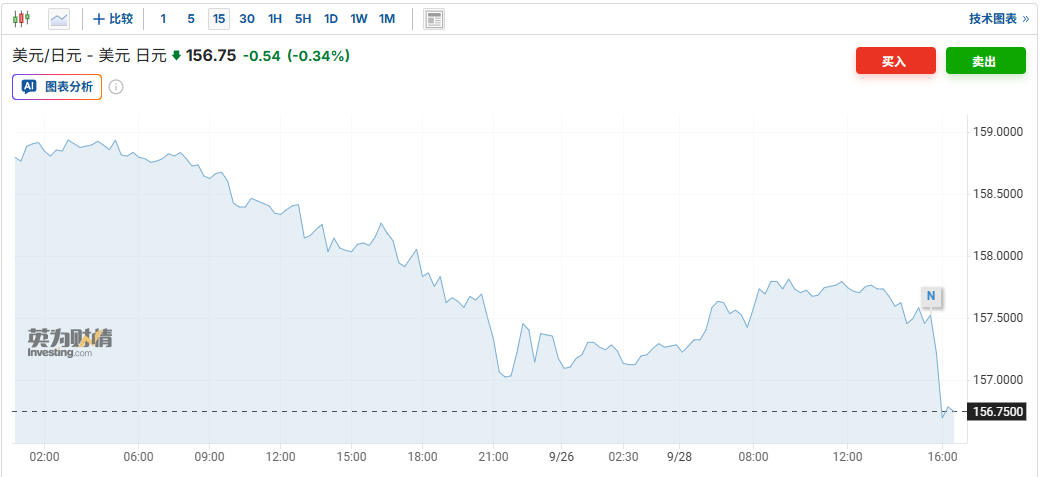
The Zhitong Finance App learned that Japan's top monetary affairs official Jun Mimura said on Monday that the market should take seriously the “very clear” messages issued by Tokyo and Washington last week about the yen. This statement sends a signal that he is ready to take action to curb the excessive depreciation of the yen. As of press release, the USD/JPY exchange rate declined slightly to 156.75.
Japan's Finance Minister Katayama Satsuki gave an unusually detailed explanation of discussions between US and Japanese leaders on exchange rates last Friday. Katayama Satsuki said that US President Trump expressed concern about the weak yen during a summit meeting with Japanese Prime Minister Sanae Takaichi. However, as a sign that Tokyo and Washington are jointly determined to deal with the weak yen, Katayama Satsuki and US Treasury Secretary Bezent once again confirmed during a phone conversation last Friday that the undervaluation of the yen is a cause for concern.
Referring to the recent depreciation of the yen in an interview, Jun Mimura said, “The Japanese Prime Minister, the Minister of Finance, and the US have sent a very clear message. The market should take this information honestly.” He also said, “I will be watching closely to see if the market continues to take this information seriously.”
Although Jun Mimura declined to comment on whether Japan might intervene again to support the yen, he said he was neither “satisfied” nor “relieved” about the recent trend of the yen — which indicates that Tokyo is still wary of the risk of the yen falling again.
The Bank of Japan raised interest rates by 25 basis points as scheduled this month, raising the benchmark interest rate to 1.25%, the highest level in 31 years. However, this interest rate hike, which was widely anticipated by the market, failed to boost the yen; on the contrary, the yen weakened. The market believes that Bank of Japan Governor Kazuo Ueda's remarks at the press conference after the interest rate decision was announced disappointed investors who expected it to make more hawkish remarks.
In addition to Ueda Kazuo's remarks about not being hawkish enough, two members of the Bank of Japan's monetary policy committee voted against interest rate hikes, raising concerns that the central bank is “not hawkish enough.” According to reports, among the nine policy committee members, Asada Unichiro and Sato Ayano voted against it. Asada Unichiro's reason is that the CPI increase excluding fresh food was less than 2%, and “the economic situation is not necessarily strong”; Sato Ayano believes that the economic and price situation has not accelerated significantly, and “it is inappropriate to raise interest rates at this time.”
As a result, traders are betting that it will be difficult for Japanese policymakers to keep up with the hawkish shift of global central banks — this will maintain a large gap between Japanese interest rates and major economies, and the yen may continue to be under pressure against the US dollar.
Strategists believe that given the continued depreciation of the yen after the Bank of Japan's September 18 policy meeting, 1 US dollar against 160 yen has once again become a level that tests Japan's weak tolerance for the yen. However, the growing threat of intervention may itself dampen the yen's decline. However, whether intervention can bring about a lasting reversal may depend largely on whether the US is involved, because historically, when monetary policy fundamentals remain unfavorable, it is often difficult for Japan's unilateral operations to have a lasting impact.
The US joined the ranks to support the yen this summer, increasing the risks faced by investors shorting the yen. US Treasury Secretary Bessent has repeatedly sent signals supporting the strengthening of the yen, and has even bluntly stated that he “is a bookmaker” on the Japanese yen exchange rate, warning traders who are shorting the yen to “not gamble with him.”
Ray Attrill, head of foreign exchange strategy at National Australia Bank, said: “The USD/JPY exchange rate is likely to return to 160, but I expect the threat of intervention will prevent breaking through this threshold.” He added that whether the US will further support Japan may depend on whether Japan is willing to raise interest rates faster or more drastically than the market currently expects.