


How Investors May Respond To Wiley Stock Dividend Raise
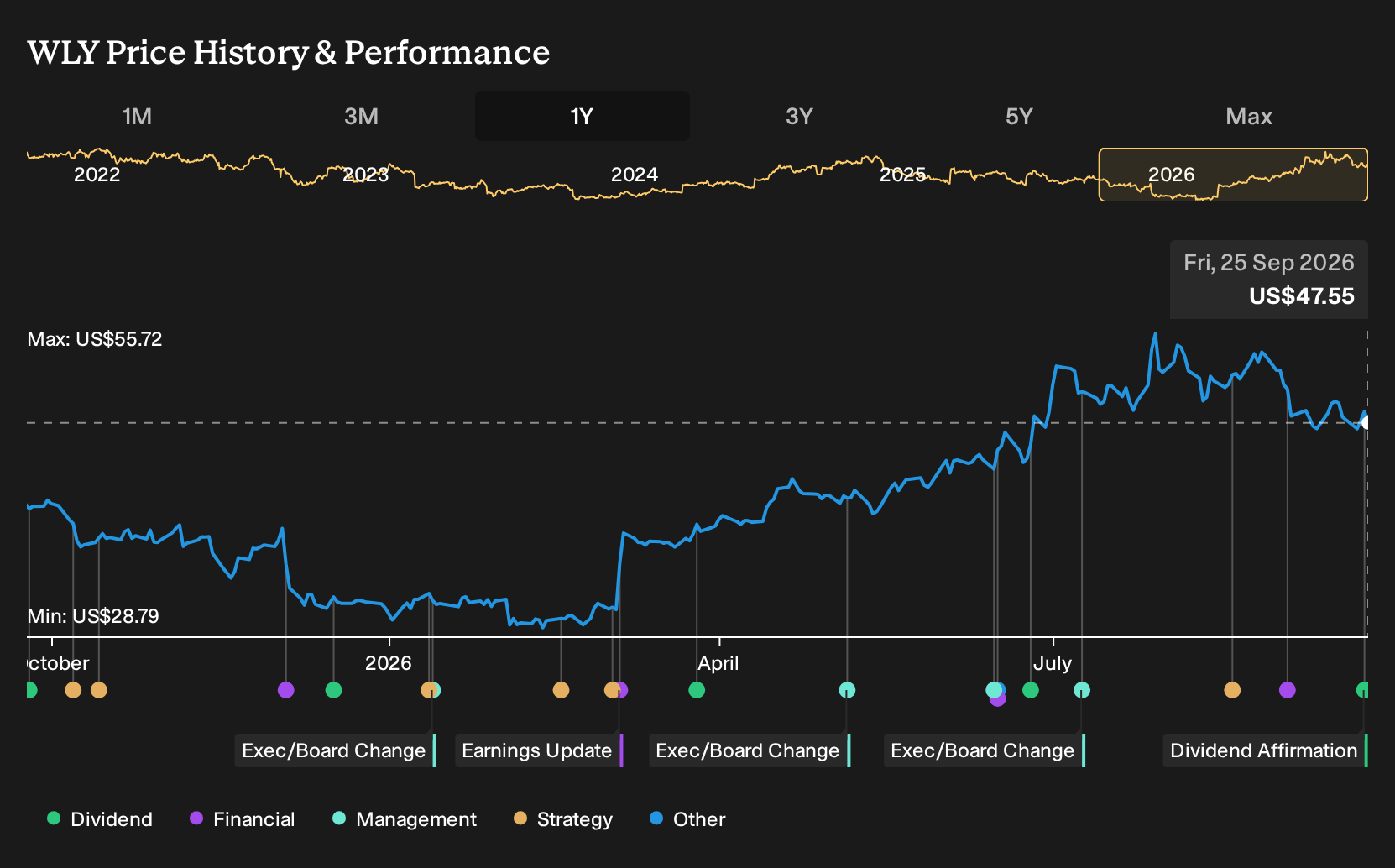
- John Wiley & Sons declared a quarterly cash dividend of US$0.3575 per share on its Class A and Class B stock, equivalent to an annual US$1.43 per share, payable on October 22, 2026 to holders on record as of October 6, 2026.
- The decision to lift the annual dividend from US$1.42 aligns with Wiley’s ongoing push into higher value digital and AI services, including its recently launched spectral analysis API portfolio.
- This development provides additional context for investors evaluating John Wiley & Sons' digital transition and capital return policies.
John Wiley & Sons Investment Narrative Recap
To own John Wiley & Sons, you need to believe the shift toward Open Access publishing, digital learning tools, and data heavy research services can offset pressure on print and traditional subscriptions. The dividend lift itself is small and does not change that core thesis. The more immediate swing factor is execution on higher margin digital offerings while keeping restructuring on track.
The largest near term risk remains revenue volatility around AI content licensing and data deals, which can be lumpy against prior one off contracts, alongside debt that limits room for error. The dividend change looks incremental, not a material tweak to that risk reward balance.
The most relevant backdrop to this dividend move is Wiley’s push into AI and data services, illustrated by the spectral analysis API portfolio launched on 3 September 2026. That product set leans on proprietary content and tools, which, if well adopted, could support recurring, higher margin income tied to research workflows rather than one off print titles.
For you as an investor, the key question is whether John Wiley & Sons can smooth out AI related revenue swings while growing Open Access and digital learning fast enough to counter funding and pricing pressure. Progress on APIs and broader data analytics may act as a practical test of that catalyst, especially with leverage and industry competition both in focus.
John Wiley & Sons' current analyst narrative points to revenue of US$1.9b and earnings of US$224.2m by 2029, based on 4.7% yearly revenue growth and an earnings increase of about US$2.6m from US$221.6m today.
Uncover how John Wiley & Sons' fair value indicates a 43% potential upside to its current price, which could narrow quickly if sentiment improves.
Exploring Other Perspectives
Two fair value ranges from the Simply Wall St Community sit between US$68 and about US$80 per share, which already shows how widely private investors can disagree on John Wiley & Sons. These views do not yet factor in AI licensing volatility or Open Access pressure. For this reason, you have strong motives to explore several alternative viewpoints.
Explore another John Wiley & Sons fair value estimate, including one that suggests as much as 69% upside from the current price!
Reach Your Own Conclusion
Disagree with existing narratives? Extraordinary investment returns rarely come from following the herd, so go with your instincts.
- A great starting point for your John Wiley & Sons research is our analysis highlighting 5 key rewards and 2 important warning signs that could impact your investment decision.
- See our latest analysis for John Wiley & Sons. The report includes a comprehensive fundamental analysis summarized in a single visual, the Snowflake, making it easy to evaluate John Wiley & Sons' overall financial health at a glance.
Looking For More Ideas Beyond John Wiley & Sons?
If you want to cross check John Wiley & Sons against other opportunities with similar or contrasting traits, the Simply Wall St screener can help you scan the market quickly using fundamental filters instead of headlines.
- Prefer income plus quality fundamentals? Shortlist companies that combine robust balance sheets with consistent metrics using this list of solid balance sheet and fundamentals (24 results).
- Hunting for potential mispricing? Sort through candidates that screen as priced below their assessed quality using this focused 32 high quality undervalued stocks.
- Want yield to do more of the heavy lifting? Zero in on companies offering substantial cash distributions that aim for durability with this targeted 8 dividend fortresses.
This article by Simply Wall St is general in nature. We provide commentary based on historical data and analyst forecasts only using an unbiased methodology and our articles are not intended to be financial advice. It does not constitute a recommendation to buy or sell any stock, and does not take account of your objectives, or your financial situation. We aim to bring you long-term focused analysis driven by fundamental data. Note that our analysis may not factor in the latest price-sensitive company announcements or qualitative material. Simply Wall St has no position in any stocks mentioned.
Have feedback on this article? Concerned about the content? Get in touch with us directly. Alternatively, email editorial-team@simplywallst.com