


The Math Doesn't Lie: What It Really Costs to Generate $300 in Dividend Income From Southern Company Stock
Key Points
Utility stocks tend to be reliable income holdings because their underlying companies’ customers do whatever it takes to keep their electricity turned on.
Southern Company’s dividend history confirms this resiliency.
Just bear in mind it’s a much better income investment than it is a growth holding.
If you've been an investor long enough, then you know utilities stocks are great dividend payers. Consumers will do whatever it takes to keep their lights turned on, after all.
But what kind of dividend income do these names generate? What would it take to produce, say $300 per month with a typical power utility name like Southern Company (NYSE: SO)?
Missed AI’s "Act 1"? Act 2 Could Be 15x Bigger. Most investors think they missed the AI boat because they didn't buy Nvidia in 2005. But according to our analysts, we’re only at the end of "Act 1"—the R&D phase. "Act 2" is the global rollout. Continue »
It's not too difficult to figure out. Based on Southern Company's forward-looking annualized yield of 3.7%, you'd need 1,188 shares of the utility stock to produce $3,600 worth of yearly dividend income. That's roughly $98,485 worth of this stock if you're buying at today's price.

Image source: Getty Images.
A stake of this size obviously won't generate $300 per month, of course, since Southern Company pays its dividend quarterly. You'd need to split this $900 payment, made every three months, into three equal pieces if you specifically need $300 in accessible cash every month.
You could certainly do worse, too. While it's clearly not a growth stock, Southern Company has not only paid its quarterly dividend like clockwork for decades now, but it has also raised its annual per-share dividend for 25 consecutive years. And by more than a little. The company's current quarterly payment of $0.76 per share is up 35% from its $0.56 payout of a decade ago. That's average yearly growth of a little more than 3%, outpacing inflation for this time frame. Patient shareholders have also been rewarded with a little bit of capital appreciation during this stretch, although progress has been erratic.
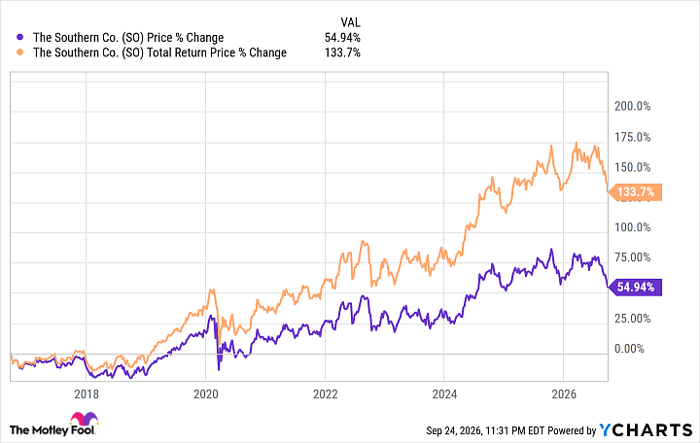
Regardless, Southern Company should first and foremost be seen as an income investment, a role it's historically played very, very well.
James Brumley has no position in any of the stocks mentioned. The Motley Fool has no position in any of the stocks mentioned. The Motley Fool has a disclosure policy.