


Kevin Warsh Just Signaled Higher-for-Longer Rates. Here's What That Means for Big Pharma Dividend Stocks.
Key Points
The Federal Reserve just raised interest rates, and further increases are likely over the next year.
The last rate-hike campaign coincided with significant declines in some pharma stocks.
The interest rates were not the main reason prices dropped, though they certainly didn't make things any better.
On Sept. 16, the Federal Reserve hiked interest rates. It happened to follow a decidedly hawkish August speech by the new Fed Chairman, Kevin Warsh. At the September meeting, Warsh said that inflation "is too high and has been for too long." The implication of his comment is that rates would need to rise further to better tamp down inflation and remain elevated for a longer period.
Such Fed actions could pose a threat to big pharma dividend stocks that investors count on to provide their portfolios with regular, stable cash flows, especially the biggest companies in that category, like Pfizer (NYSE: PFE), AbbVie (NYSE: ABBV), and Bristol Myers Squibb (NYSE: BMY). That sounds bad. But on a positive note, history says that rate hikes, even when sustained, won't be enough to break those players.
Missed AI’s "Act 1"? Act 2 Could Be 15x Bigger. Most investors think they missed the AI boat because they didn't buy Nvidia in 2005. But according to our analysts, we’re only at the end of "Act 1"—the R&D phase. "Act 2" is the global rollout. Continue »
Here's what you need to know.
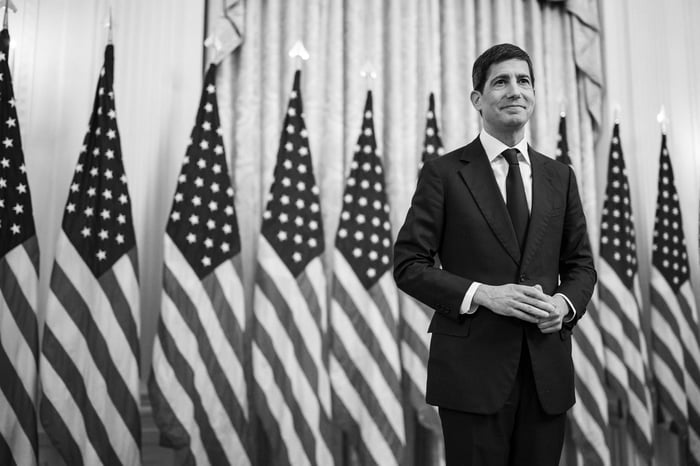
Image source: The White House.
Treasuries now pay over 5%
A 10-year U.S. Treasury note yields 5.17% annually as of Sept. 24. Further rate hikes could result in it going even higher, though the 10-year yield tends to react more to inflation expectations than to any single Fed decision. At the same time, because government debt is considered among the safest debt instruments to hold, higher yields provide an alternative to lower-yielding investments with more risk. Basically, it means more competition for dividend stocks.
At the moment, Pfizer's forward dividend yield is 6.1%, Bristol Myers Squibb's is 4.1%, and AbbVie's is 2.6%. If you want maximum income today, Treasury bonds will beat two of those stocks with a lot less risk. The U.S. government has always honored its coupon payments, while corporate boards sometimes cut dividends when times get hard.
The above comparison is an oversimplification. A fixed-rate Treasury note's coupon payment can't ever grow or shrink. Dividends are increased (and decreased) over time alongside higher earnings, even if the dividend yield may fluctuate due to changes in the stock's price. For instance, Bristol Myers Squibb lifted its quarterly per-share payout to $0.63 in January 2026. As a counterpoint, Pfizer has held its per-share dividend at $0.43 since early 2025 as its pandemic product sales shrank substantially.
Corporate bonds that have already been sold keep their original interest rates, so higher rates by themselves do not alter the cash outlays the issuer is responsible for, at least not unless new debt is issued. While debt service costs do increase when money is borrowed at a higher rate, these leading dividend stocks do not have a particularly troublesome burden.
AbbVie, the most indebted of the trio, is planning for about $2.9 billion of net interest expenses this year. In August 2026, it sold new long-term bonds, with fixed coupons as high as 6.1%, to fund its purchase of Apogee Therapeutics. Those interest expenses are just 16% of its $17.8 billion in free cash flow (FCF) generated in 2025.
Even if borrowing costs rise for a few years in a "higher for longer" world, interest would likely claim a larger but still manageable share of that cash, leaving the dividend well covered.
Did past rate hikes hurt these stocks?
The last hiking cycle was mixed for these stocks, and rates were not the main reason.
In 2022, the Fed went on a rate-hike run that took rates from nearly zero to above 4%, as the S&P 500 fell 19.4%. In that year, AbbVie's stock rose by 19%, and Bristol Myers Squibb gained 15%. Pfizer fell by 13% even though its 2022 revenue topped $100 billion, as investors braced for the pandemic-sales drop that arrived in 2023.
The Fed kept hiking rates in 2023. That was part of why Pfizer's stock then fell by 44%, and why Bristol Myers Squibb declined by 29%, with AbbVie finishing the year down 4%.
Pfizer struggled in 2023 for the same reasons as it did in 2022. Bristol Myers Squibb cut its 2023 outlook after generic copies eroded Revlimid sales faster than expected. AbbVie, for its part, had just seen its best-selling drug, Humira, face its first U.S. biosimilar competitor in January 2023.
The point to recognize here is that interest rates were rising in both years, but the share price performance was entirely reversed. The pharma-specific business factors affecting these stocks were far more important than the interest rates for their performance, though rates probably contributed to the downside.
Therefore, don't let the Fed's new campaign against inflation shake you out of your big pharma dividend stocks or encourage you to buy something else if you're on the fence. As long as the business's underlying fundamentals are intact, a little tinkering with borrowing costs won't change much in the big picture.
Alex Carchidi has no position in any of the stocks mentioned. The Motley Fool has positions in and recommends AbbVie, Bristol Myers Squibb, and Pfizer. The Motley Fool has a disclosure policy.