


What Mitsubishi (TSE:8058)'s Dividend Declaration Means For Shareholders
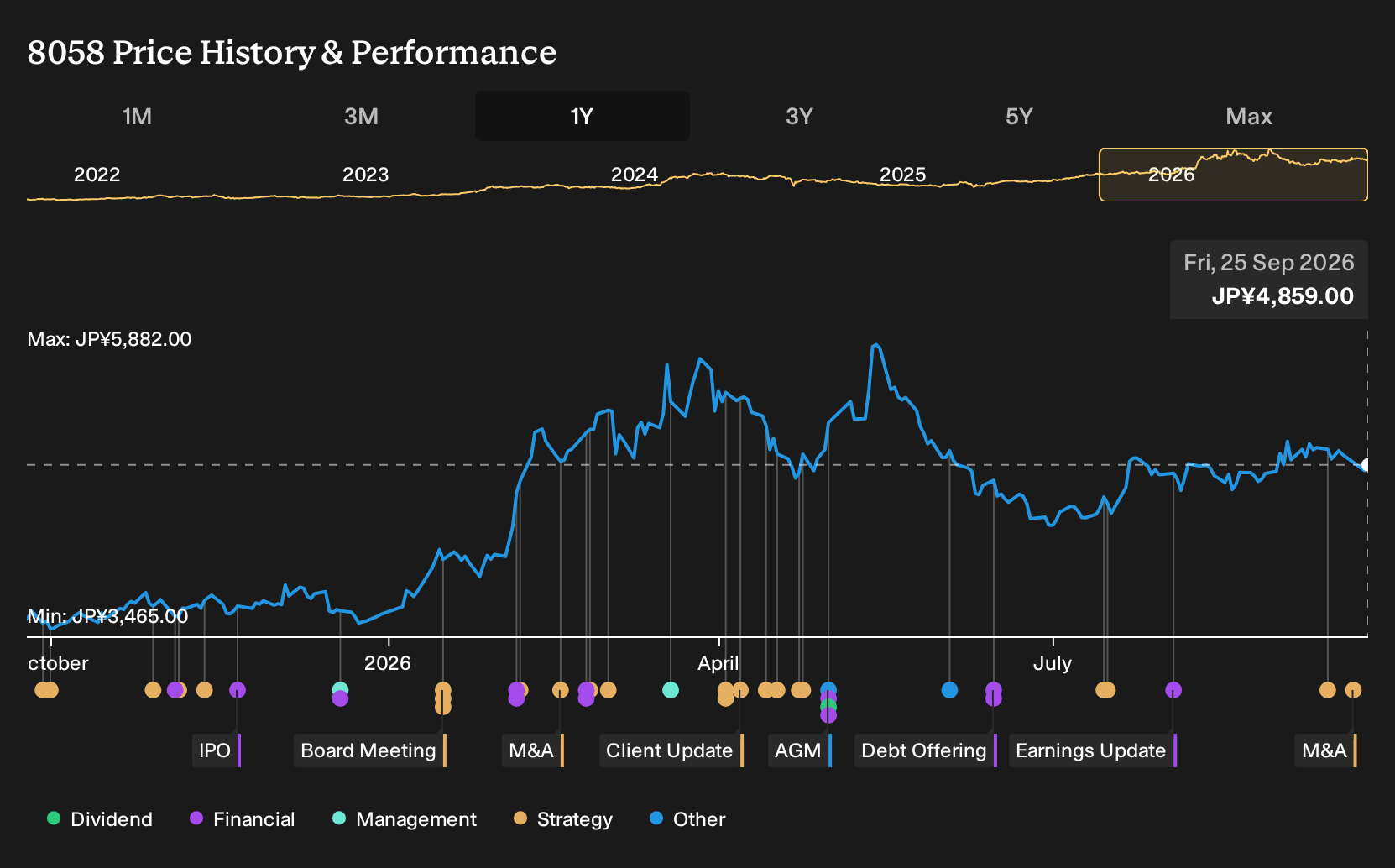
- Mitsubishi Corporation recently declared a cash dividend of ¥62.00 per share, with an ex-date that occurred on 29 September 2026, following earnings per share that exceeded estimates.
- The combination of a defined cash return to shareholders and earnings ahead of expectations highlights how Mitsubishi is currently converting a broad, diversified portfolio into distributable cash.
- This article examines how Mitsubishi's investment narrative is shaped by the recent ¥62.00 dividend declaration and earnings beat.
Scan how Mitsubishi's dividend move compares with other cash returning plays by reviewing our hand picked 14 dividend fortresses, now shaping income focused portfolios.
Mitsubishi Investment Narrative Recap
Mitsubishi appeals to shareholders who see value in a broad, globally exposed portfolio that can keep turning complex assets into steady earnings and cash. The recent earnings beat supports that view, as it suggests the underlying operations across energy, materials, and food are currently holding up. The near term catalyst remains how well management keeps reallocating capital toward higher margin, less cyclical areas.
The ¥62.00 dividend and ex date on 29 September 2026 send a clear signal on cash availability but do not materially change the key risk. Mitsubishi still leans heavily on commodity linked and capital intensive businesses. A weaker pricing backdrop or slower pay off from newer LNG, renewable fuels, and food investments could quickly pressure cash generation and limit future flexibility.
The cash dividend announcement ties directly into that capital allocation story. A defined payout on the back of earnings per share above estimates shows that Mitsubishi currently has room to return money to investors while funding its portfolio shift. For you as a holder, the question is how repeatable that cash profile is if resource markets soften.
That is why the earlier focus on growth projects in LNG, renewable fuels, and international food chains matters so much. If those areas keep building more stable, recurring income, they can offset swings in mineral resources and LNG cycles. If they lag, the risk flagged by the historically unstable dividend track record remains front and center, and future distributions could become more exposed to swings in commodity driven cash flow.
Mitsubishi Earnings Forecasts Behind The Dividend Story
Mitsubishi's current analyst blueprint points to revenues of ¥22,926.6b and earnings of ¥1,164.2b by 2029. That path is built on forecast revenue growth of 4.9% per year and an earnings increase of about ¥268.3b from current earnings of ¥895.9b.
Those projections sit at the center of the recent dividend move. A ¥62.00 per share payout in late 2026 is being funded by earnings that analysts currently frame at ¥895.9b today, with consensus pointing to ¥1,164.2b further out. For you as an investor, the link between that dividend and the forward numbers is direct. The higher the future profit pool, the more headroom management has to keep paying cash out while still reshaping the portfolio.
The same analyst set assumes Mitsubishi can expand profit margins from 4.5% today to 5.1% within roughly three years. That margin shift matters as much as the 4.9% projected top line growth, because it speaks to how well the portfolio tilt toward LNG, renewable fuels, and food supply chains may convert each yen of revenue into bottom line profit.
Consensus for 2029 effectively asks you to underwrite a business that throws off ¥22,926.6b in sales and ¥1,164.2b in earnings, with the stock trading on a P/E of 18.6x at that point. That multiple would be above the 10.8x cited for the GB Trade Distributors industry, so the market would be paying a premium for Mitsubishi's scale, mix of assets, and capital return profile.
Analyst targets currently cluster around a ¥5,264.67 share price, only 3.9% above the recent ¥5,059.0 level. That gap is small, which signals that the average forecast frames Mitsubishi as fairly priced against those 2029 revenue and earnings assumptions rather than screamingly cheap or stretched.
Behind that single consensus number sits a wide spread of views. Bullish analysts are up at ¥7,000.0, while the most cautious are down at ¥3,280.74. The size of that range gives you a sense of how differently people are reading the same ingredients, from commodity exposure and LNG cycles to the pay off from food and digital projects.
When you line those forecasts up against the fresh ¥62.00 dividend, the key question is not just whether Mitsubishi can hit ¥1,164.2b of earnings by 2029. It is whether the route to that outcome leaves enough surplus cash after reinvestment to keep distributions predictable if commodity pricing turns less friendly than it is today.
Uncover why Mitsubishi's fair value indicates an 8% potential upside to its current price that could narrow quickly.
Exploring Other Perspectives
The alternate, more optimistic view on Mitsubishi leans heavily on capital returns. Bullish analysts already expected around ¥21,450.1b of revenue and ¥1,140.2b of earnings by 2029, helped by aggressive buybacks. With a fresh ¥62.00 dividend now on the table, that upbeat cash return story may shift again, in either direction.
Explore 3 other Mitsubishi fair value estimates, including one that suggests up to 9% upside from the current price.
Decide For Yourself
Don't just follow the ticker. Dig into the data and build a conviction that's truly your own.
- A great starting point for your Mitsubishi research is our analysis highlighting 2 key rewards and 1 important warning sign that could impact your investment decision.
- See our latest analysis for Mitsubishi. The report includes a comprehensive fundamental analysis summarized in a single visual, the Snowflake, making it easy to evaluate Mitsubishi's overall financial health at a glance.
Looking For More Investment Ideas Beyond Mitsubishi?
If Mitsubishi has sharpened your focus on dividends, earnings power, and balance sheet strength, it can be useful to line it up against other candidates using the Simply Wall St Screener. That comparison helps you see where this stock fits in your wider watchlist, rather than viewing it in isolation.
- For investors who want income with an eye on resilience, scan a curated group of 14 dividend fortresses that aim to pair yield with more defensible cash generation.
- If value and financial strength matter most to you, start with a list of solid balance sheet and fundamentals (22 results) so you can weigh Mitsubishi against companies with similar footing.
- To widen the opportunity set, check a 74 high quality undiscovered gems that could complement a holding in a large, diversified group like Mitsubishi.
This article by Simply Wall St is general in nature. We provide commentary based on historical data and analyst forecasts only using an unbiased methodology and our articles are not intended to be financial advice. It does not constitute a recommendation to buy or sell any stock, and does not take account of your objectives, or your financial situation. We aim to bring you long-term focused analysis driven by fundamental data. Note that our analysis may not factor in the latest price-sensitive company announcements or qualitative material. Simply Wall St has no position in any stocks mentioned.
Have feedback on this article? Concerned about the content? Get in touch with us directly. Alternatively, email editorial-team@simplywallst.com