


My Favorite Covered Call ETF Is Overhauling How It Works. It’s a Big Win for Income Investors.
I like some ETFs because they reach into far-flung corners of the markets. Others are attractive because they take a specific major index, such as the S&P 500 Index ($SPX), and carve out a useful segment of it (top 50 stocks, low volatility stocks, any of the 11 economic sectors, etc.). But with the iShares 20+ Year Treasury Bond BuyWrite Strategy ETF (TLTW), it is even more simple than that.
It is a one-click, one-trade way to own what is essentially a iShares 20+ Year Treasury Bond ETF (TLT)-like bond ETF portfolio, and have monthly covered call writing as an overlay to boot. Could I just write the calls myself? Of course. Are there times where I’m really just “renting” TLTW, and thus prefer to own it instead of messing with the options? Sure.
TLTW, simple as it is, has generated double-digit distribution yields while long-term Treasury yields consolidated near multi-year highs. However, it is about to change its construction.
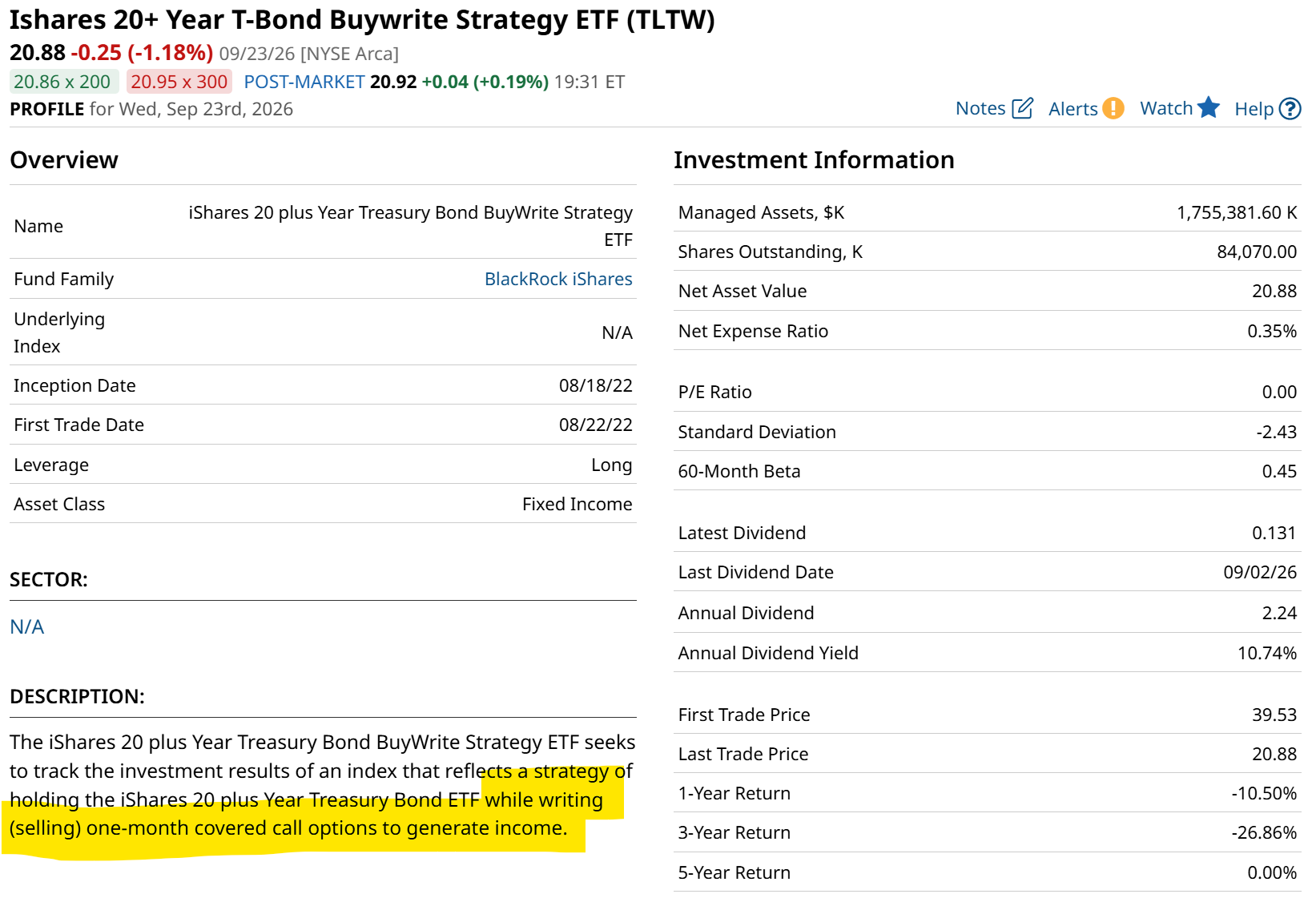
Issuer BlackRock (iShares) is rolling out a major overhaul to the fund, including renaming it the iShares TLT Premium Income+ ETF and upgrading its underlying index methodology. For investors using covered call strategies to enhance fixed-income cash flow, this shift addresses one of the biggest mechanical flaws I’ve noted in traditional buy-write funds.
Since its inception more than four years ago, TLTW tracked an index that wrote one-month, 2% out-of-the-money (OTM) call options on TLT. While effective at generating option premiums, that monthly schedule created a severe case of what we call “path dependency.” Don’t worry, it’s not contagious.
Once each month, the fund set its strike price and sold its entire option allocation. If long Treasuries rallied sharply in the first week of a monthly cycle, 100% of the fund’s capital was immediately capped for the next three weeks. Oops.
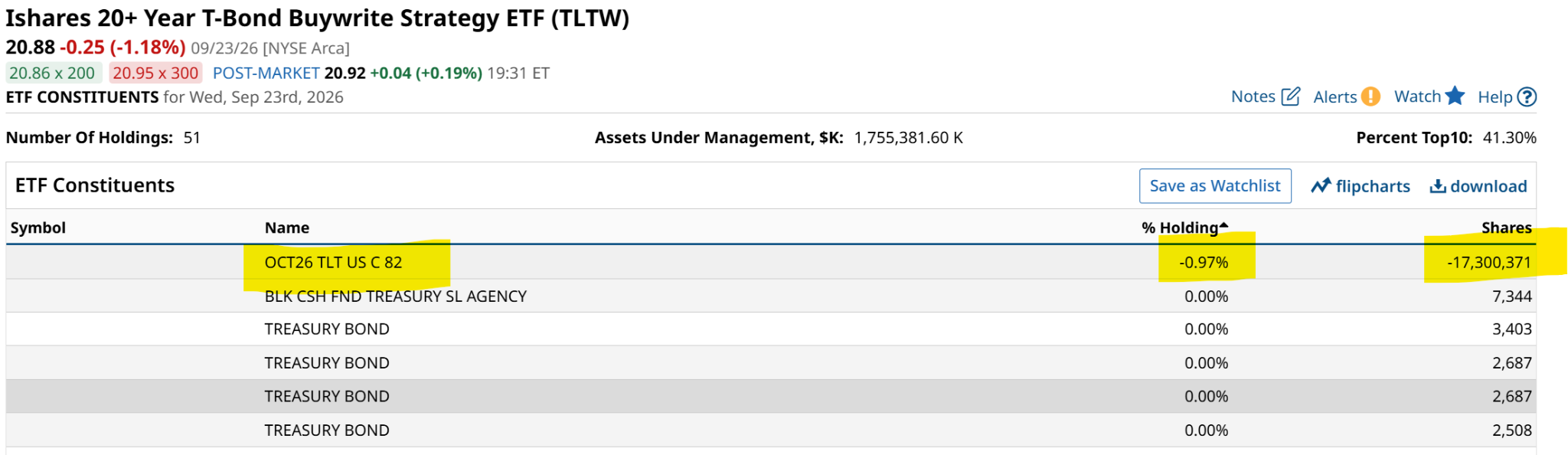
If interest rate volatility spiked mid-month, the fund couldn’t capture those higher option premiums because its options were already locked in until the next monthly roll date. And while upside capital appreciation was capped for a full month during bond rallies, the fund remained fully exposed to downside price drops if yields spiked. Heads the bond market wins, tails I lose? No thanks.
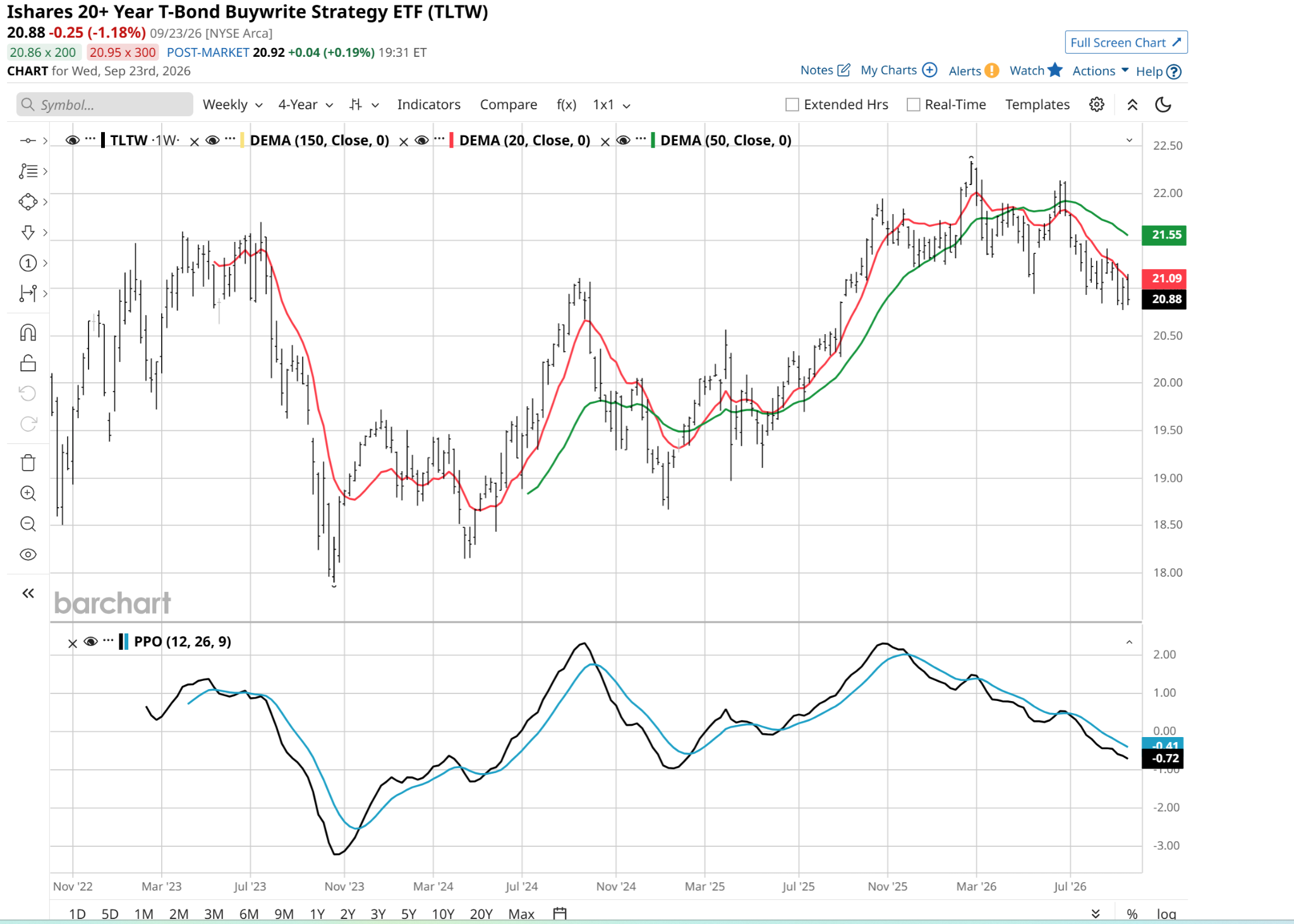
We can see that TLTW is volatile enough (thanks to the underlying 20-30 year bonds it holds with most of its capital) that this monthly roll trap only makes it worse.
What’s New? Four-Tranche Weekly Laddering.
The updated index methodology transitions TLTW away from a single monthly option roll into a four-tranche weekly laddered structure. Under this new framework, 25% of the portfolio’s written calls expire and roll every single week into options expiring across 1-, 2-, 3-, and 4-week maturities.
I Love the Changes
This weekly laddering method offers three distinct advantages. And taken together, they make me more likely to use TLTW in my “Hedged Bond” portfolio, not less so. Instead of setting one strike price for an entire month, the fund resets 25% of its option strikes every week. If TLT rallies, the next weekly tranche sells calls at a higher strike price, allowing the fund to participate in upward price momentum. Sort of a more “mark to market” method, except with the strike price of TLT as the “mark.”
We know that long-end bond yields move rapidly around economic releases and Federal Reserve commentary. Weekly rolls allow the fund to consistently sell options when implied volatility spikes, capturing higher option premiums.
And, rolling option tranches weekly reduces distribution volatility, creating a more consistent income stream for portfolio management. Frankly, this is a lot more like how I often use TLT calls, puts or both on the buy side. So I’m in sync with doing so to capture income, which is what TLTW will continue to do.
Rob Isbitts is a semi-retired CIO, former fiduciary investment advisor, and Barchart columnist. Check out his other work at ETFYourself.com (featuring the Fresh Charts weekly trading post), and ROAR.PiTrade.com, helping investors to better-manage their own portfolios.
On the date of publication, Rob Isbitts did not have (either directly or indirectly) positions in any of the securities mentioned in this article. All information and data in this article is solely for informational purposes. For more information please view the Barchart Disclosure Policy here.