


Intel (INTC) Stock Looks Reasonable Even After Its 275% Run
Intel Corporation has turned into one of the sharpest movers in big-cap chips this year, and the scale of that run now raises a simple question for investors who care about valuation. Is the current share price at US$127.39 still in step with what the company actually generates in sales.
- Intel has returned 274.8% over the past year, which puts a lot of weight on the idea that its sales can support a much richer market value than before.
- Surging interest in AI inference workloads and server demand, highlighted by Meta’s Muse AI agent and management’s comments about supply constraints, can feed expectations for stronger revenue and capacity investment, which both feed directly into how much investors are willing to pay for each dollar of Intel’s sales.
- The analysts covering Intel have run their own numbers. See what analysts think Intel's shares could be worth.
The issue now is whether that sharp move in Intel stock is justified by what the business produces in revenue today and what those sales are realistically worth on a price to sales basis.
If you want to test the same sales based question you are asking of Intel across a wider set of AI infrastructure names, it helps to start with 84 AI infrastructure stocks.
Does Intel Look Fairly Valued on Sales?
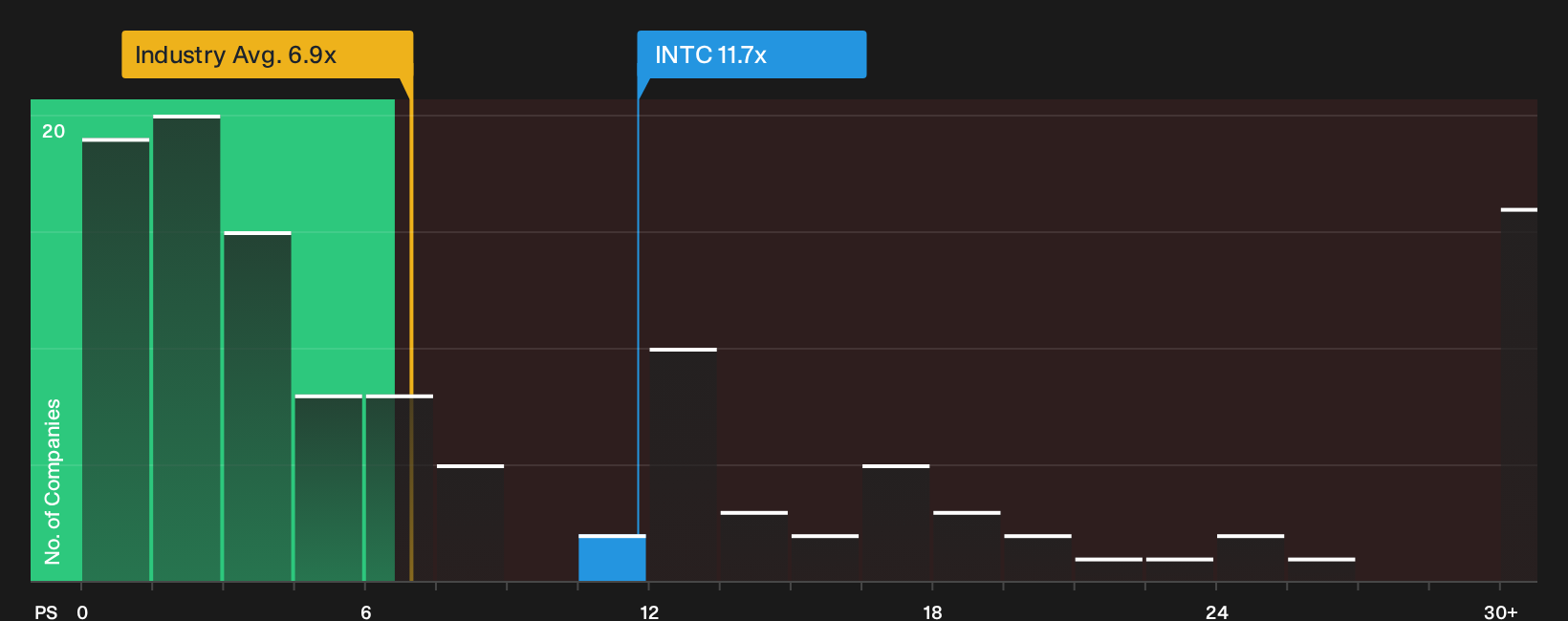
P/S is usually a cleaner lens for Intel because earnings can swing around heavy investment cycles, while revenue provides a steadier base to compare the share price against. On this measure, Intel trades on a P/S of 11.7x, which is above the broader semiconductor industry average of 6.9x yet a bit below the 13.9x peer group mark. Because the recent rally around AI CPU demand following Meta’s Muse launch has pushed expectations higher, that gap to peers reflects investors already paying up for Intel’s role in AI servers and foundry work, but not at the very top of the group.
The fair P/S level implied by the model, which blends Intel’s growth outlook, margin profile, scale and risk, sits close to the current 11.7x reading. As a result, the stock screens as about right on this framework rather than obviously cheap or expensive. To lean one way or the other, you would need to decide whether AI driven CPU demand and potential partnerships like the SK Hynix talks can sustain the kind of revenue base that keeps justifying a double digit sales multiple. Explore the numbers behind Intel's P/S valuation.
The Intel Narrative: What Would Justify Today's Price?
Narratives on Simply Wall St pick up where the Intel valuation puzzle leaves off and spell out what sort of future path for growth, profitability and earnings would need to play out for the current share price to look materially higher or lower from here. Each scenario links its number back to a clear view on how Intel's growth, margin shape and risk profile might evolve, which gives you something concrete to revisit as fresh information comes through.
Bullish Intel holders see more upside in the current price than the bears who worry expectations already build in a lot of good news.
Bull case: 75% undervalued
"They are the single largest USA based foundry... "
Discover why this Narrative puts Intel at 75% undervalued.
Bear case: 10% overvalued
"Organizational complexity and bureaucratic silos are hindering innovation and agility, which could adversely affect product development and revenue growth..."
Explore why this Narrative puts Intel at 10% overvalued.
One more Intel check that belongs beside the price chart
All the talk about Intel’s valuation only tells part of the story. Independent checks have also highlighted specific risk signals that deserve time on your screen before any next step. Take a closer look at 1 warning sign before settling on a valuation.
This article by Simply Wall St is general in nature. We provide commentary based on historical data and analyst forecasts only using an unbiased methodology and our articles are not intended to be financial advice. It does not constitute a recommendation to buy or sell any stock, and does not take account of your objectives, or your financial situation. We aim to bring you long-term focused analysis driven by fundamental data. Note that our analysis may not factor in the latest price-sensitive company announcements or qualitative material. Simply Wall St has no position in any stocks mentioned.
Have feedback on this article? Concerned about the content? Get in touch with us directly. Alternatively, email editorial-team@simplywallst.com