


Damo interprets the ECOC conference: the NPO consensus will be implemented in 2028, and optical devices have been sold out for 12-18 months. These US stocks have benefited the most
The Zhitong Finance App learned that Morgan Stanley's first minutes at the 2026 European Optical Communications Conference (ECOC) gave three key judgments: the industry consensus has moved from “whether to do an NPO” to “the first batch of products to be launched in 2028”; almost the entire optical communications supply chain has been sold out for 12-18 months, and indium phosphide (InP) substrates have become the tightest link; and regardless of the technical route, the test manufacturer Keysight is the most stable beneficiary.
Meta A Marshall and Antonio Jaramillo, analysts from the Daimo Telecom and Network Equipment Team released the latest report. The industry view is In-Line (in sync with Dashi). The minutes are a summary of a round of meetings hosted by the team during the ECOC exhibition in Malaga, Spain from September 21 to 22. This year, the 52nd ECOC, was held from September 20 to 24, and attracted more than 8,300 participants and more than 330 exhibitors, of which about 120 were from China. Damo said that detailed company-level notes for Cisco (CSCO.US), Ciena (CIEN.US), Coherent (COHR.US), Keysight (KEYS.US), Nokia (NOK.US), Tower Semiconductor (TSEM.US), and Lightmatter will be released one after another over the next few days.
NPO moving from “boycott” to “consensus”: trial operation of the first batch of products in 2028
Compared to the OFC exhibition six months ago, the biggest change at this year's ECOC is the attitude towards NPO (Near Package Optics). According to the Dama Chronicles, although optical content is growing faster than supplier production capacity, a large number of orders are scheduled for 12-18 months, and the final form of CPO/NPO is still undecided, unlike the OFC period, the industry now more generally accepts that “NPO will be implemented starting in 2028.”
The formation of this consensus is directly related to the promotion of Open CPX MSA. The industry organization is establishing uniform parameters for optical engines, making it possible to build a wider ecosystem — as a result, hyperscale cloud vendors are no longer as concerned about “vendor lock-up” and closed ecosystems as they were when the Nvidia solution was the only option. Damo still warns that there will still be huge challenges in terms of scale, production and implementation in the next few years. The consensus only means that enough suppliers are promoting open solutions, and demand for close deployment of optoelectronics in scale-up networks continues to grow, and the first batch of products will enter trial operation at least 2028.
It is worth noting that the notes clearly state that the architecture of the first generation product is unlikely to be the final form — the type of laser, the position of the laser, etc. may all change in subsequent generations, and today's technological competition “cannot lock in long-term victory or loss.” This judgment is consistent with the consensus at the conference: although there are still a few meetings that describe CPOs/NPOs as “inevitable, but not imminent,” the mainstream view is that hyperscale manufacturers will switch to NPO in the next few years.
Supply chain sold out in 12-18 months: InP substrates are the biggest throat
According to the Dama Chronicles, most component and system suppliers have sold out their production capacity over the next 12-18 months. Among them, InP substrates are “gating items” (gating items), and AXT (AXTI) and Sumitomo Electric were named in the report. Outside of InP, supply is equally tight for major categories such as EML, CW lasers, pump lasers, and gold boxes (gold boxes). According to the report, there is room for improvement in the industry if more substrates are released or yield is improved.
This judgment is mutually confirmed by the manufacturer's recent public statement. Lumentum CEO Michael Hurlston previously said that the InP supply and demand gap has exceeded 30%, and that the company's critical AI optical device production capacity “will actually be sold out in the foreseeable future,” and said the extent of the shortage “may be worse than the storage industry.” Coherent also warned about the InP shortage during an earnings call in May of this year.
The origin of this shortage can be traced back to February 2025: China has imposed export controls on indium phosphide since then, and China has produced about 70% of the world's refined indium, an upstream raw material for InP. According to data from market tracking agencies, the average price of 6-inch InP wafers has risen by about 250% to about $5,000 each since regulation; Nvidia has also taken a stake in Lumentum and Coherent to lock down the supply of optical devices.
At the ECOC exhibition site, the importance of external lasers was further specified: Lumentum showcased an eight-wavelength DWDM external laser (ELSFP) module that met MSA requirements for optical computational interconnection, clearly targeting external light source applications in CPO/NPO architectures. This echoes the Dama Chronicle's judgment that “first-generation NPO/CPO products are likely to all use external lasers, and demand for high-power lasers will increase dramatically in the next few years” — which is why LITE and COHR continue to receive the most attention in the report.
However, the sell-outs were not uniform. Damo pointed out that Cisco and Nokia said at the meeting that they still have some supply capacity, which allows them to take strategic action on supply release in the near future, but the report does not anticipate a meaningful share transfer — Ciena still holds the majority of the line system.
OCS is proliferating, but Google is still the only one
Optical Circuit Switching (OCS) is another branch of the report. Google's use of OCS has been widely reported, and its production climbs and will shift to Lumentum in the next few years. Driven by Google's successful demonstration, almost all other hyperscale vendors and new cloud vendors are testing OCS. I heard from the conference that Damo will have more customers in the next few years. But the notes also cooled down expectations: the latecomer's use case was probably smaller than Google's deployment — one customer even cancelled the deployment after fully qualifying the program. Damo still sees OCS as an opportunity for Lumentum and Coherent to increase profit margins, but believes Lumentum will take most of its value in the near future as it supplies the largest implementers.
Individual stock preferences: KEYS benefits across the board, LITE/COHR receives the most attention
Damo's core preferences continue to be strong against Keysight (KEYS.US): whatever implementation path the CPO/NPO eventually takes, optical growth will bring testing requirements, and Keysight is therefore a beneficiary of “no matter the end route”; Corning (GLW.US) is also classified as a target group of “no matter which path benefits”. “We have always been very clearly optimistic about KEYS,” the report said.
The report's judgment on LITE and COHR is that although they are likely to continue to be sold out in the foreseeable future and there will be a continued shortage of InP lasers; the Coherent (COHR.US) PhotonLink integration platform — to provide end-to-end delivery for hyperscale vendors that want to combine products from more than 6 suppliers into open solutions but lack the ability to self-assemble — is considered to be particularly suited to this need. The company also revealed that it has signed an LTA (long-term agreement) with a customer on an NPO plan. I'll start climbing next year. Although Lumentum (LITE.US) did not meet Damo at the conference, it has previously stated that it expects to announce an NPO-related LTA in the coming months. Ciena (CIEN.US) has multiple paths to success, but to significantly outperform its stated goals, the InP supply chain will need to be further relaxed in the next few years; while Cisco's demand side shows no signs of weakness, the supply chain is more manageable, giving it an opportunity to continue to expand its revenue base for cloud customers.
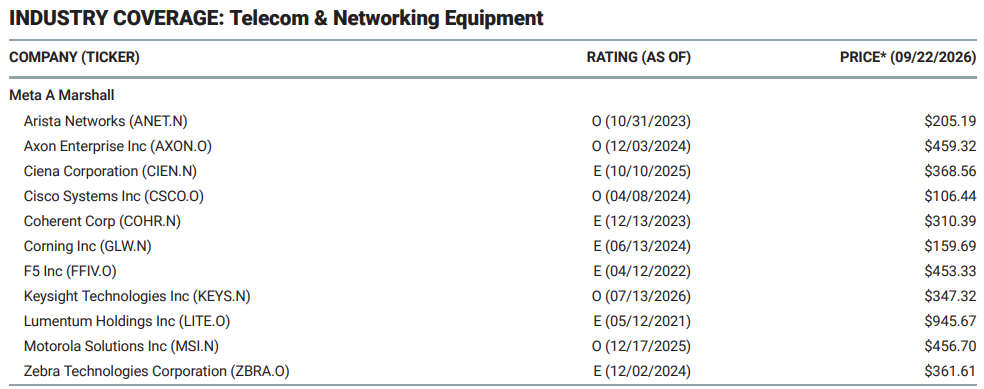
Damo maintains an in-line view of the telecom and network equipment industry. According to the research target price, Lumentum reported $945.67, Coherent reported $310.39, Keysight reported $347.32, and Ciena reported $368.56; in terms of ratings, LITE, COHR, GLW, and CIEN all held wait-and-see shares, while Keysight and Cisco (COCS.US) increased their holdings. Despite intense fundamentals, this round of the market has recently been under pullback pressure — but Damo did not adjust any ratings in this report. The conclusion was on the technical side: optical content continues to grow, the solution shape is undecided, and the supply chain is completely tight, “beneficial to almost everyone in the industry.”