


Chip stocks took Nasdaq to a new high since June, and the Nikkei Index surged: the Japanese stock market is about to make up for gains tomorrow
The Zhitong Finance App noticed that when the Japanese stock market resumed trading on Thursday, it looked likely to catch up with the AI-driven rise in the global market, while the weakening yen brought the risk of foreign exchange market intervention back into focus.
Nikkei 225 futures already reflect market optimism about stocks. The December contract traded in Osaka is about 2.5% higher than the index's closing point last Friday. Since then, the Japanese market has been closed due to the “Silver Week” holiday. Meanwhile, the yen appeared to fall easily and difficult to rise during the holiday period, and is now moving towards a fourth day of continuous decline against the US dollar.
For bond traders, the outlook is even more complicated, as uncertainty about the direction of the Bank of Japan's monetary policy offsets the boost that may be brought about by falling oil prices.
This week, global AI transactions are heating up, thanks to Meta's new AI agent showing early signs of success and Alibaba's release of what it calls the strongest AI chip in China. Recent calls from top American AI companies to slow down the pace of development have raised concerns about the industry's growth, and these developments have helped rekindle the enthusiasm of the market.
Hebe Chen, market analyst at Vantage Global Prime, said, “The re-warming global AI market, moderate improvement in risk sentiment, and weakening oil prices have left room for the Japanese stock market to catch up, while also temporarily relieving the pressure surrounding inflation and interest rate narratives.”
She added that although the weakening yen may boost exporters' stock prices in the short term, the risk of further intervention in the foreign exchange market will make traders cautious. At 6:15 p.m. Tokyo time on Wednesday, the yen was reported at around 157.88 against the US dollar.
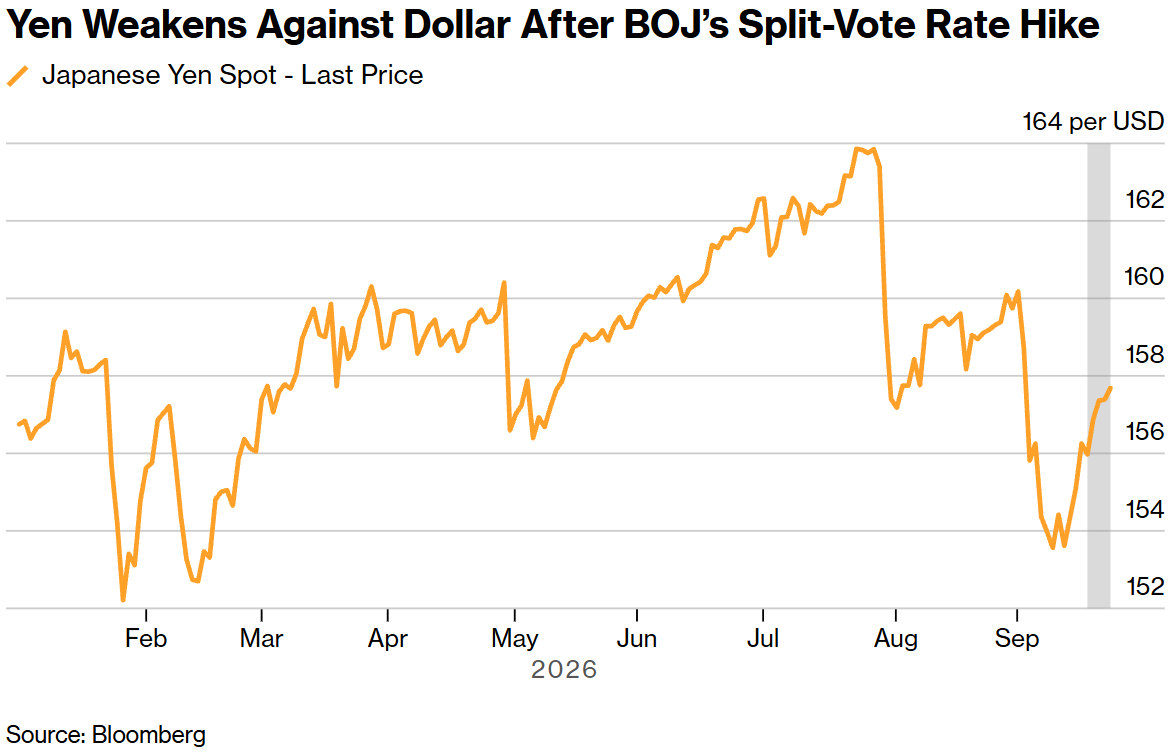
The yen weakened against the US dollar after the rate hike
Hu You, a senior research analyst at iFast Financial in Singapore, said chip equipment manufacturers such as Tokyo Electronics and Edwin Test could be among the biggest winners on Thursday. She also anticipates that chip packaging substrate manufacturer Ibidian and memory chip manufacturer Kioxia will also rise.
“A rebound driven by semiconductors and AI could provide a broad boost to the entire Japanese stock market,” she added. On Tuesday, the rise in chip stocks drove the Nasdaq 100 index to a record high for the first time since June.
In the five trading days up to September 18, the Nikkei 225 Index had a cumulative increase of 1.6%, the best weekly gain in about a month.
Japanese yen and bonds
The Bank of Japan raised the benchmark interest rate on Friday and hinted that it was open to further austerity, but the lack of more clear guidance disappointed yen traders. The yen once fell as much as 1.3% to 158.05 to the US dollar, then narrowed the decline later in the day. Earlier, Japanese media reported that the Bank of Japan had carried out an “exchange rate check” with market participants on the exchange rate level. This move is usually seen as a prelude to intervention.
Since then, the sell-off has begun again, and the yen is now falling for the fourth day in a row, the longest losing streak since the end of August. As the yen weakens, the options market's sentiment towards the yen is turning more bullish, reflecting rising demand for hedging against the risk of Japanese intervention.
Meanwhile, in the face of Thursday's reopening, bond traders received conflicting signals. Brent crude oil has fallen below $100 per barrel, and US bond yields have declined somewhat this week. While this may provide support for Japan's treasury bonds, uncertainty about the Bank of Japan's austerity path may put pressure on it.
iFAST's Hu You thinks short-term bonds will be under pressure.” “The Bank of Japan's interest rate hike establishes a higher lower limit for short-term interest rates, so it is fundamentally bad for the price of front-end Japanese treasury bonds,” she said.
Economist Taro Kimura pointed out, “After the Bank of Japan accelerated the pace of rate hikes with the latest rate hike last Friday, Governor Ueda Kazuo was more hawkish than we expected. He said little about the weak yen. Instead, he emphasized that potential inflation is approaching the 2% target and announced that the 'phase' of monetary policy has changed.”
Japanese Prime Minister Sanae Takaichi adjusted her speech schedule at the UN two days in advance to meet Trump before the first meeting between China and the US. She discussed economic and security relationships with the US leader on Tuesday.
Vantage's Hebe Chen said that the short-term outlook for Japanese assets will largely depend on the trend of yen.
She said that a further weakening of the yen could heighten concerns about inflation and reinforce expectations that the Bank of Japan will tighten again, putting pressure on Japan's treasury bonds.” The factors that initially favored the stock market may put another round of pressure on bonds.”