


3 Consumer Staples Stocks With Dividend Strength When Inflation Stays Stubborn
Stubborn inflation, higher Fed policy rates and pressured household budgets have turned the hunt for resilient income into a far more serious exercise than just chasing yield. Some investors now see high quality dividend payers as potential anchors when fast money trades on every CPI print, and missing the right kind of exposure can feel costly. This article walks through three U.S. dividend stocks from our value-focused screener that appear closely tied to these macro shifts, and explains how the same forces that rattle markets might affect each stock’s income appeal and risk profile.
The three dividend stocks below are just a starting sample, since the full screen surfaced 51 more U.S. companies with income profiles and value characteristics that create equally interesting stories not covered here.
If you want to go straight to the source and identify candidates that fit your own risk and income targets, analyze the High-Quality Dividend-Paying Value Stocks in the U.S. screener.
Tyson Foods (TSN)
Tyson Foods brings the screener’s income and value tilt into the grocery aisle, with a global protein business that leans on everyday demand for meat and prepared foods rather than discretionary splurges. This is the kind of cash flow profile many dividend seekers look for.
Tyson Foods runs a global protein empire across Beef, Pork, Chicken and Prepared Foods. It generates the largest revenue from Beef at about US$21.9b, Chicken at roughly US$17.2b and Prepared Foods near US$10.3b, and carries a market value of about US$18.5b.
Continuous operational efficiencies, supply chain optimization, and manufacturing improvements are delivering tangible cost savings, higher fill rates, and reduced waste, which should support net margin expansion and greater earnings stability.
The real swing factor is how one pressure point in its protein mix ultimately shapes pricing power and cash flow resilience for shareholders.
That hinge point is exactly what the full narrative for Tyson Foods unpacks, showing where Tyson Foods’ pricing power, capital allocation and payout ambitions could be quietly decoupling from headline protein cycles.

Hershey (HSY)
Hershey fits the screener’s high quality dividend and value theme by leaning on everyday treats and pantry brands that shoppers keep buying even as rates stay high and budgets feel tight.
Hershey runs a broad snack and confectionery portfolio, led by North America Confectionery at about US$9.8b in revenue, with North America Salty Snacks contributing roughly US$1.4b and International operations adding close to US$1.0b, supporting a market value near US$34.1b.
For income focused investors watching inflation eat into real returns, Hershey offers a cash rich, brand heavy business that has long used pricing power and disciplined dividends to act as a stabiliser when more cyclical stocks react sharply to every macro headline.
The 2025 cocoa shock, a ~60% GAAP EPS collapse driven largely by non-cash hedge mark-to-market, obscured an underlying cash engine that remained intact.
What matters next is how one quiet shift in cost and pricing dynamics feeds through to the margins that ultimately fund Hershey’s future dividends.
That quiet shift is exactly what the full narrative for Hershey unpacks, revealing how cocoa volatility, pricing power and future dividends could be pulling Hershey in a different direction.

Kraft Heinz (KHC)
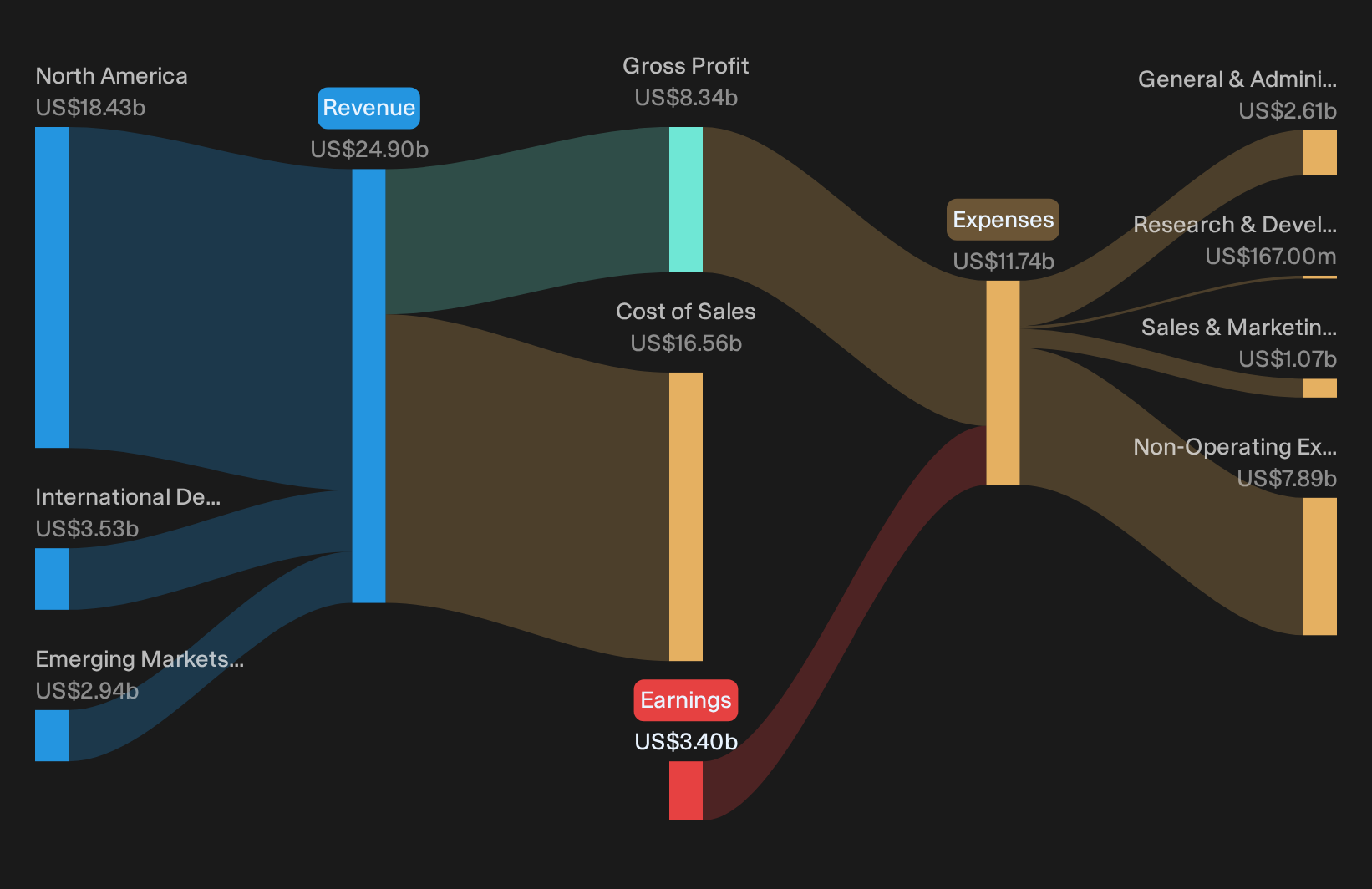
Kraft Heinz fits the high quality dividend value theme as a large consumer staples group built around pantry brands and regular grocery spending. It draws about US$18.4b from North America, US$3.5b from International Developed Markets and US$2.9b from Emerging Markets, and has a market value near US$29.0b.
Kraft Heinz appeals to income focused investors in this screener because it mixes well known everyday brands with a higher dividend yield profile. This can look especially relevant when inflation, higher rates and weaker real wages push many households toward cheaper, familiar at home meals.
The dividend is not a side detail; Kraft Heinz paid $474 million in cash dividends at $0.40 per share in the first quarter, and management explicitly said sustaining the dividend remains a capital allocation priority alongside protecting the investment-grade balance sheet.
What really matters now is how one unresolved margin pressure shapes the trade off between keeping that income stream attractive and rebuilding earnings strength.
That margin trade off is exactly what the full narrative for Kraft Heinz breaks down, showing where Kraft Heinz’s income stream could be quietly decoupling from today’s pressured earnings picture.
Seeking Alternatives Before The Crowd
Fresh ideas move first. Watch early momentum, quiet breakouts and dropping valuations before they get caught by headlines and priced in. These picks are under the radar for now; consider them before they become widely followed.
- Track where strong cash generation meets resilient balance sheets, then scan the curated list of solid balance sheet and fundamentals (23 results) while it still flies below broad market attention.
- Look for high yield without overlooking durability, and review the hand picked 7 dividend fortresses before payout trends draw broader interest.
- Identify growth stories connected to real infrastructure demand, and work through the focused 39 power grid technology and infrastructure stocks while these operators remain less widely noticed.
This article by Simply Wall St is general in nature. We provide commentary based on historical data and analyst forecasts only using an unbiased methodology and our articles are not intended to be financial advice. It does not constitute a recommendation to buy or sell any stock, and does not take account of your objectives, or your financial situation. We aim to bring you long-term focused analysis driven by fundamental data. Note that our analysis may not factor in the latest price-sensitive company announcements or qualitative material. Simply Wall St has no position in any stocks mentioned.
Have feedback on this article? Concerned about the content? Get in touch with us directly. Alternatively, email editorial-team@simplywallst.com