


With a $103.4 billion contract, Microsoft (MSFT.US) and Anthropic together account for 85%: How fragile is Nscale's (NSCL.US) IPO story?
Zhitong Finance App learned that British AI data center developer Nscale (NSCL.US) submitted an S-1 registration statement to the US Securities and Exchange Commission on Friday and plans to list on the New York Stock Exchange under the stock code “NSCL”. Among them, the most eye-catching figure in the prospectus is the total contract value of US$103.4 billion — the company, which has only been established for two years, is already on par with some established infrastructure giants in terms of contract size.
However, if you take this number apart, it's a completely different version of the story.
According to the prospectus, the two companies Microsoft (MSFT.US) and Anthropic together account for 85% of Nscale's total contract value. Among them, Microsoft has signed multiple agreements with Nscale since the end of 2025, totaling about US$43.8 billion, and the execution period will be extended to 2033. Anthropic, on the other hand, signed a 44.6 billion US dollar computing power lease agreement in August this year, covering server racks and equipment at the flagship data center in West Virginia.
Customer concentration is more evident on the revenue side. In the first half of 2026, the revenue contribution of Nscale's single largest customer reached 52%, and the company declined to disclose the customer's name in the prospectus. Looking ahead, Microsoft contributed about 73% of Nscale's revenue for the full year of 2025. The company even wrote in its risk alert that “a significant portion of our revenue is driven by a limited number of customers.”
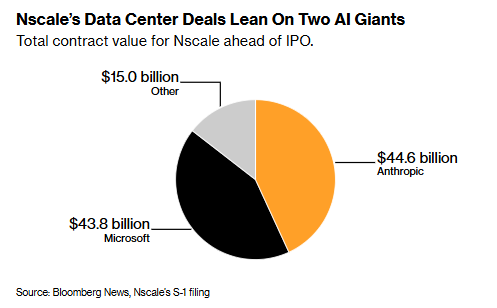
This structural dependency is not unique to Nscale. According to estimates from relevant agencies in March of this year, Microsoft and Meta (META.US) account for about half of Nebius (NBIS.US)'s annual sales; Microsoft contributed about 67% of CoreWeave (CRWV.US) revenue in 2025. These new cloud service providers generally try to use “customer diversification” to hedge against market questions about their excessive reliance on Silicon Valley giants, but actual data does not support this narrative.
Of the 100 billion contract, no more than 2.6 billion is actually running
It is also worth noting that of the total contract value of $103.4 billion, only $2.6 billion was “active” as of the end of August — that is, those already completed and generating revenue. This means that the conversion rate of the contract amount is less than 2.5%. The vast majority of the rest are multi-year promises on paper, which can only be fulfilled in stages until the data center is completed, chips are in place, and electricity is connected.
Nscale's financial data for the first half of the year is also worth taking a close look. Revenue was US$140.6 million, an increase of more than 12 times over the previous year, but the net loss reached US$1.02 billion — the loss was more than seven times the revenue. An even more critical figure is that the cost-to-revenue ratio has been inverted. The revenue cost for the first half of the year was 189.6 million US dollars, which surpassed the revenue itself, and the company was unable to even achieve gross profit.
In addition to operating cash flow pressure, the balance sheet situation is not easy. As of the end of August, Nscale's debt was over $8 billion, and this figure has not included the amount of financing provided by Dell (DELL.US). A notable statement also appeared in the prospectus — management had “serious doubts” about whether the company could “continue to operate” on the grounds that forecasting capital requirements relied on uncommitted debt and equity financing. Although management eventually came to the conclusion that this risk could be mitigated by delaying or cutting capital expenditure, the appearance of words such as “continuing operation” in an IPO document itself sends a strong signal.
Nvidia: Shareholder, Supplier, or Implicit Risk Guarantor
The relationship between Nscale and Nvidia (NVDA.US) is far more summed up by the words “chip supplier.”
Nvidia holds more than 5% of Nscale's issued share capital. On the supply chain side, Nvidia is the exclusive source of GPUs for the nScale data center, and the two sides have signed a total capacity lease agreement of 1.2 billion US dollars. On the financing side, Nvidia participated in multiple Nscale funding rounds, including a $3.1 billion convertible bond offering earlier this month, of which $1 billion was subscribed by Nvidia. On the credit side, Nvidia agreed to provide an obligation guarantee of up to $860 million for Nscale's lease agreement for a facility in Ward County, Texas.
This multi-dimensional binding forms an alarming structure: Nvidia is both a shareholder and supplier of Nscale, and underpins its leasing obligations. Nscale acknowledged in its prospectus that the close relationship with Nvidia “does not eliminate supply chain risks” — there is still uncertainty about whether the latest AI accelerators can be delivered to data centers on time.
The ghost of “circular trading”
The Nscale case, viewed in the context of the AI infrastructure industry, points to a broader problem. Currently, there are a large number of “circular transactions” in the AI industry chain — AI Labs promises to purchase computing power to new cloud service providers, new cloud service providers purchase chips from Nvidia, and Nvidia then invests equity in these AI laboratories and new cloud service providers. Funds and orders circulate in the same closed circle, ultimately driving the valuations and contract size of all parties to expand at the same time.
According to statistics, the total AI investment, financing arrangements, and cooperation projects Nvidia has participated in has exceeded 750 billion US dollars. Nvidia CFO Colette Kress once said that demand from AI laboratories receiving financial support from Nvidia will account for about a quarter of the company's business next year.
The Bank for International Settlements specifically mentioned this development in its annual report this year. Some analysts compare it to “circular chain” transactions in the 1980s US savings and loan crisis — connected transactions covered up real risks, amplified hidden systemic risks, and eventually led to the collapse of about one-third of loan institutions.
Back to Nscale itself. Its $44.6 billion contract with Anthropic is not a foregone conclusion. The prospectus clearly states that the agreement comes with milestone conditions and strict computing power consistency requirements. Once Nscale fails to meet the standards, the contract can be terminated. A more immediate signal is that Nscale has acknowledged that no binding funding commitments have been obtained for the Anthropic contract. The company plans to build an 8 gigawatt data center campus in West Virginia, and is expected to launch 2 gigawatts of computing power until 2028 — there is still a long way to go before the contract starts generating revenue.
Meanwhile, at least one signature customer has pulled back. In April of this year, OpenAI withdrew from the Stargate infrastructure project with nScale in Norway and the UK. Microsoft has taken over the Norwegian data center, and Google (GOOGL.US) plans to take over OpenAI's role in the UK project. Earlier, there were also reports that NScale had negotiated the supply of computing power with TikTok's parent company ByteDance, but Nscale's S-1 document did not mention anything about this.
The target valuation for NScale's current IPO is US$35 billion, which is more than double the US$14.6 billion valuation when it raised in March of this year. Based on the annualized revenue of 140 million US dollars for the previous six months, this valuation corresponds to a market sales ratio of about 50 times. Nscale's IPO underwriters include Goldman Sachs, J.P. Morgan Chase, and Morgan Stanley.
However, the current market environment has changed. The stock price of NScale's listed competitor Coreweave fell by more than 10% in the past month, while Nebius remained basically flat.
Rothschild & Co. Redburn gave a “sell” rating when it launched coverage of Nscale's listed competitors on Monday, while warning that these companies face high rental costs and debt financing dependencies, and that sales growth “is closely linked to the availability of capital, so growth cannot be taken for granted.”