


The global economy is likely to become fragmented! Australia is betting on AI as a new engine for growth
The Zhitong Finance App learned that in the next 40 years, where the global economy may become more fragmented and difficult to predict, Australia will rely on the deployment and development of artificial intelligence (AI) to drive economic growth. According to the “2026 Generational Report” released by the Australian Treasury on Monday, “the rise and application of AI may help achieve” the long-term labor productivity growth assumption of 1.2%, a level similar to the forecast in the 2023 report.
Speaking at the Australian National University and unveiling the report, Australian Treasury Secretary Jim Chalmers said, “Our strengths in the 2010s will shift to new advantages such as renewable energy and key minerals, strong institutional and strategic partnerships, and AI-enabled services.”
The data center boom has become a rare bright spot in the Australian economy. Westpac estimates that the scale will be comparable to the expansion of the liquefied natural gas (LNG) industry in the early 2010s. However, in the short term, this trend may exacerbate supply constraints in the Australian economy, which are already driving up inflation and forcing the Reserve Bank of Australia to raise interest rates.
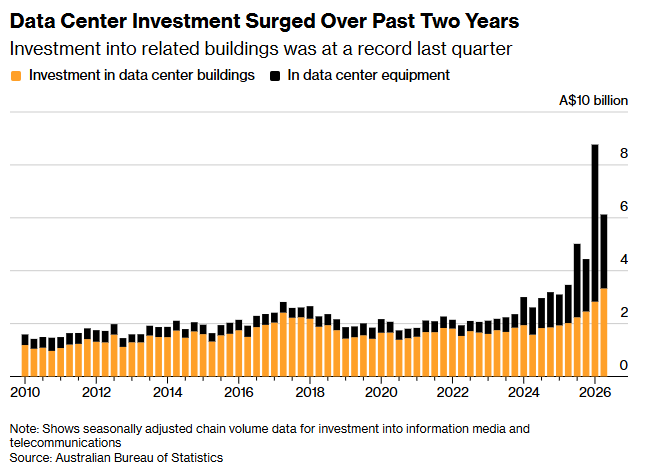
Australian data center investment has surged in the past two years
The report predicts that by the mid-2060s, Australia's average annual economic growth rate will slow to 2% from 3% in the past 40 years. The report indicates that conflict and competition are intensifying. While economic openness will continue to bring growth, reduce inflationary pressure, and boost Australian productivity, countries and businesses will need to balance supply chain efficiency with national security. “Future economic performance will depend on remaining open to reap the benefits of well-functioning markets while protecting against the severe shocks caused by geopolitical instability,” the report said.
Chalmers said Australia's fertility rate will “drop further and faster” than expected just three years ago. He said that Australia, which currently has an estimated population of 28.1 million, is expected to increase to about 39 million by the mid-2060s, which is lower than the previous forecast of more than 40 million people.
The report also emphasizes that “the pressure on intergenerational equity is increasing” due to long-term challenges brought about by changes in housing, demographic structure, and other structural economic trends. The report estimates that “if the housing ownership rate remains at the level of 1981, according to the latest data currently available, about 250,000 households between the ages of 25 and 34 will own their own homes”.