


3 Consumer Bank Stocks Facing The Biggest Rate Pressure Right Now
The Fed just nudged rates up to 3.75% to 4%, and that small move reshuffles the math for every U.S. consumer bank and credit card issuer you track. Higher borrowing costs can strain household budgets, yet they also change how interest income flows through lenders like the ones in this screener. This article walks through 3 stocks most exposed to that news, and shows how each could either help or hurt your portfolio story.
The three stocks that follow are just a sample from this rate sensitive corner of U.S. consumer banks and credit card lenders, and the full screen surfaced 53 more companies with equally compelling narratives that are not covered below. To see the rest of the universe in one place, head straight into the U.S. Consumer Banks and Credit Card Lenders screener to identify and analyze the highest conviction ideas for your watchlist.
World Acceptance (WRLD)
World Acceptance sits right in the sweet spot of this screener, focused on higher-rate consumer lending where every Fed move quickly reshapes what borrowers pay and what lenders earn. This makes the next part of its story especially important for you to watch.
"Investors may be overestimating the sustainability and pace of recent customer base and loan origination growth; recent results showed the highest new originations in years, but management indicates no intention to pursue double-digit portfolio growth, suggesting near-term revenue expectations may be too high."
What happens if a single pressure point on funding costs and credit quality shifts faster than those optimistic earnings assumptions allow for?
If you want to see how that pressure could accelerate or stall the next chapter for World Acceptance, read the full narrative for World Acceptance for the full risk reward picture.

Happen (HAPN)
Happen operates right where this screener focuses, offering U.S. consumers and small businesses a mix of digital banking and unsecured personal lending that reacts quickly when Fed policy shifts. This puts its credit card refinancing and debt consolidation franchise directly in the spotlight after the latest rate move.
Happen generates most of its roughly $1.4b in revenue through Happen Bank at about $1.38b, with a smaller contribution from the parent entity, and carries a market value near $1.9b. This keeps it squarely within the “sizable” consumer finance group targeted by this screen.
"The company's ongoing enhancement of proprietary data, AI-driven risk models, and direct control over its tech stack have enabled persistent outperformance in credit quality versus peers. This leads to lower credit losses, higher loan sale prices, and lower provisions, which structurally supports future improvements in net income and margins."
What happens if one quiet shift in how those loans are funded starts to matter more than all the efficiency work happening on the platform?
That funding shift is exactly what full narrative for Happen unpacks, revealing how Happen's credit engine could either accelerate or stall if capital costs start to decouple.

National Bank Holdings (NBHC)
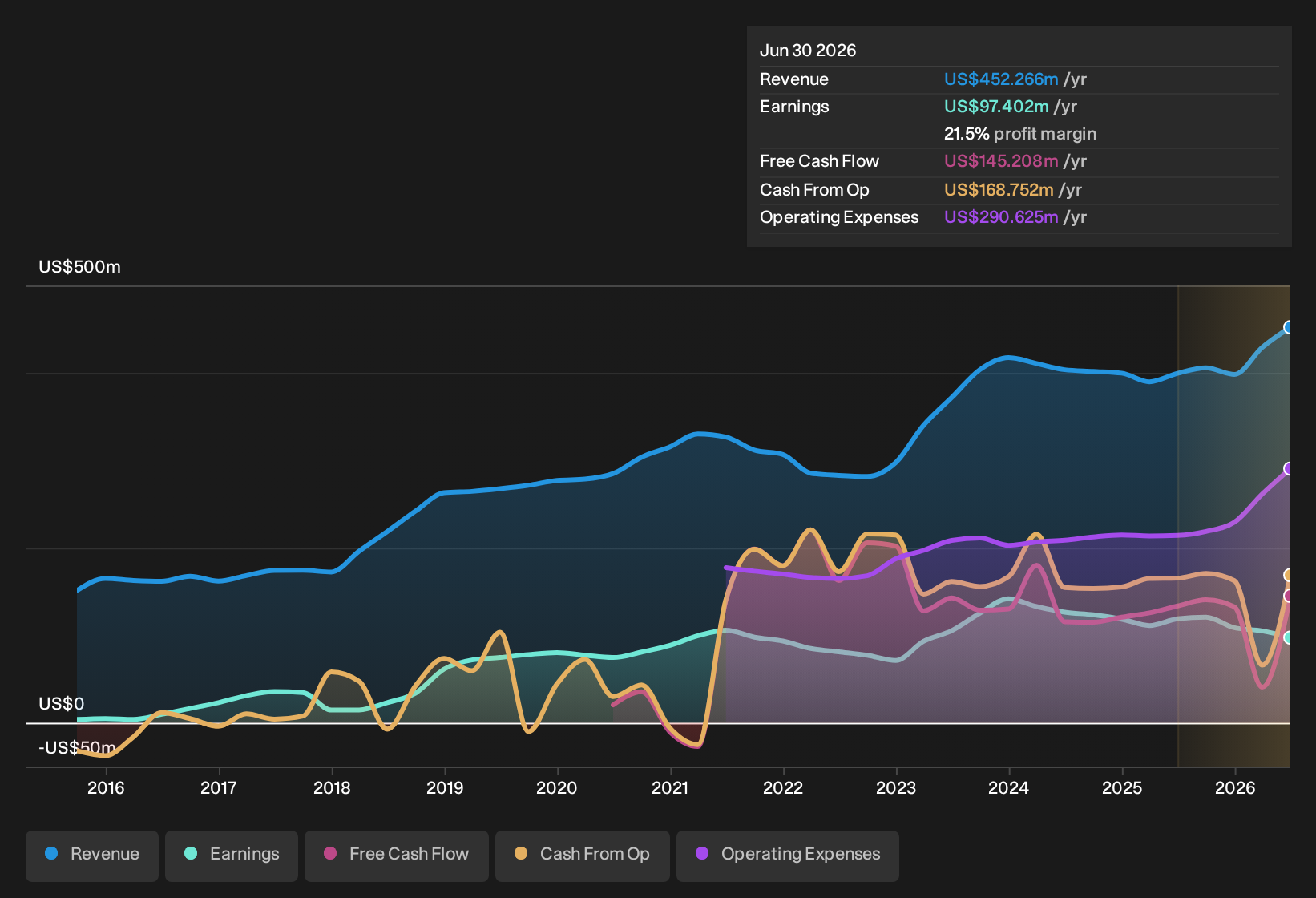
National Bank Holdings plugs into this rate sensitive bank and card issuers screen through NBH Bank, where consumer and business lending help shape how higher short term rates feed into interest income for a roughly US$1.8b regional player.
National Bank Holdings runs NBH Bank, a regional lender serving commercial, small business, and household customers, earning about US$452 million from core banking in the U.S., with a market value near US$1.8b.
"The successful launch of the 2UniFi platform, with positive early feedback and plans for further feature expansion (including fee-based membership offerings and integrated fintech services for SMBs), positions the company to capitalize on the shift toward digital banking and technology-driven financial solutions, potentially driving incremental noninterest income and expanding high-margin fee revenue streams."
For investors, the real swing factor is how one unseen shift in funding costs interacts with that higher margin digital push.
When that funding mix starts to bite, full narrative for National Bank Holdings shows how National Bank Holdings' digital push could still turn higher rates into an accelerating earnings story.
Seeking Fresh Alternatives Before They Fly
Fresh ideas tend to move first. By the time the crowd notices the breakout, the most attractive entry points may already be out of reach. Scan these under the radar lists while it matters to evaluate opportunities at an earlier stage.
- Identify potential cash generative compounders early by running your portfolio ideas through the 35 high quality undervalued stocks before momentum traders start focusing on stretched valuations.
- Track practical AI momentum by filtering for real earnings power with the 38 profitable AI stocks that aren't just burning cash while many investors still emphasize stories that are burning cash.
- Consider the grid upgrade cycle by reviewing the curated 39 power grid technology and infrastructure stocks and evaluating infrastructure plays before they attract wider attention.
This article by Simply Wall St is general in nature. We provide commentary based on historical data and analyst forecasts only using an unbiased methodology and our articles are not intended to be financial advice. It does not constitute a recommendation to buy or sell any stock, and does not take account of your objectives, or your financial situation. We aim to bring you long-term focused analysis driven by fundamental data. Note that our analysis may not factor in the latest price-sensitive company announcements or qualitative material. Simply Wall St has no position in any stocks mentioned.
Have feedback on this article? Concerned about the content? Get in touch with us directly. Alternatively, email editorial-team@simplywallst.com