


3 Consumer Fintech Stocks Retail Investors Are Watching for High Yield Savings
When the Fed lifts rates to 4% and borrowing costs rise across credit cards, car loans, and mortgages, the ripple effect hits consumer fintechs and online banks in very different ways. Some businesses gain fresh appeal as high yield savings providers. Others face slower customer spending and tougher funding conditions. This article examines three stocks exposed to this news, outlining where higher rates might help and where investors may want to tread carefully.
The stocks covered below are just a starting sample, while the full screen surfaced 10 more U.S. consumer fintechs and online banks with equally compelling rate and savings narratives that are not discussed here. To identify and analyze those additional high yield players in one place, head straight to the U.S. Consumer Fintechs & Online Banks Offering High‑Yield Savings screener.
SLM (SLM)
SLM Corporation ties into this high yield savings screen as a consumer finance player that sits closer to private education lending than pure online banking. This distinction matters for how higher Fed rates flow through to its funding mix, interest margins, and loan demand.
SLM Corporation primarily originates and services private education loans for US students and families, while also offering online high yield savings, money market accounts, and CDs. It generated about US$1.7b from consumer financial services and has a market value near US$4.8b.
The company is positioning itself as a key private lender as recent federal reforms change how students and families use government loan programs, which can support private loan demand and future revenue.
What happens if a single pressure point in its credit performance and funding costs shifts at the same time as those reforms mature?
That hinges on how funding costs, credit trends, and student demand intersect in the next phase. Read the full narrative for SLM to see how these forces could be quietly accelerating or masking SLM's potential.

Ally Financial (ALLY)
Ally Financial plugs directly into this high yield savings theme as a digital bank where rate sensitive customers park cash, while the wider group still leans heavily on auto finance, insurance, and middle market lending.
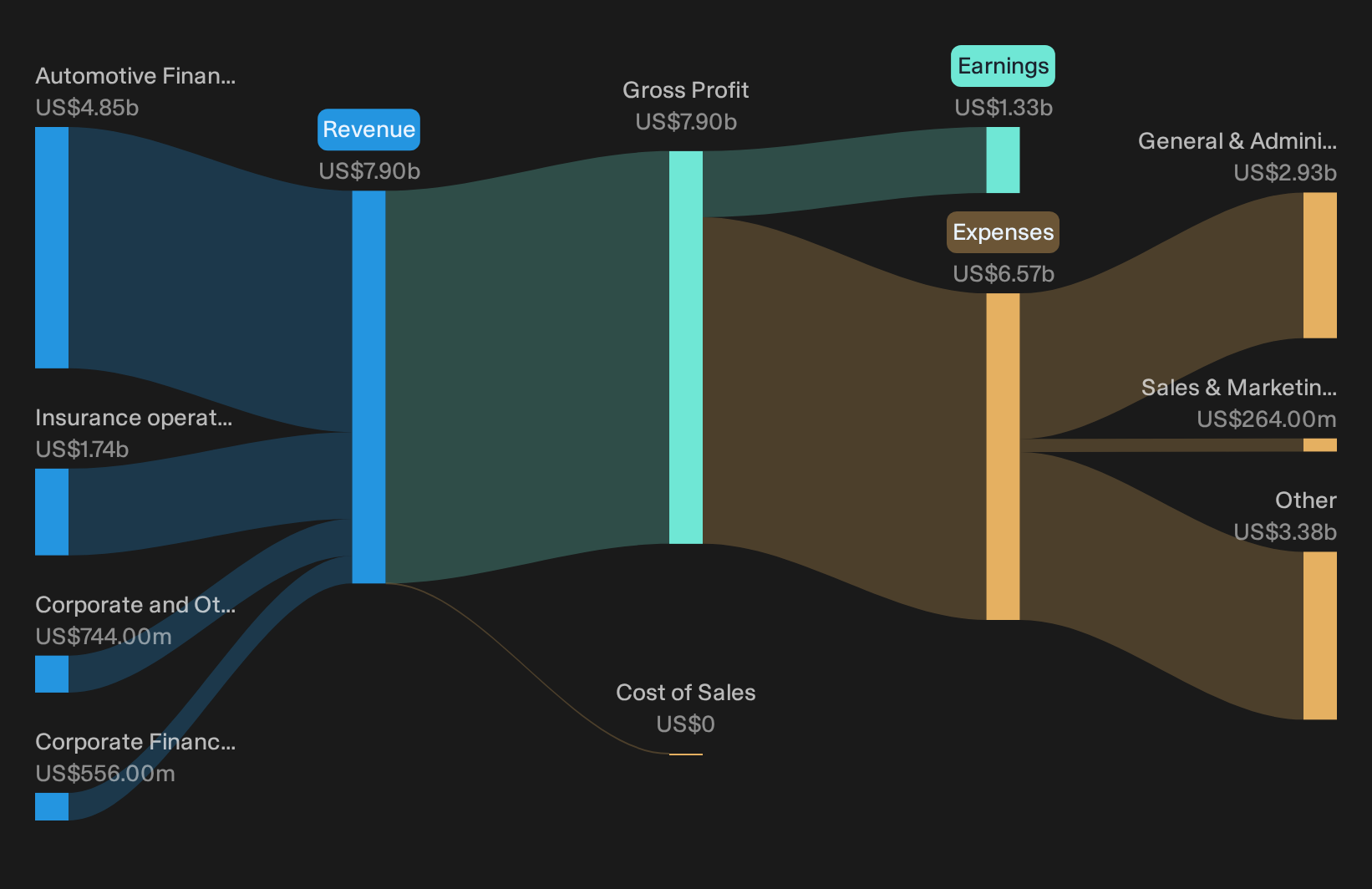
Ally Financial runs a largely online bank alongside its auto and commercial finance arms, generating about US$4.9b from Automotive Finance, US$1.7b from Insurance, US$556 million from Corporate Finance, and US$744 million from Corporate and Other, with a market value around US$12.1b.
The continued rise of electric vehicle adoption and alternative mobility solutions, like subscription services and ride-sharing, threatens to structurally reduce traditional auto ownership rates. As a result, Ally's core auto lending business could face sustained pressures on origination volumes, creating a negative long-term impact on top-line revenue and curbing growth prospects.
What really matters now is how one quiet shift in its rate sensitive deposit base alters the balance between funding costs, pricing power, and long run profitability.
That quiet shift starts with deposits. Read the full narrative for Ally Financial to see how Ally Financial could turn rate sensitive funding into an accelerating edge for returns.
Enova International (ENVA)
Enova International plugs into this high yield focused screen as a purely online lender, using data and software to serve consumers and small businesses that want fast access to credit and cash style products.
Enova International generates about US$1.7b from consumer financial services and has a roughly US$4.3b market value, giving it meaningful scale in tech driven nonbank lending.
Higher Fed rates, tighter credit, and a tougher backdrop for small firms all put a spotlight on how Enova prices risk, sources funding, and manages loan quality across cycles.
The ongoing migration of small businesses and consumers toward digital lending, supported by preferences for speed and convenience, continues to drive strong demand and originations for Enova, which is well positioned with its online only business model.
What happens if one quiet shift in funding costs or credit performance changes the balance between that demand and future profitability.
When that balance shifts, read the full narrative for Enova International to see how Enova International's data engine could be accelerating upside while quietly capping downside risk.

Seeking Alternatives Before Momentum Flies
Fresh ideas move first. When the next breakout builds quiet momentum, late money often gets caught chasing what is already flying. Scan these under the radar lists while it matters and consider your options early.
- Identify companies with strong balance sheets before they attract a crowd by running the list of solid balance sheet and fundamentals (23 results) and focusing on fundamentals that can support staying power through different rate cycles.
- Track developments in automation by monitoring the 95 robotics and automation stocks and paying attention to companies involved in long term demand for smarter, faster production.
- Follow potential power grid upgrades by scanning the 37 power grid technology and infrastructure stocks and concentrating on infrastructure players that may be aligned with spending on resilience and electrification.
This article by Simply Wall St is general in nature. We provide commentary based on historical data and analyst forecasts only using an unbiased methodology and our articles are not intended to be financial advice. It does not constitute a recommendation to buy or sell any stock, and does not take account of your objectives, or your financial situation. We aim to bring you long-term focused analysis driven by fundamental data. Note that our analysis may not factor in the latest price-sensitive company announcements or qualitative material. Simply Wall St has no position in any stocks mentioned.
Have feedback on this article? Concerned about the content? Get in touch with us directly. Alternatively, email editorial-team@simplywallst.com