


The wave of sell-off in US debt ushered in the “dawn”! The 5% high interest rate opportunity attracts a crazy influx of capital
The Zhitong Finance App learned that although the world's largest bond market is shrouded in all kinds of anxiety, some investors have seen an attractive reason to buy — profit.
As high inflation, expanding budget deficits, and a wave of corporate issuances jointly drove the sell-off of US Treasury bonds for several months, the US Treasury bond market reached another important milestone this week — the yield on the benchmark 10-year US Treasury bond broke 5% for the first time in nearly three years, and then as the risks facing global crude oil supply continued to increase oil prices, the 10-year US Treasury yield further rose to the highest level since 2007.
After the Federal Reserve raised interest rates for the first time in more than three years as scheduled on Wednesday, and gave a signal that it would raise interest rates further in the future, the continued upward trend in US Treasury yields has temporarily abated, at least for now.
However, the rise in US Treasury yields has caused significant losses to investors, and major bond indices have lost money in 2026 and the past five years. Rising yields on long-term treasury bonds have also added resistance to the economy, and mortgage interest rates have risen to their highest level in more than a year.
Fortunately, for investors, one possible “dawn” is that they now have an opportunity that has only been occasional since the global financial crisis — to buy now and lock in an annualized return of around 5% for the next 10 years or more. A growing number of money managers are finding this opportunity difficult to turn down.
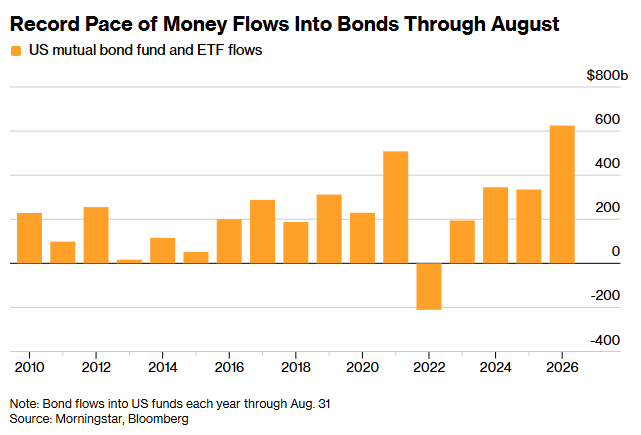
As of the end of August, bond capital inflows reached a record
According to Morningstar data, as of the end of August, there was a net inflow of 625 billion US dollars into US bond mutual funds and exchange-traded funds (ETFs) this year, the highest level for the same period since statistics began in 2010. Asset managers, including Pacific Investment Management (PIMCO) and Vanguard Group (Vanguard Group), expect this inflow of capital to accelerate as investors realign their portfolios and move from stocks to fixed income assets.
Kevin Nicholson, chief global fixed income investment officer at Riverfront Investment Group, said: “These interest rates are very attractive for investment capital, especially when you consider this type of investor — who has been fully allocating shares for the past 15 years or more.” Kevin Nicholson said that the company has increased its holdings of bonds with shorter maturities and is also considering buying bonds with longer maturities.
For Daleep Singh, chief global economist at Prudential Global Investment Management (PGIM), capital inflows are of additional importance as the market fears that massive borrowing by hyperscalers (hyperscalers) in the field of artificial intelligence (AO) is boosting US Treasury yields. This background also created conditions for US Treasury Secretary Bessent to take steps to reduce long-term yields, including increasing the Treasury's repurchases of long-term debt.
Daleep Singh said that the 10-year and 30-year US Treasury bond auctions performed well last week, which allayed market concerns to a certain extent. In particular, the issuance of 30-year long-term treasury bonds had a final yield of about 5.31%, and demand performance hit a very strong level in history.
Buyers also began entering the market earlier this week when the 10-year US Treasury yield surpassed 5%. These buying actions were verified as yields fell below this level after the Federal Reserve announced its interest rate decision. On Thursday, the 10-year yield fell to 4.93%.
Daleep Singh said that the amount of capital flowing into the bond market is “absolutely encouraging” and “even if record-scale corporate bond issuances are competing for the same funding pool, US Treasury issuance is still attractive at such a level of yield.”
It is worth mentioning that the trend of higher yields has spread to the US investment-grade fixed income market. One of the indicators known as the “worst yield-to-worst yield” (yield-to-worst) of the Bloomberg US Composite Bond Index (yield-to-worst) — that is, the worst annualized return an investor can get if they buy a bond now and hold it until maturity, or if the issuer makes early repayment — has risen to 5.3% from 4.15% before the outbreak of the Middle East War in February.
Compared to ultra-secure money market funds, the prospect of bonds earning more than 5% a year is becoming more attractive. Before the Federal Reserve raised interest rates, money market funds had an average yield of around 3.4%. Meanwhile, the spread between 10-year Treasury yields and the dividend yield expected by the S&P 500 index next year is close to the highest level in 20 years.
Matt Wrzesniewsky, head of portfolio management for fixed income clients at Pioneer Group, said: “The bonds are back and so are the returns. It's a very powerful tool to use.” “A yield of 5% is usually the level at which a market begins to really come to a consensus.”
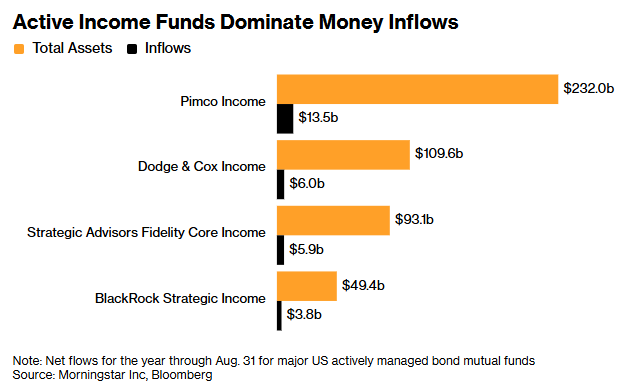
Active income funds dominate capital inflows
Admittedly, investors have heard that bonds are attractive many times over the past five years, but then unexpectedly strong economic growth and inflation, as well as concerns about the fiscal outlook, once again lost support for the logic of bullish bonds. Hoisington Investment Management, a long-term bully in the US bond market, turned bearish in July due to concerns about debt and inflation.
However, even if the US composite bond index fell 1.6% cumulatively during the year as of Wednesday, and is expected to record its first annual decline since 2022, bond buyers still have reason to remain confident. The mathematical relationship between bonds means that given the current level of revenue generated by the index, if the yield of the US Composite Bond Index rises to 6.2% in the next year, investors entering the market now will only begin to lose money. And the benchmark index has never had the worst return to maturity of more than 6% since 2001.
Michael Cudzil, senior portfolio manager at Pacific Investment Management, said: “For investors buying at current levels, there is still a significant upward buffer in yield.”
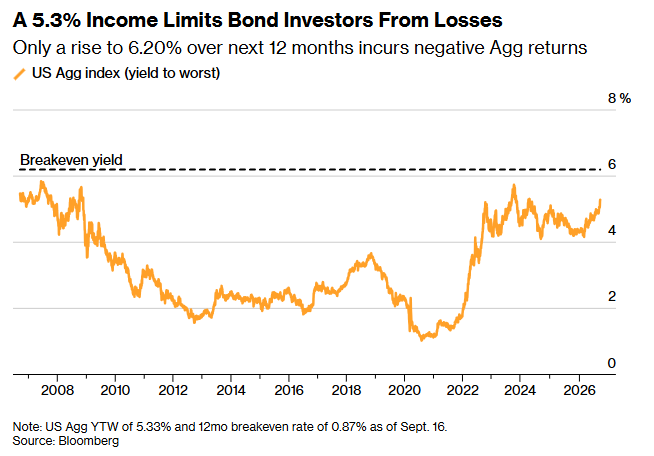
The US Composite Bond Index will only show negative returns if the yield rises to 6.20% in the next 12 months
Furthermore, the continued rise in the stock market has now entered its fourth year, which has also largely boosted market demand for bonds. According to Morningstar's data, target-date funds (target-date funds) will become more conservative as investors approach retirement. Since the end of 2023, such funds have been increasing their bond holdings every quarter. As a large number of baby boomers prepare to leave the labor market in the next few years, the need for stable investment income is likely to persist, especially when returns are at high levels.
Shelly Antoniewicz, chief economist at the Investment Company Institute, said, “We are still in a demographic cycle where baby boomers are gradually shifting to investment types with stable cash flow (bonds and dividend-paying stocks) and away from net growth stocks.”
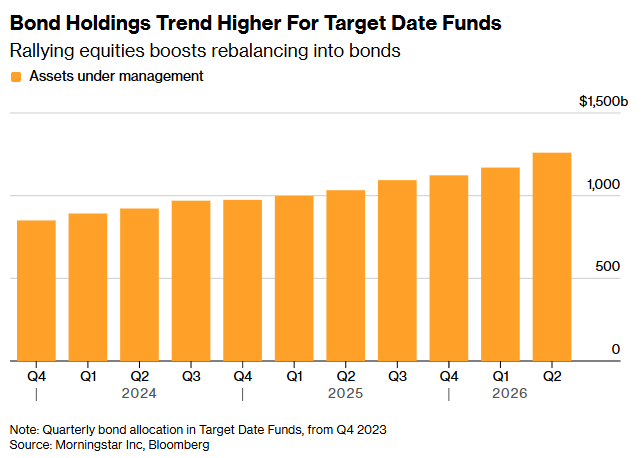
The rise in the stock market pushes capital to be reallocated to bonds