


How Investors Are Reacting To Synaptics (SYNA) Robotics Simulation Support
- Synaptics announced that its first CTS module, powered by the SN6012T touch controller and designed for dexterous robotic hands and Physical AI systems, is now supported within NVIDIA Isaac Sim and works with Astra Edge AI processors and NVIDIA Holoscan.
- The CTS module’s high density 5x12 taxel array, fast rebound sensor design, and native support for NVIDIA’s Newton engine are intended to make Synaptics’ hardware easier to prototype, validate, and integrate into next generation robotics platforms.
- This development provides additional context for understanding Synaptics' investment narrative around Edge AI and Core IoT, particularly in light of the NVIDIA Isaac Sim integration.
Synaptics Investment Narrative Recap
To own Synaptics, you need to believe that Core IoT and Edge AI can shift the business from legacy PC and mobile exposure toward higher value, system level solutions. The Isaac Sim support for its CTS module fits that story because it reinforces a use case where Synaptics combines sensors and Astra processors into a single, testable platform for customers.
The near term swing factor is still execution on scaling Core IoT design wins into meaningful revenue while the company remains unprofitable with a recent loss of US$490.8m. The biggest risk stays the same. Channel build out, product focus, and funding needs all have to be managed while debt is not well covered by operating cash flow.
The CTS module integration lines up directly with Synaptics’ Astra Edge AI processors, which are already positioned as a hub for touch, vision, and motion data with support for NVIDIA Holoscan. That makes this announcement more than a single product update. It is another point of evidence that the firm is trying to sell complete building blocks for Physical AI and robotics.
If Astra based systems gain traction, that could support the existing catalyst narrative built around Core IoT growth, higher silicon content per device, and more differentiated AI solutions. The flip side is execution risk. If industrial and robotics customers are slow to adopt, Synaptics keeps carrying the cost of this R&D and platform work while profitability and cash coverage of debt remain key pressure points.
Analysts currently frame Synaptics' setup around revenue rising to US$1.6b and earnings reaching US$21.2m by 2029, which implies 9.4% yearly sales growth and a swing in earnings of roughly US$512m from a loss of US$490.8m today.
Uncover why Synaptics' fair value indicates a 43% potential upside to its current price, which could narrow quickly.
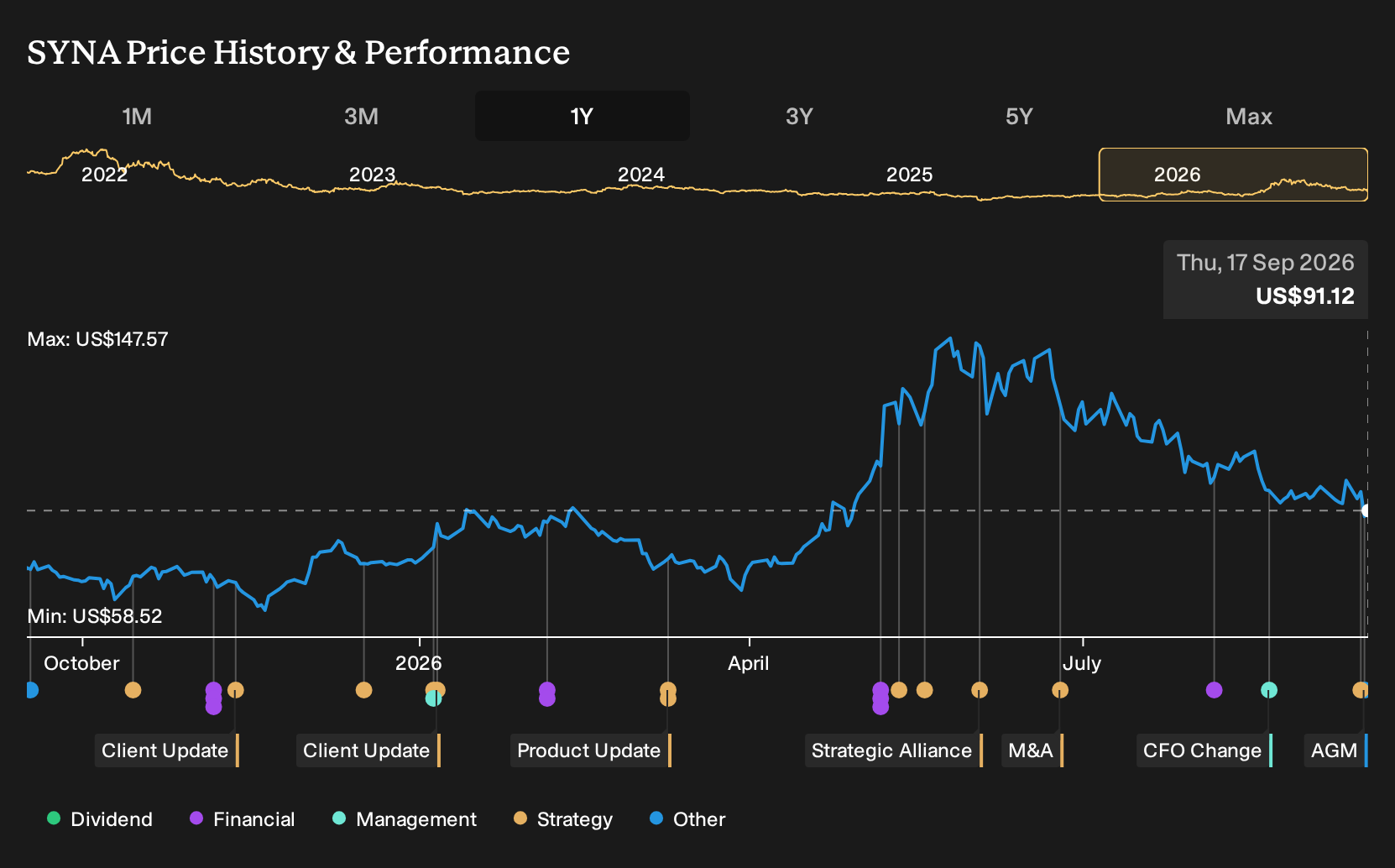
Exploring Other Perspectives
One alternate view focuses on ramp timing risk for Synaptics. Before this CTS news, the most cautious analysts already highlighted slow Astra and Core IoT rollouts, while still estimating about US$1.6b of revenue and US$23.0m of earnings by 2029. This update can be treated as a reason to recheck those assumptions and compare multiple narratives.
Explore 4 other Synaptics fair value estimates, including one that suggests as much as 13% downside from the current price.
Reach Your Own Conclusion
Disagree with existing narratives? Extraordinary investment returns rarely come from following the herd, so trust your own analysis.
- A great starting point for your Synaptics research is our analysis highlighting 2 key rewards and 1 important warning sign that could impact your investment decision.
- See our latest analysis for Synaptics. The report includes a comprehensive fundamental analysis summarized in a single visual, the Snowflake, making it easy to evaluate Synaptics' overall financial health at a glance.
Looking for more investment ideas beyond Synaptics?
Once the Synaptics story is clear in your mind, it can help to set it alongside other opportunities that match different priorities such as value, balance sheet strength, or risk profile. A screener lets you do that quickly without getting lost in endless tickers.
- If you want quality and value in the same place, start with a curated 29 high quality undervalued stocks that combine solid fundamentals with prices that analysts assess as below fair value.
- For readers who care most about resilience and capital protection, narrow your search to a 11 resilient stocks with low risk scores that score well on stability and downside risk measures.
- If your priority is financial strength above all else, focus on a list of solid balance sheet and fundamentals (23 results) where low leverage and healthy fundamentals do the heavy lifting.
This article by Simply Wall St is general in nature. We provide commentary based on historical data and analyst forecasts only using an unbiased methodology and our articles are not intended to be financial advice. It does not constitute a recommendation to buy or sell any stock, and does not take account of your objectives, or your financial situation. We aim to bring you long-term focused analysis driven by fundamental data. Note that our analysis may not factor in the latest price-sensitive company announcements or qualitative material. Simply Wall St has no position in any stocks mentioned.
Have feedback on this article? Concerned about the content? Get in touch with us directly. Alternatively, email editorial-team@simplywallst.com