


Data Center Expansion Might Change The Case For Investing In Microsoft Stock (MSFT)
- Microsoft plans to more than triple its global data center capacity to over 38 gigawatts by 2032, with a large share aimed at AI workloads and supported by long term power, regulatory, and marketplace partnerships across Azure and broader cloud services.
- This build out arrives alongside strong Azure revenue disclosure, deepening AI integrations with customers and regulators, and significant partner activity on Microsoft Marketplace. Together, these trends highlight how infrastructure, compliance, and workload demand are increasingly linked for the business.
- We will now look at how this massive data center expansion reshapes Microsoft's investment narrative around AI driven cloud demand.
Microsoft Investment Narrative Recap
To own Microsoft, you need to believe its heavy AI and cloud investments convert into durable usage across Azure, Copilot, and the broader software stack, without eroding profitability. The short term swing factor is still execution on AI capacity and power, plus turning that $678b backlog into realized, high quality revenue. The latest customer and Marketplace news does not materially change that core bet.
The biggest near term risk remains that AI infrastructure spending runs ahead of real demand, which could pressure free cash flow and margins if workloads slow. Added reliance on large AI and hyperscaler clients, alongside potential capacity bottlenecks or grid constraints, keeps operational delivery risk firmly in focus for shareholders.
Among recent updates, the expanded partnership with Talkdesk around Customer Experience Automation is especially relevant. It uses Microsoft Azure commitments and Marketplace to make it easier for enterprises to deploy AI agents across customer service, tying Microsoft’s cloud consumption, AI tools, and partner ecosystem into a single commercial path.
This matters for catalysts because it shows how AI infrastructure, Marketplace distribution, and partner workloads can feed each other. If more software providers follow Talkdesk’s model and lean on Azure commitments, Microsoft could see deeper engagement from existing clients, while still needing to manage the same CapEx, power, and delivery risks outlined above.
Microsoft’s current analyst storyline assumes revenue reaches US$567.2b and earnings land at US$212.2b by 2029, based on 19.6% yearly revenue growth and an earnings increase of about US$78.5b from US$133.7b today.
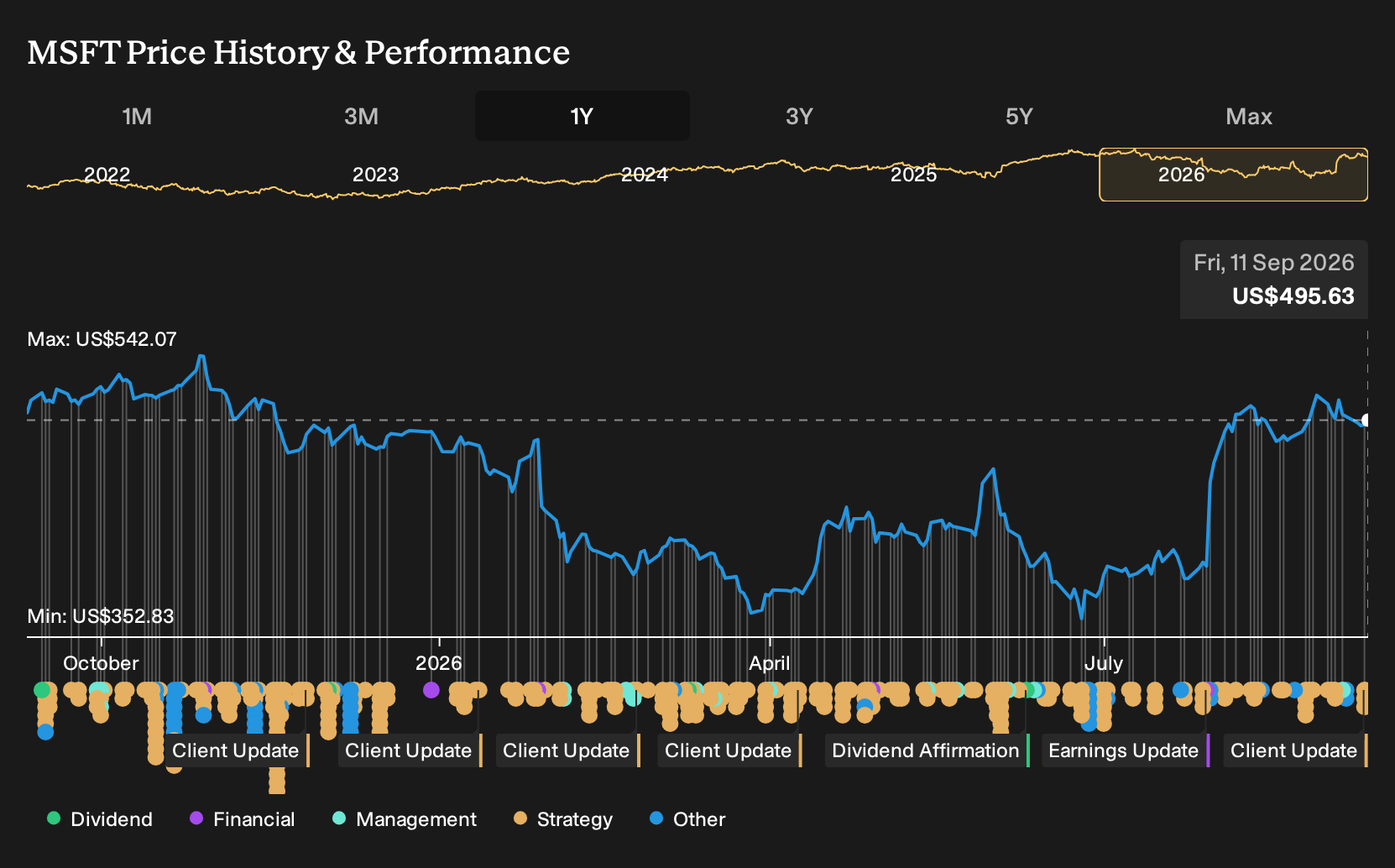
Uncover why Microsoft's fair value indicates a 16% potential upside to its current price that may not last much longer.
Exploring Other Perspectives
One alternate view focuses less on AI marketplace momentum and more on the risk that Microsoft’s heavy AI CapEx simply does not pay off. The lowest analysts were only baking in revenue of about US$496.0b and earnings of US$200.4b by 2029, paired with a 19.9x P/E, which reflects a much more cautious narrative. These forecasts were set before the latest Marketplace partnerships, so you may see them shift as investors reassess how deals like Talkdesk and TrueFoundry reshape the balance between infrastructure spending and real AI usage.
Explore 61 other Microsoft fair value estimates, including one that suggests as much as 20% downside from the current price.
Reach Your Own Conclusion
Don't just follow the ticker. Dig into the data and build a conviction that's truly your own.
- A great starting point for your Microsoft research is our analysis highlighting 3 key rewards and 1 important warning sign that could impact your investment decision.
- See our latest analysis for Microsoft. The report includes a comprehensive fundamental analysis summarized in a single visual, the Snowflake, making it easy to evaluate Microsoft's overall financial health at a glance.
Looking For More Ideas Beyond Microsoft?
Once you have a view on Microsoft, it can help to compare that thesis with other opportunities that share similar qualities or offer different risk and reward profiles. The Simply Wall St Screener gives you a fast way to filter for stocks that match the type of portfolio you want to build.
- If you want to focus on potential mispricing, start with companies that combine quality fundamentals with the possibility of a discount to intrinsic value through the 32 high quality undervalued stocks.
- For investors who care most about resilience and capital preservation, you can narrow the field to businesses with stronger balance sheets and cleaner fundamentals using the list of solid balance sheet and fundamentals (23 results).
- If you are hunting for opportunities that the market may be overlooking, consider screening for financially sound but less widely followed companies through the 15 high quality undiscovered gems.
This article by Simply Wall St is general in nature. We provide commentary based on historical data and analyst forecasts only using an unbiased methodology and our articles are not intended to be financial advice. It does not constitute a recommendation to buy or sell any stock, and does not take account of your objectives, or your financial situation. We aim to bring you long-term focused analysis driven by fundamental data. Note that our analysis may not factor in the latest price-sensitive company announcements or qualitative material. Simply Wall St has no position in any stocks mentioned.
Have feedback on this article? Concerned about the content? Get in touch with us directly. Alternatively, email editorial-team@simplywallst.com