


3 Bank Stocks With Rising Rate Exposure and Strong Deposit Franchises
Interest rates across major economies are climbing again, central banks are leaning hawkish, and inflation worries refuse to fade, so bank stocks are back in the spotlight. Some large lenders could gain from higher policy rates, while others face tougher funding and credit conditions. This article unpacks that tension and examines three global large cap bank stocks that appear well placed to navigate the latest rate shock.
The three stocks covered below are a small sample, and the full screen surfaced 55 more large cap banks with equally compelling stories that are not covered here. To go beyond the short list and identify which lenders best fit your own risk profile, head straight into the Global Large-Cap Bank Stocks (Beneficiaries of Rising Interest Rates) screener.
Royal Bank of Canada (TSX:RY)
Overview: Royal Bank of Canada is a large universal bank that collects deposits and provides lending, wealth, insurance, and capital markets services worldwide.
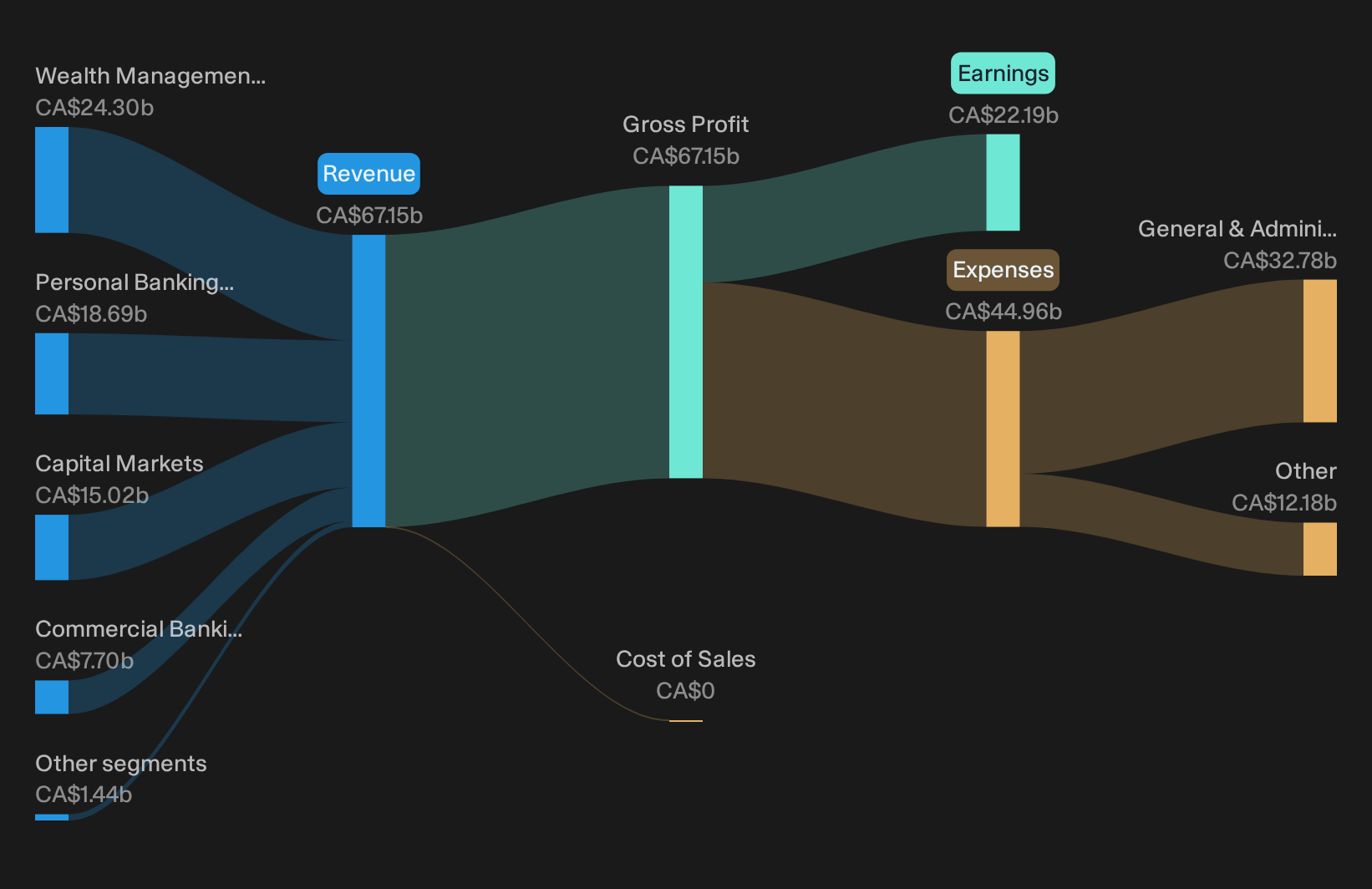
Operations: Royal Bank of Canada generates revenue primarily from Wealth Management at about CA$24.3b, Personal Banking at CA$18.7b, and Capital Markets at CA$15.0b.
Market Cap: CA$394.8b
Royal Bank of Canada sits near the center of this rising rate theme, because its deposit rich franchise can translate policy moves into lending margins.
"Strategic investments in AI and digitalization, such as the ATOM Foundation and Lumina platform, expanded use of data analytics, and digital banking product launches, are driving cost efficiencies, deeper customer engagement, and higher transaction volumes, which should support future revenue and net margin growth.
What matters next is how one quiet shift in funding and credit costs shapes how much of that margin potential actually reaches shareholders.
When funding costs start to bite, the full narrative for Royal Bank of Canada shows how Royal Bank of Canada could still convert its digital push into accelerating earnings power and resilient returns.
Bank of Montreal (TSX:BMO)
Overview: Bank of Montreal is a large North American lender focused on everyday banking, commercial credit, wealth advice, and capital markets services that are closely tied to G7 interest rate cycles.
Operations: Bank of Montreal generates revenue primarily from Canadian Personal and Commercial Banking at about CA$10.6b, U.S. Banking at CA$11.0b, and Capital Markets at CA$8.2b, with Wealth Management contributing CA$6.0b.
Market Cap: CA$168.5b
Bank of Montreal gives this rising rate screen a pure play feel, because its sizeable Canadian and U.S. deposit and loan books sit right where G7 policy moves feed directly into net interest income.
"BMO's continued investment in digital and AI-powered banking platforms, such as the LUMI Assistant and multiple award-winning payment innovations, is improving operational efficiency and customer engagement, which should drive increased net margins and persistently positive operating leverage."
What really matters for investors is how resilient that margin story looks if one unseen pressure on credit costs starts to build.
As those credit pressures build, the full narrative for Bank of Montreal shows how Bank of Montreal's digital momentum could keep earnings accelerating while risk costs quietly shift in the background.

Bank of Nova Scotia (TSX:BNS)
Overview: Bank of Nova Scotia is a large Canadian lender whose global deposit and loan franchise links rising policy rates to interest income.
Operations: Bank of Nova Scotia generates revenue mainly from Canadian Banking at CA$11.9b, International Banking at CA$9.6b, Global Wealth Management at CA$7.1b, and Global Banking and Markets at CA$6.8b.
Market Cap: CA$158.0b
Bank of Nova Scotia gives this higher rate screen an international flavor, because its Canadian retail engine is paired with sizeable Pacific Alliance lending and wealth operations where policy moves are feeding directly into spreads.
"Expansion of banking and wealth management services in high-growth Pacific Alliance countries (Mexico, Peru, Chile, Colombia) positions BNS to capture revenue growth from increasing financial inclusion and rising middle-class demand for loans and investment products, supporting future top-line and earnings expansion."
What really moves the needle for Bank of Nova Scotia now is how one still underappreciated shift in credit costs shapes that rate-driven income story.
That credit shift is the real swing factor, and the full narrative for Bank of Nova Scotia lays out how Bank of Nova Scotia could turn those pressures into accelerating earnings resilience.

Seeking Alternatives Before The Crowd
Fresh ideas move first. By the time a breakout is flying, early entry is gone and momentum is already caught. Scan these under the radar picks now and evaluate them while they are still less widely followed.
- Explore reliable income streams before yields attract more income-focused investors with the 2 dividend fortresses curated to spotlight durability as well as payout strength.
- Look for under followed growth stories that still appear overlooked on the numbers using the 9 high quality undiscovered gems curated for quality balance sheets and cleaner earnings.
- Research the next AI infrastructure wave while valuations still appear grounded through the 89 AI infrastructure stocks curated for real cash flows, not hype.
This article by Simply Wall St is general in nature. We provide commentary based on historical data and analyst forecasts only using an unbiased methodology and our articles are not intended to be financial advice. It does not constitute a recommendation to buy or sell any stock, and does not take account of your objectives, or your financial situation. We aim to bring you long-term focused analysis driven by fundamental data. Note that our analysis may not factor in the latest price-sensitive company announcements or qualitative material. Simply Wall St has no position in any stocks mentioned.
Have feedback on this article? Concerned about the content? Get in touch with us directly. Alternatively, email editorial-team@simplywallst.com