


How Investors Are Reacting To ITW Stock Broad Based Growth Continues
- Illinois Tool Works reported broad-based segment growth and strong demand for new products, supported by enterprise initiatives that helped maintain profitability despite softer conditions in automotive OEM and foodservice equipment, and the business now targets 3 to 4% organic revenue growth for 2026 while continuing dividends and share buybacks.
- The combination of diversified segment momentum and ongoing enterprise programs gives Illinois Tool Works more room to offset pressure in weaker end markets and still support its stated focus on shareholder returns.
- We will now look at how Illinois Tool Works' investment narrative lines up with this broad-based growth and enterprise initiative progress.
Look beyond Illinois Tool Works' steady enterprise programs and see how other industrial players with similar fundamentals line up in our hand picked list of solid balance sheet and fundamentals (23 results).
Illinois Tool Works Investment Narrative Recap
To own Illinois Tool Works, you need to be comfortable with a steady, execution-driven story. The thesis hinges on broad-based growth across its seven segments, customer-backed product development, and enterprise initiatives that aim to lift margins even when specific end markets cool. Management is now talking about 3% to 4% organic revenue growth in 2026, which frames expectations more clearly.
The key short term swing factor is whether those enterprise programs can keep offsetting pressure in weaker areas like automotive OEM and foodservice equipment. Recent commentary does not radically change that setup. The biggest risk still sits in segment level softness or tariff and demand shocks that could erode organic growth and net margins at the same time.
The most relevant fresh data point is management’s target for 3% to 4% organic revenue growth in 2026 while keeping dividends and buybacks in the mix. That update ties directly to Illinois Tool Works’ long running push for above market organic gains and margin benefits from its enterprise initiatives, rather than one off cost cuts.
For you as a shareholder, the question is whether that growth ambition feels realistic given pockets of weakness in automotive, construction and test and measurement. If execution on enterprise programs and new product demand holds up, it can help counter those segment risks. If not, the combination of high debt levels and slower expected top line growth becomes more of a concern for the medium term story.
Illinois Tool Works' analyst narrative points to forecast revenue of US$18.4b and projected earnings of US$3.8b by 2029, anchored to an assumed 3.8% yearly revenue growth rate, with an earnings increase of about US$0.6b from current earnings of US$3.2b.
Uncover why Illinois Tool Works' fair value indicates an 11% potential upside to its current price that could narrow quickly.
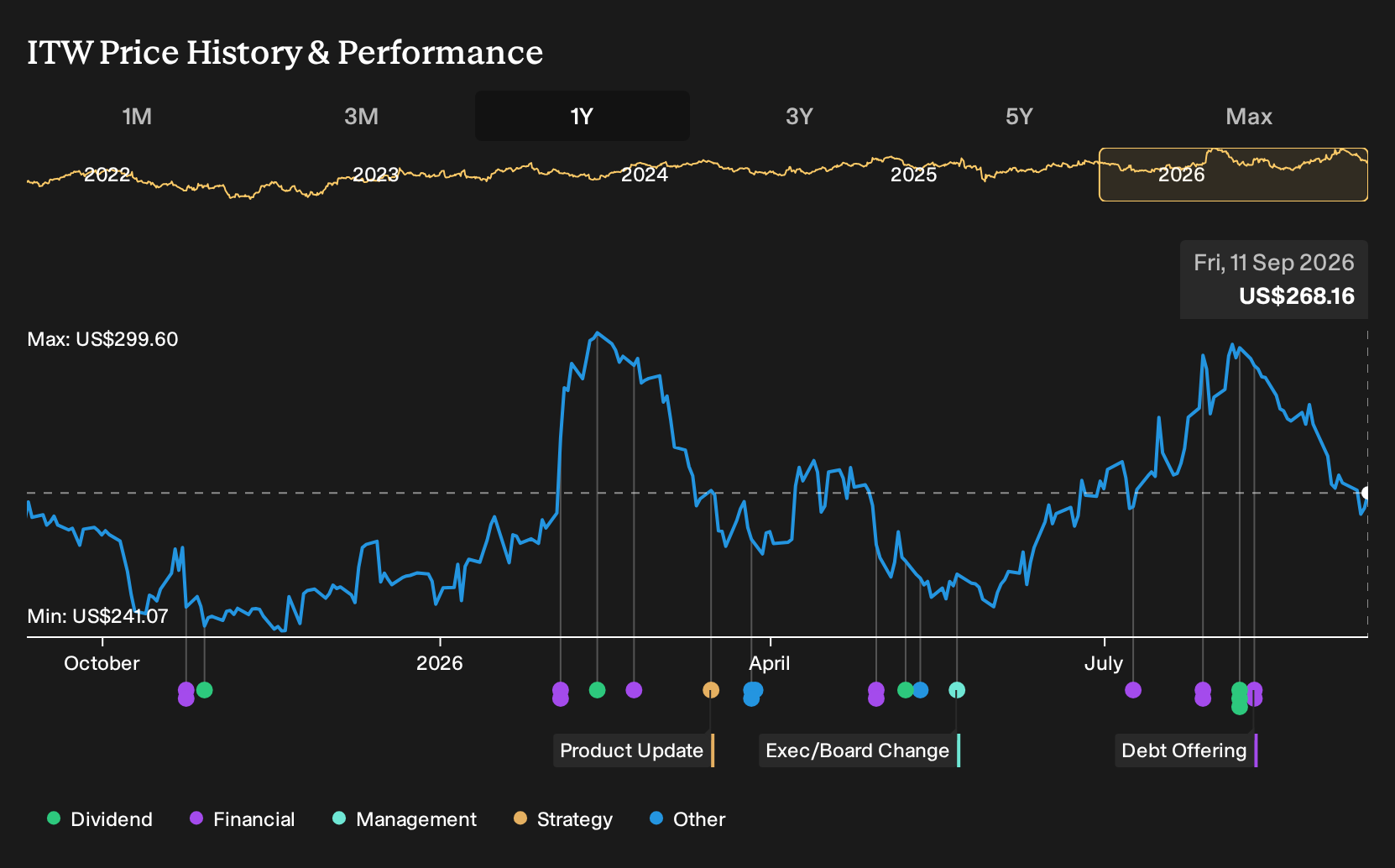
Exploring Other Perspectives
Two fair value views from the Simply Wall St Community span roughly US$172 to US$296 per share, which is a wide gap for the same Illinois Tool Works story. That spread sits against recent pressure in automotive, construction and Test & Measurement, as well as ongoing enterprise initiatives, so you should compare several community viewpoints before leaning on any single valuation.
Explore another Illinois Tool Works fair value estimate, including one that suggests as much as 36% downside from the current price.
Reach Your Own Conclusion
Don't just follow the ticker. Dig into the data and build a conviction that's truly your own.
- A great starting point for your Illinois Tool Works research is our analysis highlighting 4 key rewards and 1 important warning sign that could impact your investment decision.
- See our latest analysis for Illinois Tool Works. The report includes a comprehensive fundamental analysis summarized in a single visual, the Snowflake, making it easy to evaluate Illinois Tool Works' overall financial health at a glance.
Looking for more investment ideas beyond Illinois Tool Works?
If the Illinois Tool Works story has sharpened your thinking, you can use that same lens across a wider opportunity set using the Simply Wall St Screener. Focus on the criteria that matter most to you and let the data do the heavy lifting.
- If capital protection comes first, review our 11 resilient stocks with low risk scores to see businesses that score well on stability and downside resilience.
- For investors seeking quality at a sensible entry point, explore the 32 high quality undervalued stocks and compare fundamentals with your own margin of safety rules.
- If you prefer companies that are not widely followed, sort through the 15 high quality undiscovered gems and look for opportunities that may not yet be crowded.
This article by Simply Wall St is general in nature. We provide commentary based on historical data and analyst forecasts only using an unbiased methodology and our articles are not intended to be financial advice. It does not constitute a recommendation to buy or sell any stock, and does not take account of your objectives, or your financial situation. We aim to bring you long-term focused analysis driven by fundamental data. Note that our analysis may not factor in the latest price-sensitive company announcements or qualitative material. Simply Wall St has no position in any stocks mentioned.
Have feedback on this article? Concerned about the content? Get in touch with us directly. Alternatively, email editorial-team@simplywallst.com