


IPO Interpretation | Taotao Auto Industry Interview: Global share of 10.9% ranked first with high increase in net profit and profit quality
The A-share listed company Taotao Auto (301345.SZ) went one step further in the Hong Kong stock listing process. According to the Hong Kong Stock Exchange's disclosure on September 7, the company has passed the Hong Kong Stock Exchange's main board listing hearing, and CITIC Securities acted as the sole sponsor. According to Frost & Sullivan data, in terms of revenue, Taotao Auto Industry ranked first in the global electric low-speed vehicle industry in 2025, with a market share of about 10.9%.
Revenue and profit continued to grow, profitability indicators fluctuated slightly
According to the prospectus, Taotao Auto Industry is an enterprise dedicated to providing outdoor leisure and electric mobility solutions, and its products are sold to more than 90 countries and regions. The company's international market position is driven by a comprehensive product portfolio covering electric mobility products and power sports products, and is supported by a broad customer base in leisure, travel and functional use scenarios. Taotao Auto has built a hierarchical independent brand matrix for different user groups and channels, covering the four major brands DENAGO™, GOTRAX™, TEKO™, and TAO MOTOR™. The matrix achieves accurate coverage of core customer groups and forms brand synergy through differentiated positioning and operation.
Financial reports show that Taotao Auto Industry continued the trend of increasing both revenue and profit, but profit indicators fluctuated slightly during rapid expansion, which formed two main lines for understanding the company's current fundamentals.
From 2023 to 2025, the company's revenue increased from 2.144 billion yuan to 3,941 billion yuan, with a two-year compound growth rate of about 35.6%; net profit increased from 280 million yuan to 816 million yuan, a compound growth rate of about 70.6%. The profit growth rate was significantly faster than revenue growth. For the four months ended April 30, 2026, revenue reached 1,591 million yuan, an increase of about 66.0% over 959 million yuan in the same period of the previous year; net profit of 292 million yuan, an increase of about 54.7% over 189 million yuan in the same period last year. Operating profit also increased from $304 million in 2023 to $934 million in 2025, and was $358 million in the first four months of 2026, an increase of about 67.0% over the previous year. From a financial perspective, the company is still in a processional cycle of scale expansion. The simultaneous rise in revenue and operating profit indicates that the main business has strong capacity to expand.
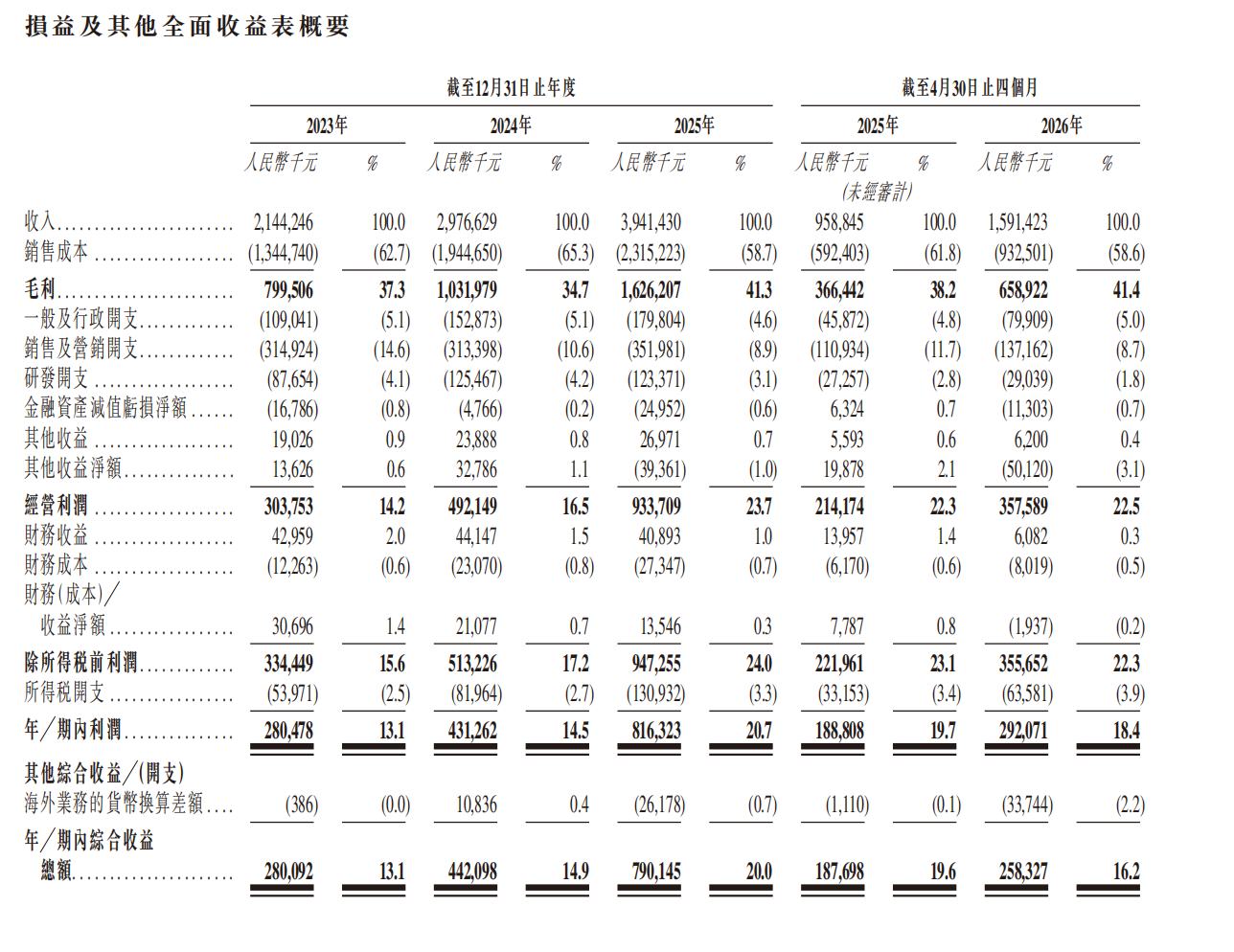
The profit structure was further dismantled, and gross margin showed a trend of falling first and then rising. Gross margin was 37.3% in 2023, fell to 34.7% in 2024, rebounded to 41.3% in 2025, and 41.4% in the first four months of 2026. Overall, it is at a high level. The operating profit margin increased from 14.2% in 2023 to 23.7% in 2025, and declined slightly to 22.5% in the first four months of 2026. The net profit margin rose from 13.1% in 2023 to 20.7% in 2025, but fell to 18.4% in the first four months of 2026, down about 2.3 percentage points from the full year of 2025. This fluctuation is mainly affected by other factors such as net earnings turning negative, changing net finance from positive to negative, and rising share of income tax expenses. The net amount of other income in 2025 was -39.36 million yuan, and the first four months of 2026 was -50.12 million yuan; the net financial amount was 19.37 million yuan in the first four months of 2026, compared to 7.79 million yuan for the same period last year. In other words, the company's core operating profit margin is still at a historically good level, but the disturbance of non-operating projects on final profit has increased, and structural changes in profit quality are more noteworthy than a simple decline in growth rate.
The performance on the cost side showed obvious economies of scale and structural trade-offs. Sales and marketing expenses fell as a share of revenue from 14.6% in 2023 to 8.9% in 2025, and 8.7% in the first four months of 2026, indicating that while the company's revenue is expanding, marketing efficiency has improved. The share of general and administrative expenses is stable between 4.6% and 5.1%, and the control is good. However, R&D expenditure as a share of revenue fell from 4.1% in 2023 to 3.1% in 2025, and fell further to 1.8% in the first four months of 2026. The decline in R&D expenses is beneficial to the release of profits in the short term, but whether it can form continuous product iteration and channel barriers in the medium to long term still needs to be judged based on the competitive pattern of the industry. For a manufacturing company that accounts for a very high share of overseas revenue and the core category is in the rapid expansion stage, cost optimization is a double-edged sword: on the one hand, it reflects the release of operating leverage, and on the other hand, it may also mean that future growth depends more on production capacity and channels rather than product technology premiums.
Overall, the fundamentals of Taotao's auto industry are still in the expansion channel, with sufficient growth momentum, and the profit center has moved significantly from the previous two years; however, the company has also moved from simply pursuing growth to a stage where growth and profit quality are equally important. In the future, we need to focus on observing the degree of matching between profit growth rate and revenue growth rate, the volatility of non-operating profit and loss, and whether overseas capacity utilization can continue to support high gross margin.
The first-come-dividend growth logic of production capacity is yet to be tested
If you carefully disassemble its prospectus, you can see that Taotao Auto's product portfolio has undergone fundamental restructuring in the past three years, and electric low-speed vehicles have jumped from a marginal category to a core growth engine. According to prospectus data, revenue from electric low-speed vehicles soared from 785 million yuan in 2023 to 1,957 billion yuan in 2025, increasing about 24 times over three years. The share of revenue jumped from 3.7% to 49.8%, and further rose to 61.0% in the first four months of 2026. At the same time, the former pillar category of electric scooters shrunk from 718 million yuan in 2023 to 474 million yuan in 2025, and the share of revenue fell from 33.4% to 12.0%; electric balance scooters shrunk from 296 million yuan to 124 million yuan, accounting for 13.8% to 3.1%. The overall power sports product line also showed a contraction trend. The share of all-terrain vehicle revenue fell from 29.0% to 16.5%, and off-road motorcycles fell from 5.7% to 5.0%.
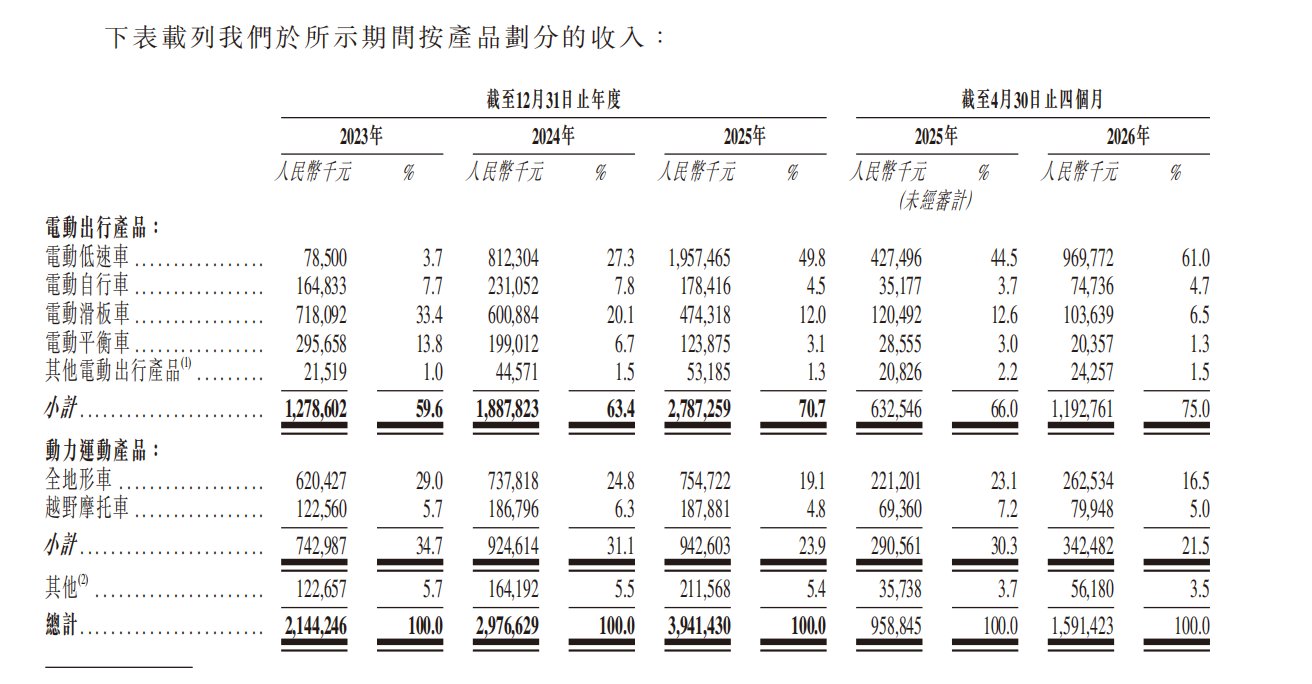
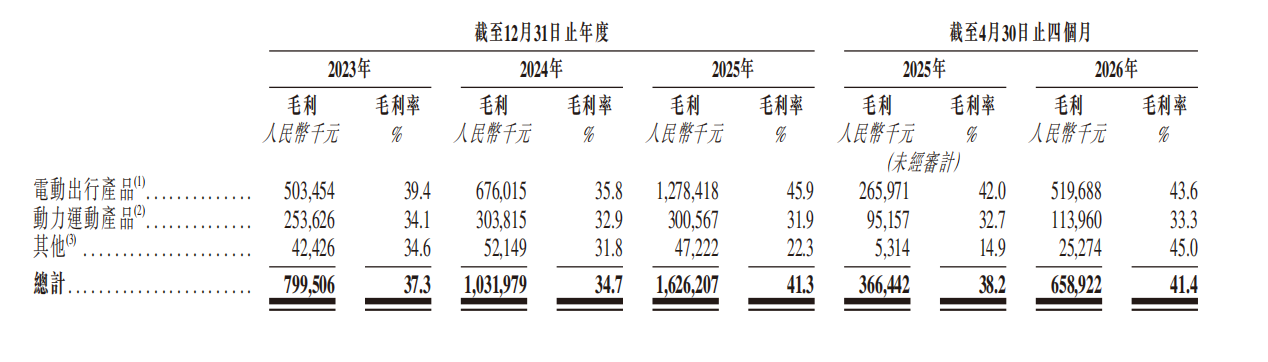
As can be seen, the company has essentially completed its strategic focus from multi-point growth to single-point breakthroughs. Electric low-speed vehicles are currently the only real growth engine, and the rest of the categories have either remained successful or are under pressure. The financial rewards of this structural transformation are significant — overall gross margin rebounded from 34.7% in 2024 to 41.3% in 2025, and remained at 41.4% in the first four months of 2026. Among them, the gross margin of electric mobility products increased sharply from 35.8% in 2024 to 45.9% in 2025, and 43.6% in the first four months of 2026, which is significantly higher than the 31.9% to 33.3% of power sports products. The continuous increase in the share of high-margin categories forms the core driving force for improving the company's profitability.
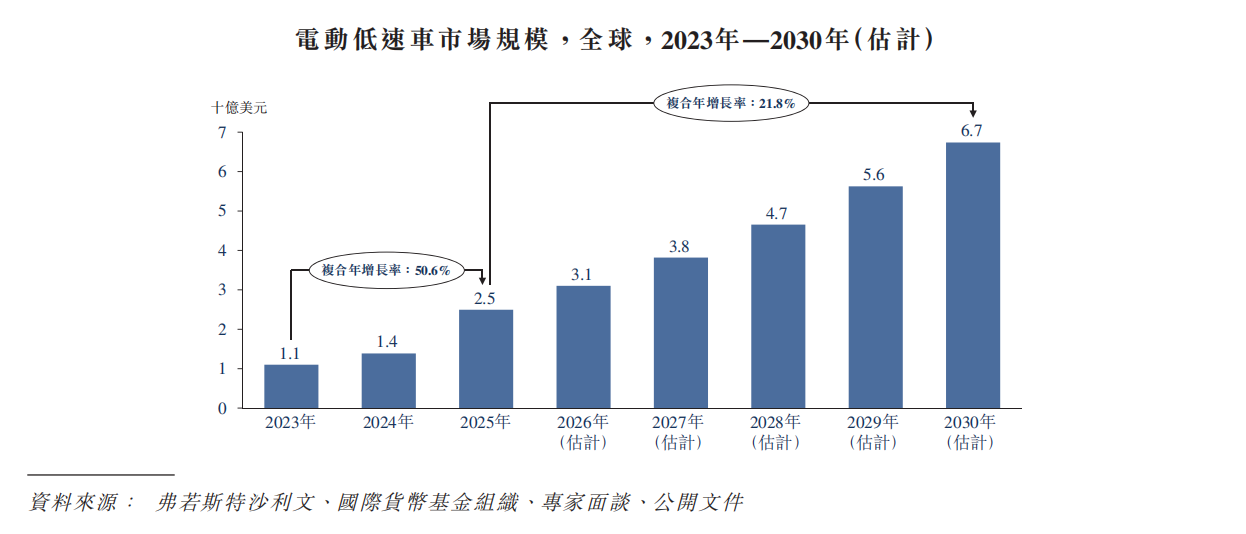
Whether the results of this single-point breakthrough can continue depends on the growth rate of the industry and the evolution of the competitive landscape. From an industry perspective, electric low-speed car racing tracks are still in the expansion period. According to Frost & Sullivan data, the global electric low-speed vehicle market increased from about 1.1 billion US dollars in 2023 to about 2.5 billion US dollars in 2025, with a compound annual growth rate of about 50.6%, showing the characteristics of explosive expansion. The market is expected to increase further to around US$6.7 billion in 2030, with a compound annual growth rate of about 21.8% from 2025 to 2030. This means that the industry is transitioning from an early stage of ultra-rapid growth to a period of rapid growth. The growth center has declined, but the absolute increase is still considerable — the next five years will add about 4.2 billion US dollars in market space.
Turning our gaze to the competitive landscape, industry concentration is still low, and leading companies have yet to form absolute barriers. In 2025, in the global electric low-speed vehicle market in terms of revenue from electric low-speed vehicles, Taotao Vehicle Industry ranked first, with a market share of about 10.9%. However, the second-place share (9.6%) was not much different; the top five combined were only about one-third. This means that the so-called number one in the world is more about running fast than having strong barriers. Sustainability with leading share still depends on the speed of production capacity implementation and channel penetration efficiency.
Overall, the fundamentals of Taotao's auto industry are still in the expansion channel, with sufficient growth momentum. The profit center has moved significantly higher than in the previous two years, but the company has also moved from simply pursuing growth to a stage where growth and profit quality are equally important. In the future, if the company can use the first-mover window to make up for R&D and brand shortcomings, it is expected that it will establish a more stable competitive position before the industry pattern is defined.