


Lincoln Electric (LECO) Stock Looks Fully Valued Despite Cash Flow Upside
Lincoln Electric Holdings has more than doubled shareholder returns over the past five years, yet the valuation checks send mixed signals, with the intrinsic value estimate pointing to upside while market multiples lean the other way.
- The stock has returned 105.6% over five years, which puts long term holders in a strong position and raises the bar for anyone thinking about fresh capital going in now.
- Future cash generation from Lincoln Electric Holdings' welding equipment and consumables business can support the intrinsic value case, while any pressure on customer investment cycles or capital spending may weigh on how much of that value investors choose to pay for today.
- The broader valuation scorecard is mixed, with 3 out of 6 checks identifying Lincoln Electric Holdings as attractively priced, and the remainder indicating a fuller valuation.
The issue now is whether the current share price already reflects the intrinsic value that the Discounted Cash Flow estimate implies for Lincoln Electric Holdings, or still leaves room for more.
Spot opportunities beyond Lincoln Electric Holdings by reviewing 32 high quality undervalued stocks, which also pair solid cash generation with balance sheets investors can scrutinize with the same rigor.Does Lincoln Electric Holdings Look Undervalued on Cash Flow?
The Discounted Cash Flow (DCF) approach used here aims to estimate a value for Lincoln Electric Holdings based on the cash it can realistically return to shareholders over time. On the latest figures, the business produced trailing twelve month free cash flow of about $558.7 million, and the model assumes that this cash generation continues to grow rather than shrink over the coming decade.
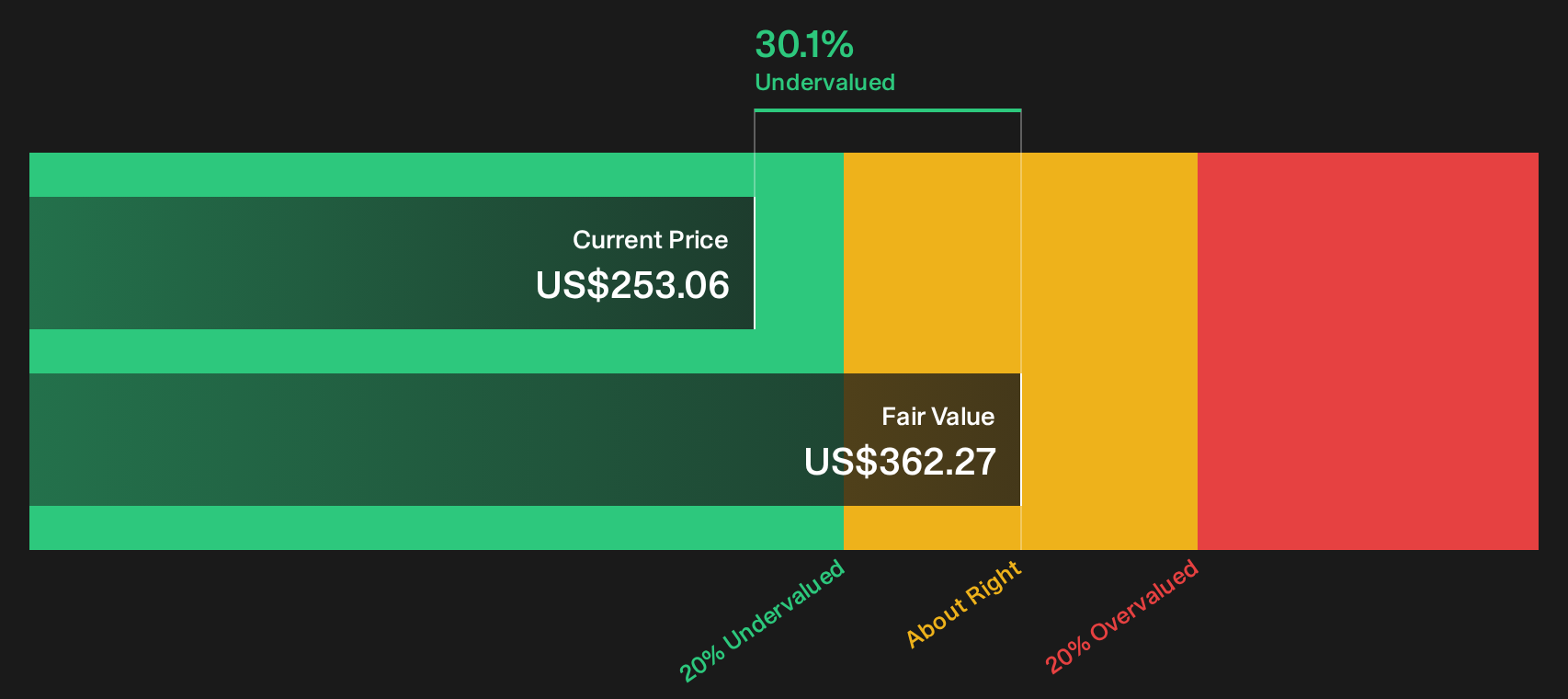
Feeding those projections into a 2 Stage Free Cash Flow to Equity framework leads to an estimated intrinsic value of about $362 per share. Compared with the current trading price, the DCF output suggests Lincoln Electric Holdings appears undervalued by roughly 30.1%. This indicates that investors may currently be paying less than the cash flow model suggests could be reasonable for the welding operation today.
On this DCF view, Lincoln Electric Holdings appears undervalued relative to what its projected cash flows appear to justify.
Our Discounted Cash Flow (DCF) analysis suggests Lincoln Electric Holdings is undervalued by 30.1%. Track this in your watchlist or portfolio, or discover 32 more high quality undervalued stocks.
Is Lincoln Electric Holdings Getting Expensive on Earnings?
The P/E ratio is a way to see what investors are paying for each dollar of Lincoln Electric Holdings earnings. For a mature industrial group, it often gives a clearer yardstick than revenue or book value multiples.
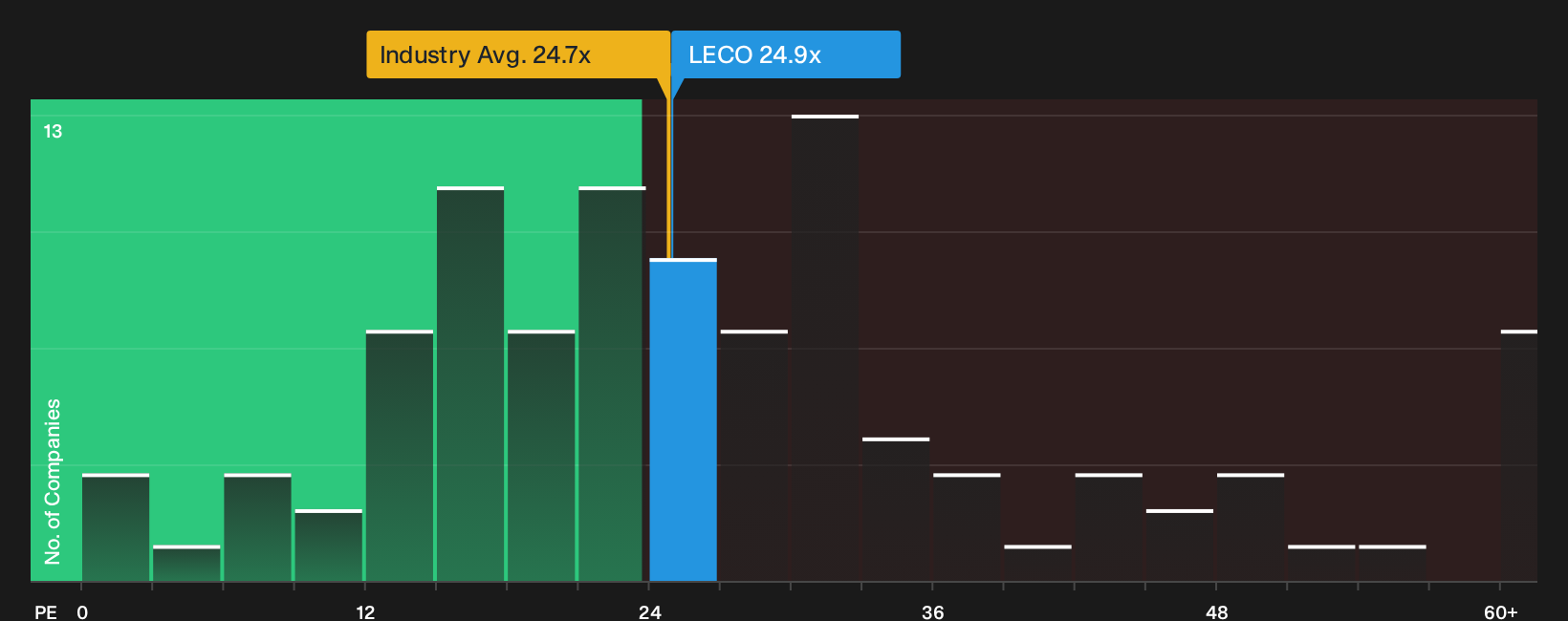
Lincoln Electric Holdings currently trades on a P/E of about 24.9x. That is slightly above both the Machinery industry average at roughly 24.7x and the peer group level near 23.1x. The fair P/E ratio implied by the model is about 22.5x, which is lower than where the shares change hands today.
The gap between the current 24.9x and the 22.5x fair ratio indicates that investors are paying a premium to what the company specific profile might justify. Relative to sector norms and similar businesses, the stock appears fully priced on earnings.
On this earnings yardstick, Lincoln Electric Holdings currently trades at a higher P/E than both its tailored fair P/E and its Machinery peers.
See what the numbers say about this price — find out in our valuation breakdown.
The Lincoln Electric Holdings Narrative: What Would Justify Today's Price?
Simply Wall St Narratives for Lincoln Electric Holdings sit between the DCF puzzle and the P/E premium, explaining which views on future growth, profitability and earnings would need to prove right for the stock to be worth materially more or less than its current market price. Each scenario links its figures to a specific path for Lincoln Electric Holdings' growth profile, margins and risk balance that you can revisit on the Community page as new information becomes available.
Community views on Lincoln Electric Holdings sit far apart, with one camp leaning into long term automation demand and the other focused on cyclical and valuation risk.
Bull case: 17% undervalued
"Product mix shift towards higher-value automation, robotics, and proprietary wear plate solutions (including through acquisitions like Alloy Steel) will raise exposure to premium product categories, supporting margin improvement and long-term earnings growth..."
Read the full Bull Case to see why Lincoln Electric Holdings could be undervalued
Bear case: roughly fairly valued
"Despite positive pricing actions, Lincoln Electric's core business remains highly dependent on traditional welding equipment for sectors like oil and gas, construction, and shipbuilding that are vulnerable to downturns and shifting global capital expenditure cycles..."
Read the full Bear Case to see why Lincoln Electric Holdings could be overvalued
Do you think there's more to the story for Lincoln Electric Holdings? Head over to our Community to see what others are saying!
The Bottom Line
Lincoln Electric Holdings screens as undervalued on a Discounted Cash Flow (DCF) view, yet looks overvalued on earnings multiples compared with peers and its tailored fair P/E. That split comes from the intrinsic value model leaning on future cash generation and capital needs, while the market ratio reflects current sentiment about growth and where comparable industrial stocks trade today. With broader checks landing in a mixed zone, the key question is whether Lincoln Electric Holdings can keep converting its welding franchise into resilient free cash flow that ultimately closes the gap between intrinsic value and a full-looking multiple.
This article by Simply Wall St is general in nature. We provide commentary based on historical data and analyst forecasts only using an unbiased methodology and our articles are not intended to be financial advice. It does not constitute a recommendation to buy or sell any stock, and does not take account of your objectives, or your financial situation. We aim to bring you long-term focused analysis driven by fundamental data. Note that our analysis may not factor in the latest price-sensitive company announcements or qualitative material. Simply Wall St has no position in any stocks mentioned.
Have feedback on this article? Concerned about the content? Get in touch with us directly. Alternatively, email editorial-team@simplywallst.com