


Did $40 Million Verdict Just Shift BD's (BDX) Investment Narrative?
- Legal Bay LLC reported that it is funding qualified plaintiffs in ongoing Bard PowerPort and implanted port catheter lawsuits after a US$40 million compensatory verdict against C.R. Bard, a Becton Dickinson subsidiary, in federal multidistrict litigation where almost 4,000 federal cases remain pending as of September 2026.
- The scale of alleged device complications, ranging from catheter fracture to serious infection and treatment disruption, highlights potential legal, operational, and reputational pressures on Becton Dickinson that could affect product support costs, risk management priorities, and focus within its medical technology portfolio.
- We will assess how Becton Dickinson's investment narrative is pressured by large scale Bard PowerPort litigation and the recent US$40 million verdict.
Pressure test Becton Dickinson's legal risk profile against other healthcare players by scanning a curated set of 11 resilient stocks with low risk scores built to prioritize resilience over headline shocks.
Becton Dickinson Investment Narrative Recap
To own Becton Dickinson, you need to be comfortable with a large, diversified medical technology group where the appeal is stable demand, recurring consumables and the potential for margin improvement via the BD Excellence program. The Bard PowerPort litigation adds headline risk, but the core thesis still rests on execution in medical supplies, drug delivery and connected care.
In the near term, the biggest operational swing factor remains how well Becton Dickinson handles tariff headwinds, China procurement pressure and the planned separation of the Biosciences and Diagnostics business. The Bard verdict raises legal uncertainty, yet the key business risk is still execution and cost control during this portfolio reshaping.
There are no fresh corporate announcements tied directly to this verdict. The most important reference point for you is management’s existing plan to separate the Biosciences and Diagnostic Solutions operations. That move, once completed, would leave Becton Dickinson more focused on medical technology with a consumables heavy revenue mix.
For investors weighing the PowerPort cases, that separation plan is central. It concentrates the story around execution in core medical and interventional products. In those areas, recurring usage and productivity gains from BD Excellence are expected to matter most, while legal, trade and reimbursement pressures remain the key watchpoints.
Becton Dickinson Forecasts, Valuation and Legal Overhang
Becton Dickinson's narrative projects US$21.4b revenue and US$3.3b earnings by 2029. This assumes revenue declines of 1.6% per year and an earnings increase of about US$1.7b from US$1.6b today.
Analysts currently factor in a modest step down in top line expectations, with forecasts pointing to a 1.6% annual revenue decline over the next three years, even as profitability is expected to improve. The story hanging over the stock is that profit margins are projected to move from 7.3% today to 15.6% in 2029. As a result, the earnings engine is expected to do more of the heavy lifting than sales growth.
On those numbers, consensus sees earnings rising from US$1.6b today to US$3.3b by 2029, a bit more than a 2x increase, even with revenue drifting lower. That kind of gap between shrinking turnover and higher profit depends heavily on cost discipline, pricing power in key product lines and the impact of BD Excellence savings showing up in operating leverage.
Valuation assumptions sit on top of those profit targets. To line up with current analyst thinking, you would be working off a 2029 earnings estimate of US$3.3b and revenue of US$21.4b, paired with a P/E of 17.5x on those projected earnings. That compares with a P/E of 30.5x today for Becton Dickinson and a current sector reference point of 27.5x for the US medical equipment group, so the implied path is one where earnings are higher, but the multiple is lower.
Putting that into share price terms, analyst targets cluster around US$195.67 for Becton Dickinson, with the most optimistic at US$225 and the most cautious at US$170. With the stock last quoted at US$184.74, that consensus figure sits about 5.6% above the current level. This signals that, on average, the sell side sees the shares as roughly in line with their modelled fair value.
Those projections depend on more than just earnings power. Assumptions also include an annual 4.57% reduction in the share count over the next three years, which lifts earnings per share even if net income progresses more slowly. For anyone tracking per share metrics, that buyback effect can matter as much as the headline profit figure when comparing the stock to peers facing their own litigation issues.
Legal risk around the Bard PowerPort and implanted port catheter suits complicates this picture. The US$40m compensatory verdict is a concrete data point that investors can set against the forecast margin expansion story. If legal expenses, settlements or product support costs rise meaningfully, that pressure could eat into the move from a 7.3% margin profile toward the 15.6% level currently embedded in the models.
Analysts also flag tariff exposure and China procurement pressure, which already sit in the risk section of most research reports and matter for anyone comparing Becton Dickinson with other medical device issuers facing fewer trade or regulatory frictions. A forecast US$275m tariff hit in fiscal 2026 is one example of how non legal factors may weigh on profitability alongside the Bard PowerPort headline risk.
For readers, the key question is how much confidence to place in a scenario where earnings almost double while revenue edges lower and legal, trade and separation execution risks all pull in the opposite direction. If you think litigation costs, portfolio reshaping and procurement pressure absorb more of the forecast margin gains than current estimates suggest, then the projected 2029 profit and P/E profile may look demanding relative to the legal overhang now attached to Becton Dickinson.
- Revenue assumptions: 1.6% annual decline to US$21.4b by 2029.
- Earnings path: increase from US$1.6b today to US$3.3b by 2029.
- Profitability: margin shift from 7.3% to 15.6% under current forecasts.
- Valuation anchors: P/E moving from 30.5x today to 17.5x on 2029 earnings, against a sector reference of 27.5x.
- Equity structure: share count expected to fall 4.57% per year over the next three years.
Viewed together, the litigation around Bard PowerPort, the separation of Biosciences and Diagnostics, and the tariff and China headwinds create a tight balance between forecast margin expansion and the extra costs and distractions that come with legal and regulatory scrutiny. Readers comparing Becton Dickinson with lower risk healthcare peers may want to weigh whether the projected 2029 earnings and valuation multiples offer enough compensation for carrying that mix of legal, trade and execution uncertainty through the rest of the decade.
Uncover why Becton Dickinson's fair value points to a 10% potential upside to its current price, which could narrow quickly as litigation risk becomes clearer.
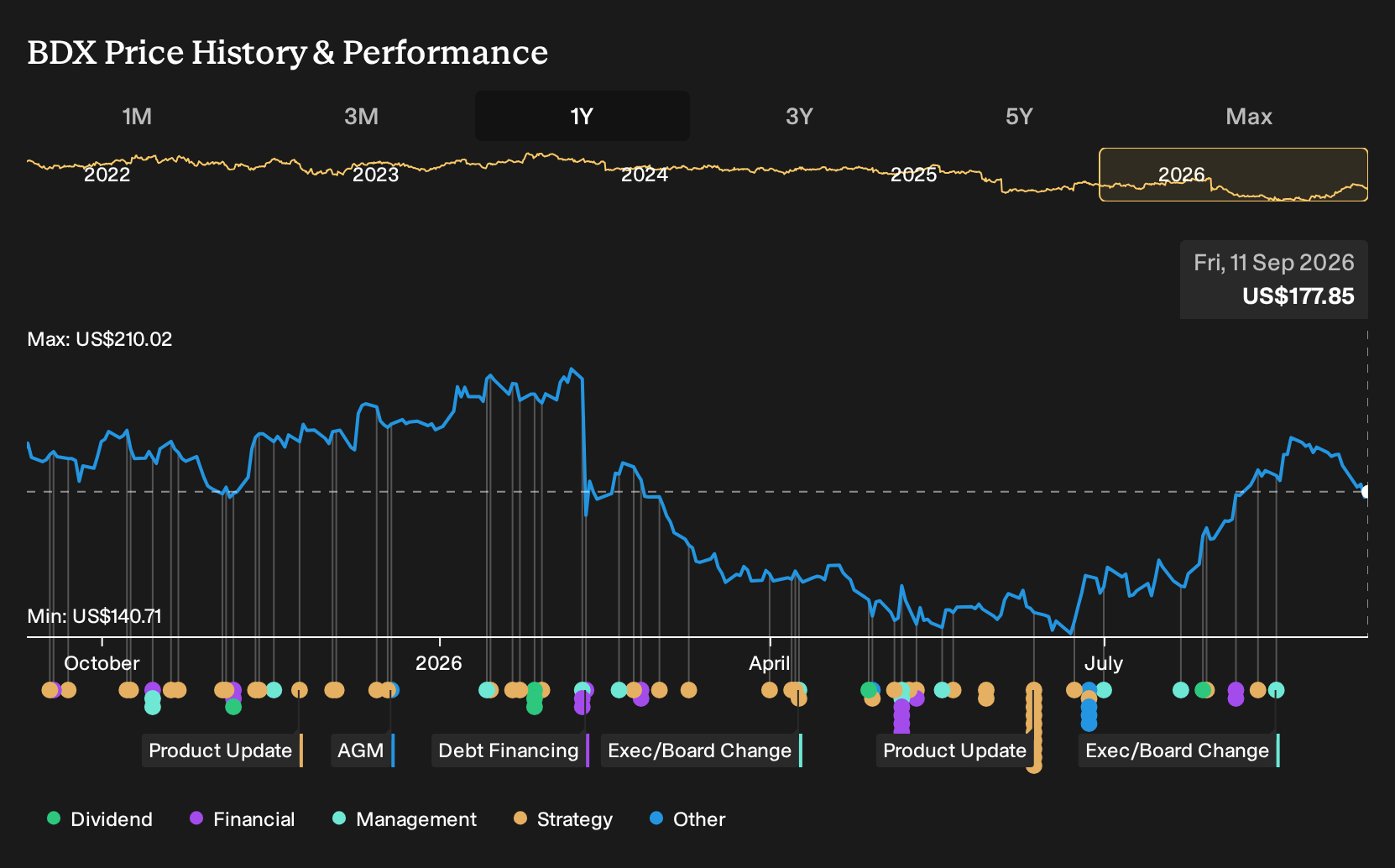
Exploring Other Perspectives
One alternate view puts price pressure at the center of the Becton Dickinson story rather than tariffs or the PowerPort lawsuits. The most cautious analysts were already working with steeper 3.3% annual revenue declines and only US$2.4b in earnings by 2029. You can treat that as a stress test and compare it with other, more optimistic viewpoints that may now shift after this verdict.
Explore 2 other Becton Dickinson fair value estimates, including one that suggests it could be worth just $195.67.
The Verdict Is Yours
Don't just follow the ticker. Dig into the data and build a conviction that's truly your own.
- A great starting point for your Becton Dickinson research is our analysis highlighting 4 key rewards and 2 important warning signs that could impact your investment decision.
- See our latest analysis for Becton Dickinson. The report includes a comprehensive fundamental analysis summarized in a single visual, the Snowflake, making it easy to evaluate Becton Dickinson's overall financial health at a glance.
Looking For More Ideas Beyond Becton Dickinson?
If the Bard PowerPort headlines have you rethinking concentration risk around Becton Dickinson, it can help to widen the lens and line this story up against a broader set of listed healthcare and non healthcare stocks. A focused screen lets you keep the legal and balance sheet questions in mind while filtering for the kind of risk and return profile that actually fits your own plan.
Use the Simply Wall St Screener to compare Becton Dickinson with other opportunities that line up with your preferred mix of resilience, income, or potential mispricing.
- For investors who want potential upside while keeping an eye on entry price, review a curated 32 high quality undervalued stocks that may offer a starting point for further research.
- If capital preservation and financial strength sit at the top of your checklist, focus your search on a list of solid balance sheet and fundamentals (23 results) that screens for sturdier fundamentals.
- Readers who prefer to limit surprise shocks can anchor their watchlist around a 11 resilient stocks with low risk scores that filters for stocks with more resilient risk profiles.
This article by Simply Wall St is general in nature. We provide commentary based on historical data and analyst forecasts only using an unbiased methodology and our articles are not intended to be financial advice. It does not constitute a recommendation to buy or sell any stock, and does not take account of your objectives, or your financial situation. We aim to bring you long-term focused analysis driven by fundamental data. Note that our analysis may not factor in the latest price-sensitive company announcements or qualitative material. Simply Wall St has no position in any stocks mentioned.
Have feedback on this article? Concerned about the content? Get in touch with us directly. Alternatively, email editorial-team@simplywallst.com