


Deckers Outdoor (DECK) Stock Looks Below Fair Value On Cash Flow And Earnings
Deckers Outdoor has seen its share price fall sharply over the past year, yet both an intrinsic value estimate and market multiple checks currently point to a stock that screens as cheap rather than stretched.
- The share price is down 31.4% over the past year, which leaves current holders asking whether the weakness reflects fundamentals or has gone too far.
- Future cash generation from brands like UGG and HOKA can support the current valuation if margins and demand hold up. However, any sustained hit to consumer spending or product momentum may pressure those same cash flows.
- The broader valuation workup leans cheap, with Deckers Outdoor scoring 5 out of 6 on value checks that compare its trading level to an intrinsic value estimate and peer multiples.
The issue now is whether the market is correctly pricing in the risks around Deckers Outdoor or leaving a margin of safety for patient investors.
Scan beyond Deckers Outdoor and line up other potentially mispriced consumer names using our curated list of 31 high quality undervalued stocks for a broader view on value opportunities.
Is Deckers Outdoor a Bargain on Cash Flow?
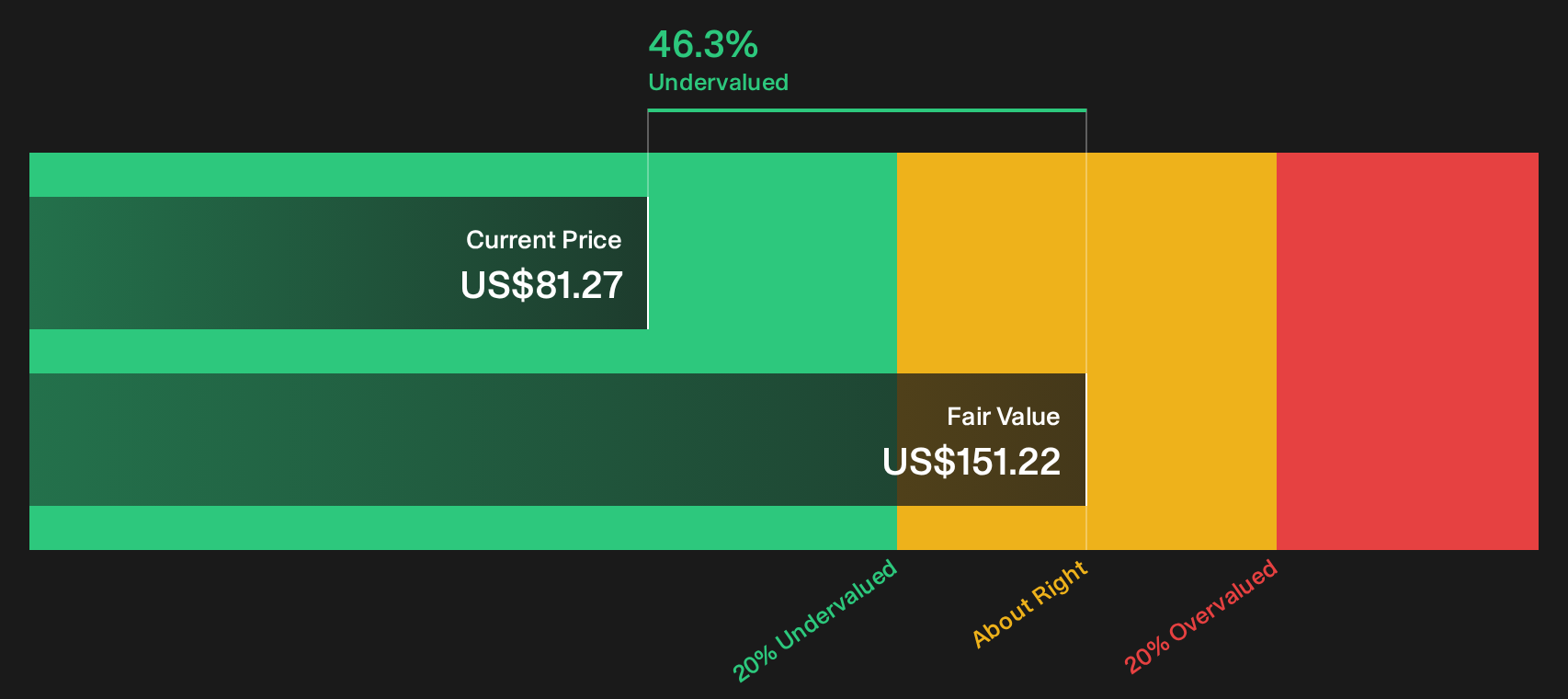
The Discounted Cash Flow (DCF) model here is based on projected free cash that Deckers Outdoor can return to shareholders over time. Recent twelve month free cash flow sits at about $1.10b, which sets a high baseline and reflects a business already generating substantial cash rather than one hoping to reach that point.
Analysts feeding this DCF assume growing free cash flows rather than a shrinking stream, then discount those estimates back to today. On those inputs, the model points to an intrinsic value of about $151 per share. Against the current share price, that suggests the stock trades at a 46.3% discount to this estimate. On this cash flow view, the Deckers Outdoor stock price appears materially undervalued.
Our Discounted Cash Flow (DCF) analysis suggests Deckers Outdoor is undervalued by 46.3%. Track this in your watchlist or portfolio, or discover 31 more high quality undervalued stocks.
Does Deckers Outdoor Look Undervalued on Earnings?
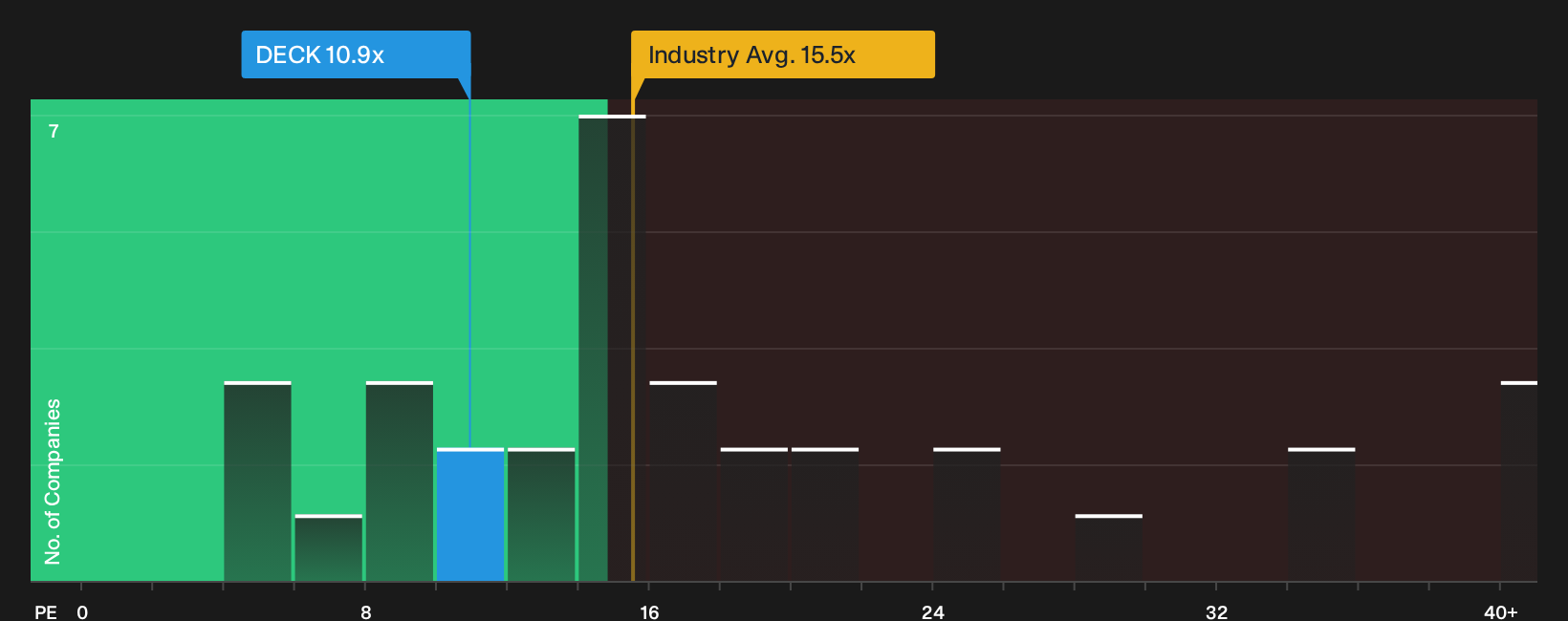
P/E works well for Deckers Outdoor because earnings are positive and the business is already well into its profit cycle. The stock trades on a P/E of about 10.9x, which sits well below both the luxury sector average of roughly 15.5x and a peer group near 16.0x. On the model used here, a fair P/E for Deckers Outdoor is 17.5x, which reflects its industry, profitability profile, size and risk.
That fair multiple implies a wide gap between what the market currently pays for each dollar of Deckers Outdoor earnings and what might be expected based on those fundamentals. The share price would need a materially higher P/E to close that spread, even before considering any change in the underlying profit base.
On this P/E lens, Deckers Outdoor stock appears undervalued relative to both sector norms and its modelled fair multiple.
See what the numbers say about this price — find out in our valuation breakdown.
The Deckers Outdoor Narrative: What Would Justify Today's Price?
Narratives for Deckers Outdoor pick up where the valuation puzzle leaves off by explaining which paths for growth, profitability and earnings would need to occur for the share price to appear meaningfully higher or lower than today, and how those paths relate to the current market value of the stock. Each scenario links its figures to a clear view on potential expansion, margin resilience and key risks, which you can revisit as new information appears on Simply Wall St's Community page.
The community is split on Deckers Outdoor, with one camp leaning into brand strength and buybacks while the other questions how resilient future earnings really are.
Bull case: 34% undervalued
"The continued investment in direct-to-consumer (DTC) operations and expansion into new markets with selective retail partnerships is expected to enhance margins by reducing reliance on wholesale channels and increasing full-price sales with higher-margin direct sales strategies."
Read the full Bull Case to see why Deckers Outdoor could be undervalued
Bear case: 16% overvalued
"Escalating global tariffs on footwear, coupled with rising freight and input costs, are expected to materially erode Deckers' gross margins over the next several years."
Read the full Bear Case to see why Deckers Outdoor could be overvalued
Do you think there's more to the story for Deckers Outdoor? Head over to our Community to see what others are saying!
The Bottom Line
Deckers Outdoor screens as undervalued on both Discounted Cash Flow (DCF) and P/E work, with the intrinsic value estimate implying a wide cushion to the current share price. The broader valuation checks are strong, so the debate now is less about whether the stock is cheap and more about why. Everything hinges on whether brands like UGG and HOKA can sustain cash generation and margins against cost pressures and any cooling in demand. If those cash flows hold up, the current discount may reflect a mispricing. If they do not, the apparent value can quickly turn into a value trap.
This article by Simply Wall St is general in nature. We provide commentary based on historical data and analyst forecasts only using an unbiased methodology and our articles are not intended to be financial advice. It does not constitute a recommendation to buy or sell any stock, and does not take account of your objectives, or your financial situation. We aim to bring you long-term focused analysis driven by fundamental data. Note that our analysis may not factor in the latest price-sensitive company announcements or qualitative material. Simply Wall St has no position in any stocks mentioned.
Have feedback on this article? Concerned about the content? Get in touch with us directly. Alternatively, email editorial-team@simplywallst.com