


Viasat (VSAT) Expands Asia Pacific Capacity, Is The Valuation Upside Still Compelling?
Viasat’s ViaSat-3 F3 launch puts Asia-Pacific capacity in focus
Viasat (VSAT) just switched on its ViaSat-3 F3 satellite for commercial service in Asia-Pacific, opening fresh bandwidth supply in underpenetrated markets that management sees as fertile ground for new connectivity demand.
Recent trading tells a mixed story for Viasat. The share price is US$74.31 after falling 14.8% over the past month, even though the 90-day share price return is 5.9% and the one-year total shareholder return is 143.2%. This suggests that long-term momentum remains strong as investors reassess how new ViaSat-3 capacity could affect growth prospects and risk.
Spot emerging trends around Viasat’s satellite rollout by scanning hand-picked communications and connectivity players in the 16 high quality undiscovered gems.Bulls see ViaSat-3 capacity and a 143.2% one year return as proof Viasat is being re-rated. Bears point to losses and cash burn. Which story does the current valuation lean toward?
Most Popular Narrative: 26.7% Undervalued
Viasat’s most followed narrative puts fair value at $101.44 against a last close of $74.31, framing the ViaSat-3 buildout and spectrum assets as the main swing factors behind that gap.
Industry demand for interoperable hybrid satellite/terrestrial networks and open architecture (such as 5G NTN roaming) positions Viasat to leverage its spectrum assets and expertise in aggregating multi-orbit networks, potentially lowering capital intensity, expanding the customer base, and improving margin structure.
Want the full story behind that 26.7% upside call? The narrative leans on steady revenue expansion, a profit margin reset, and a future earnings multiple usually reserved for premium communications platforms. Curious which specific growth, margin, and discount rate assumptions have to line up to support that $101.44 figure?
Result: Fair Value of $101.44 (UNDERVALUED)
Have a read of the narrative in full and understand what's behind the forecasts.
Still, heavy capital spending on ViaSat-3 and Inmarsat, along with rising competition in broadband and direct to device, could quickly challenge that upside story.
Find out about the key risks to this Viasat narrative.
Another View on Viasat’s Valuation
Analysts see upside for Viasat, yet the Simply Wall St DCF model points in the opposite direction. At $74.31, the stock trades above an estimated future cash flow value of $56.25, which frames Viasat as overvalued on this lens. Which set of assumptions do you trust more?
Look into how the SWS DCF model arrives at its fair value.
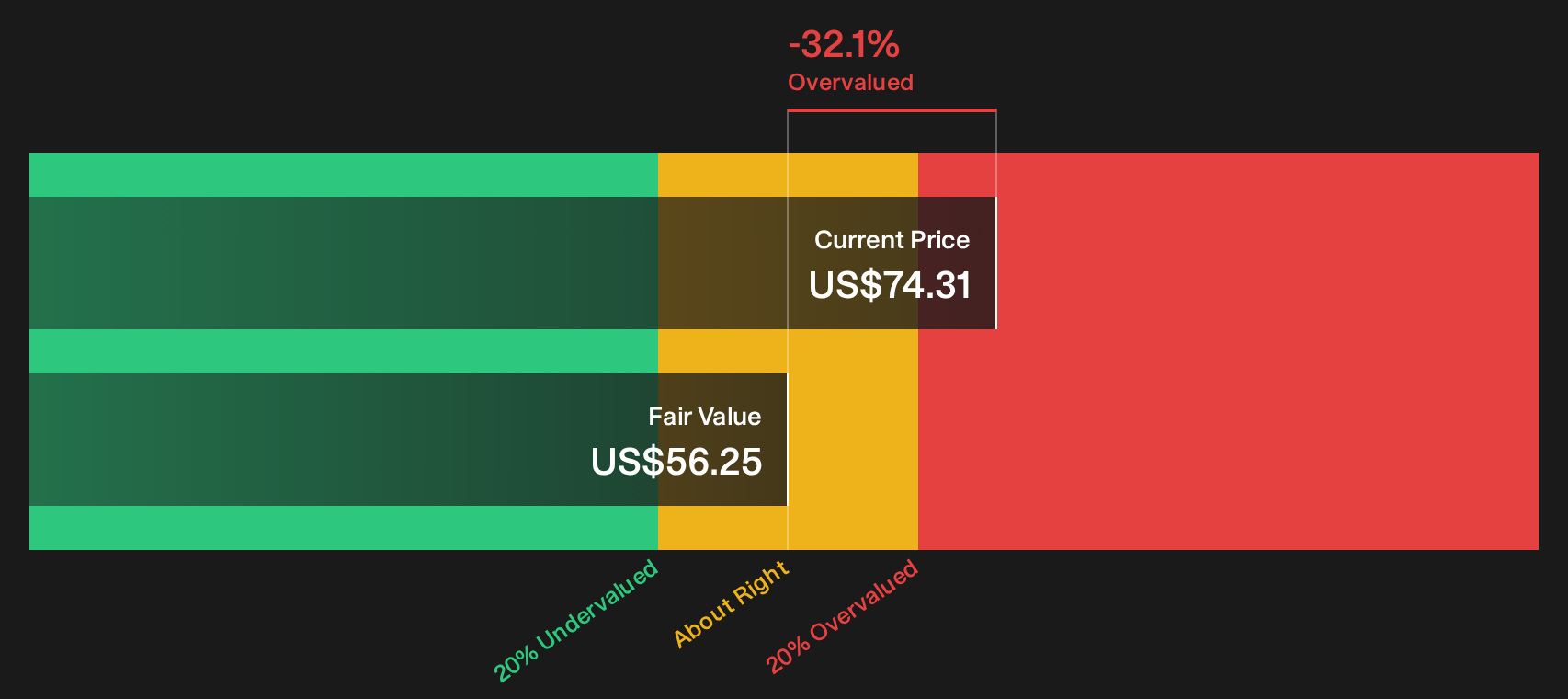
Simply Wall St performs a discounted cash flow (DCF) on every stock in the world every day (check out Viasat for example). We show the entire calculation in full. You can track the result in your watchlist or portfolio and be alerted when this changes, or use our stock screener to discover 31 high quality undervalued stocks. If you save a screener we even alert you when new companies match - so you never miss a potential opportunity.
Next Steps
Mixed messages around Viasat’s valuation can be confusing, so move quickly, review the numbers for yourself, and weigh the 4 important warning signs.
Ready for more ideas beyond Viasat?
If you stop with just one ticker, you miss the chance to compare, pressure test, and sharpen your next move across very different opportunity sets.
- Target potential mispricings by scanning companies that score well on quality and valuation through the 31 high quality undervalued stocks.
- Prioritise resilience and balance sheet strength by filtering for businesses with robust fundamentals in the list of solid balance sheet and fundamentals (23 results).
- Focus on steady cash returns by zeroing in on income opportunities using the 6 dividend fortresses.
This article by Simply Wall St is general in nature. We provide commentary based on historical data and analyst forecasts only using an unbiased methodology and our articles are not intended to be financial advice. It does not constitute a recommendation to buy or sell any stock, and does not take account of your objectives, or your financial situation. We aim to bring you long-term focused analysis driven by fundamental data. Note that our analysis may not factor in the latest price-sensitive company announcements or qualitative material. Simply Wall St has no position in any stocks mentioned.
Have feedback on this article? Concerned about the content? Get in touch with us directly. Alternatively, email editorial-team@simplywallst.com